

ESSAY ONE: INTRODUCTION
This essay, 85 Queer Films Made Under the Hays Code (1934-1968), examines Queer Film under the notorious Hays Code, spanning the years from 1934 to 1968. A second essay, entitled 85 Queer Films from the New Hollywood (1968-1980), covers Queer Cinema from the introduction of the MPAA rating system in 1968 to the end of the New Hollywood era in 1980.
These essays reflect my perspective on the portrayal of the LGBTQ+ community on the Big Screen over two contrasting eras. A gay man who, although a medical doctor by profession, fell in love with movies at a young age. A gay man who grew up and went to college and medical school in Ireland and, by chance, got the opportunity to review movies in the mid-nineteen-eighties, first for In Dublin and then for The Irish Times. A gay man who followed his dreams to California and has lived in Los Angeles since the nineteen-nineties.
What is Queer Cinema? It can have different meanings for different people. If there is a gay character that is a character and not a prop for straight people to laugh at, then, in my opinion, it’s Queer Cinema. It’s also a sensibility. A sensibility that would bring movies like The Bride of Frankenstein, The Women, and Auntie Mame under the queer umbrella, even if they didn’t have gay supporting characters. The fact that gay men directed all these movies completes the picture!
1934: THE HAYS CODE
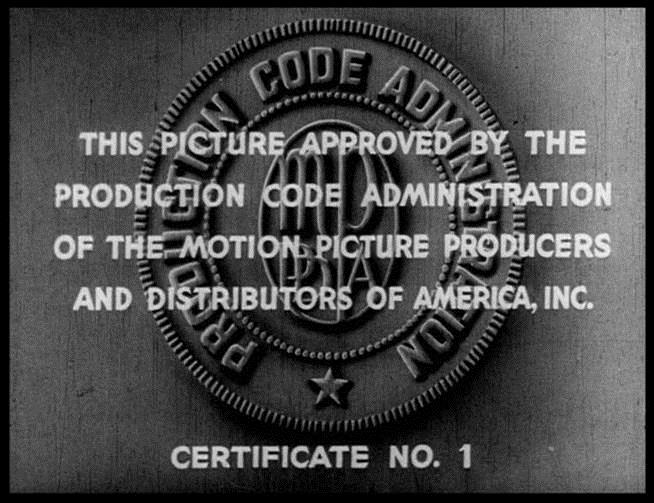
The notorious Hays Code, which, although formulated in the early twenties, was only enforced in earnest with the arrival of Joseph Breen at the Hays Office in 1934. Under Breen, overt references to sexuality, particularly homosexuality, were frowned upon. As a result, gay or straight directors, writers, and actors had to be more creative in presenting while, at the same time, disguising a gay character. This dichotomy, however, led to thirty-four years of movie classics in which Queer characters were not only present in memorable supporting roles but were also featured in leading roles.

A revealing glimpse into Joseph Breen’s mindset emerges from the last pre‑Code—or more precisely, the only film that straddles the transition from the pre‑Code era to full Hays enforcement—Lloyd Bacon’s Wonder Bar. Starring Al Jolson, with songs by Harry Warren and Al Dubin and musical staging by Busby Berkeley, it’s another breathless Warner Bros. revue. Blink and you’ll miss it, but tucked inside is a brief comic moment in which a man dances with another man. That tiny gag so infuriated Breen—especially because it had slipped past him just two months before he assumed office—that he successfully pressured the state censor boards in Ohio and Pennsylvania to excise the scene. What’s striking is not only the intensity of his reaction but the selectivity of it. The film’s finale, “Goin’ to Heaven on a Mule,” features white performers in Blackface, including Jolson, surrounded by grotesque caricatures of Black life—watermelons included. Yet this sequence, appallingly racist by any standard, drew no comment from Breen at all. His outrage was reserved entirely for the fleeting hint of same‑sex humor.
| YEAR | FILM | US DISTRIBUTOR |
| NOT SUBMITTED TO THE HAYS OFFICE RELEASED IN THE US WITHOUT THE CODE SEAL OF APPROVAL | ||
| 1953 | The Moon is Blue (US) | United Artists |
| 1955 | Les Diaboliques (France) | United Motion Picture Organization (UMPO) |
| 1959 | Some Like It Hot (US) | United Artists |
| 1960 | Purple Noon (France) | Times Film Corporation |
| 1961 | A Taste of Honey (UK) | Continental Distributing |
| 1965 | My Hustler (US) | Andy Warhol Films |
| 1967 | The Fox (Canada – US) | Claridge Pictures –Warner Bros. – Seven Arts |
| 1967 | Portrait of Jason (US) | Film-Makers’ Distribution Center |
| SUBMITTED TO THE HAYS OFFICE – APPROVED WITHOUT CUTS RELEASED IN THE US WITH THE CODE SEAL OF APPROVAL | ||
| 1953 | I Vitelloni (Italy) | Janus Films |
| 1960 | Oscar Wilde (UK) | Vantage Films TCF in the US |
| 1960 | The Trials of Oscar Wilde ((UK) | Warwick Films Columbia Pictures in the US |
| 1963 | The L-Shaped Room (UK) | Columbia Pictures |
| 1964 | The Leather Boys (UK) | Columbia Pictures |
| 1967 | The Producers (US) | Embassy Pictures |
| 1967 | Reflections in a Golden Eye (US) | Warner Bros. – Seven Arts |
| SUBMITTED TO THE HAYS OFFICE – MINOR CUTS ORDERED RELEASED IN THE US WITH THE CODE SEAL OF APPROVAL | ||
| 1949 | Kind Hearts and Coronets (UK) Fully Restored Measured in seconds rather than minutes. A subtle toning down of immorality, in addition to intimations that Louis’ crimes did not go unpunished. | Eagle-Lion Films |
| 1957 | The Strange One (US) Mostly Restored – Some Small Gaps Remain Lines more directly implying same-sex attraction were removed. Measured in seconds rather than minutes. | Columbia Pictures |
| 1966 | Persona (Sweden) Restored to Director-Approved Version Measured in seconds rather than minutes. A few frames of nudity and some dialogue tightening. Bibi Andersson’s sexual monologue was left largely intact. | Lopert/United Artists |
| 1967 | Valley of the Dolls (US) Minor trimming for rating and pacing. Not censorship per se. What we see today is what audiences saw in 1967. | TCF |
| SUBMITTED TO THE HAYS OFFICE – SEAL OF APPROVAL REFUSED RELEASED IN THE US WITHOUT THE CODE SEAL OF APPROVAL | ||
| 1961 | Victim (UK) RELEASED IN THE US WITHOUT A CODE SEAL IN 1961 GOOD REVIEWS – A MODEST BOX-OFFICE SUCCESS | Rank Film Distributors of America |
| SUBMITTED TO THE HAYS OFFICE – SEAL OF APPROVAL REFUSED APPEALED TO THE MPAA | ||
| 1964 to 1965 | The Pawnbroker (US) RELEASED IN NY STATE WITHOUT A CODE SEAL IN 1964 APPEALED TO THE MPAA WON THE APPEAL (6-3) GENERAL RELEASE IN THE US WITH FULL SEAL OF APPROVAL | Allied Artists |
Table 1 shows seventeen queer films and their relationship to the Production Code Administration (PCA), that section of the Hays Office responsible for granting or withholding the precious Seal of Approval. It says something about the ingenuity of Hollywood, and other sources, that during this period, only one Queer Film – the 1961 British film Victim, directed by Basil Dearden and starring Dirk Bogarde – was denied a seal outright, due to its queer subject matter. Unfazed, Rank Film Distributors of America pressed ahead with a US release, where, thanks to some good reviews, it generated modest box-office success. When Victim was released on VHS in the US in 1986, it received a PG-13 rating by the MPAA. Three years later, Sidney Lumet’s The Pawnbroker was also submitted to the Hays Office and was also rejected outright. Producer Eli Landau and Allied Artists APPEALED the verdict to the MPAA – meanwhile, the film was released in New York State without a Code Seal – and the MPAA board voted 6-3 to overturn the PCA’s decision. The film was released in the US in 1965 with the Code Seal of approval. The ruling was one of a series of injuries to the Production Code that would prove fatal within three years.
In this essay (ESSAY ONE) and the follow-up essay (ESSAY TWO), the terms HAYS CODE, HAYS OFFICE, SEAL OF APPROVAL, CODE SEAL, PRODUCTION CODE ADMINISTRATION (PCA) and JOSEPH BREEN are all used interchangeably.
Only three of our 85 queer films from 1934 to 1968 were released with cuts imposed by the PCA. Director Robert Hamer’s masterpiece Kind Hearts and Coronets (England, 1949) and Ingmar Bergman’s masterpiece Persona (Sweden, 1966) required minimal cutting before they were released in the US. As shown in Table I, these scenes have since been restored.
In 1957, producer Sam Spiegel submitted Columbia Pictures’ queer film The Strange One, starring then-unknown Ben Gazzara, to The Hays Office. The not-so-subtle queer themes and violent hazing rituals guaranteed that cuts would be mandatory, and the resulting movie had less of an impact than the Calder Willingham book and play on which it was based. All of these scenes have now been restored.
In 1966 and 1967, there was a lot of back-and-forth between Twentieth Century Fox (TCF) and the Hays Office. We are talking Valley of the Dolls (1967). However, although the PCA raised questions about the dolls of the title and some queer thematics, the cuts that were decided upon had more to do with rating and pacing than censorship alone – the MPAA was just a year away. As a result, what we see today is essentially what audiences saw back in 1967.
It is a testament to the power of the Hays Office, in the mid-1950s, that it could DEMAND a change to the ending on Mervyn LeRoy’s The Bad Seed (1956) because Rhoda had to be punished for killing little Claude Daigle. During this period some of the studios began a dialogue with the PCA during the production of films with risqué or problematic themes. Movies like Universal’s Touch of Evil and Spartacus and Allied Artists’ The Big Combo were trimmed while still in production and the finished product was then approved, outright. This resulted, on the one hand, in the preservation of Welles vision and the survival of gay couple Fante and Mingo and, on the other, the cutting of the famed Oysters and Snails scene from Spartacus which was later reinstated in the 1991 restoration.
However, as the fifties gave way to the sixties, American cinema audiences were becoming younger and better educated. The PCA was slowly dying, and, as a result, a slew of queer films that only a few years before would have been censored, were given a free pass (see Table 1). At the same time, boutique distribution networks were established specifically to manage British and Foreign-language films, as well as American arthouse fare, destined for repertory cinemas. What follows is a list of some of the best-known examples and the films they distributed:
- Eagle-Lion Films: Kind Hearts and Coronets (UK, 1949)
- Janus Films: I Vitelloni (Italy, 1953)
- United Motion Picture Organization (UMPO): Les Diaboliques (France 1955)
- Times Film Corporation: Purple Noon (France/Italy 1960)
- Continental Distributing: A Taste of Honey (UK, 1961)
- Rank Film Distributors of America: Victim (UK, 1961)
- Allied Artists: The Pawnbroker (US, 1964-1965)
- Andy Warhol Films: My Hustler (US, 1965)
- Lopert – United Artists: Persona (Sweden, 1966)
- Claridge Pictures: The Fox (Canada-US, 1967)
- Film-Makers’ Distribution Center: Portrait of Jason (US, 1967)
- Embassy Pictures: The Producers (US, 1967)
Catering to more sophisticated audiences, many of whom understood and even spoke the language of these exotic foreign movies, the boutique distribution firms couldn’t give a toss about the Hays office. Of the seventeen movies listed in Table 1, six were NOT submitted to the PCA. These movies were often edgier in tone, sometimes openly queer, and naturally at home in the boutique art‑house circuit. Their success with educated urban audiences carved a path for other filmmakers to challenge, and ultimately erode, the authority of the Code.
In 1959, writer/director/producer Billy Wilder decided not to submit his outrageous gender – and genre-bending comedy Some Like It Hot. Released with a big fuck you to the Hays Office, the Marilyn Monroe classic was an instant smash, and many regard Wilder’s decision not to submit his film as the Code’s death knell. However, it is worth noting that the first major studio movie to bypass Joseph Breen was director/producer Otto Preminger’s The Moon is Blue in 1953. Both movies were released through independent distributor United Artists. The Moon is Blue was banned in Boston but was hugely successful in other parts of the US and, on March 25 1954, the film’s star Maggie McNamara, whose utterance of the word VIRGIN caused a scandal, found herself in the company of Deborah Kerr, Lesley Caron, Ava Gardner and the eventual winner Audrey Hepburn as a nominee for Best Actress of 1953 in a Leading Role.
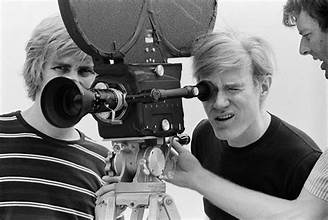
QUEER-THEMED FILMS AT THE HAYS-MPAA TRANSITION.
As the 1960s progressed, queer cinema played a crucial role in undermining the Code.
The release of two queer films with overt homosexual themes – Sidney J. Furie’s The Leather Boys in 1964 and John Huston’s Reflections in a Golden Eye in 1967 – without any cuts, signaled to everyone in the industry that the Hays Office was now a crippled animal waiting to be put out of its misery.
In 1964, the PCA refused outright to grant director Sidney Lumet’s The Pawnbroker, starring Rod Steiger, a seal of approval – the movie’s bleak post-Holocaust setting, a woman’s bare breasts on camera, and a queer African American character were all too much! The film’s Producer, Ely Landau, and his distributor, Allied Artists, were having none of this. They decided on a two-pronged approach: they would make arrangements for the film to be released without Hays Code approval – it was originally released in New York state under these conditions in 1964 – and it would appeal the PCA’s verdict to the Motion Picture Association of America (the same MPAA that would take over the rating system after the PCA’s dissolution in 1968). They won. The MPAA voted 6 to 3 to reverse the PCA’s verdict. The film was given the Hays Code seal of approval on its general US release in 1965. The ruling was one of a series of injuries to the Production Code that would prove fatal within three years.
In early 1966, the Filmmaker’s Cinematheque and later the Hudson Theatre in New York began showing the Andy Warhol-produced, Warhol and Chuck Wein-directed film My Hustler. With screenings first advertised in The Village Voice and eventually spreading through word of mouth, the movie became an underground sensation, running continuously despite occasional police raids, at both theaters for over two years. Public demand was high, and Regional runs were arranged between 1966 and 1969 in Los Angeles, Chicago, Tucson, San Bernardino, Albuquerque, Akron and Indianapolis. To this day, it remains the only Factory film to turn a profit and is the only Factory film to be available on digital media.
A few months later, financiers Shirley Clarke and Graeme Ferguson, along with Film-Makers Distribution, decided to release Clarke’s documentary, Portrait of Jason, independently, bypassing the Code entirely by focusing on film festivals, college campuses, and independent cinemas. The plan worked. Although it had its detractors, the film was quickly recognized as a groundbreaking example of cinema verité.
Likewise, when producer Raymond Stross (who also produced The Leather Boys) and his wife, actress Anne Heywood, wanted to market their small, Canadian movie with an explicit lesbian theme called The Fox, based on D.H. Lawrence’s novel, they and their distributor Claridge Pictures, in conjunction with Warner Bros.-Seven Arts, decided to take the same route. Bypassing the Hays Office, the film was released independently, without a Code seal. Playing at Film Festivals, Art Houses, and College Campuses, it found an audience, and Lalo Schifrin’s Oscar-nominated score gave it a second wind in the Spring of 1969 – the movie was not shown in LA until 1968. It was subsequently submitted to the newly appointed MPAA and received an R rating.
Mel Brooks’ debut feature, The Producers, was released by Embassy Pictures in the fall of 1967. Producer Joseph E. Levine nevertheless chose to submit the film to the Hays Office, fully aware that the Production Code’s authority was rapidly eroding. He also understood that the film’s flamboyantly gay characters—written as broad comic figures—were unlikely to provoke meaningful pushback from a system that was already losing its grip on Hollywood. He was correct. The film received the seal of approval without a single cut.
| ESSAY ONE – TABLE 2 85 Queer Films Made Under the Hays Code FIFTEEN QUEER‑THEMED FILMS AT THE HAYS → MPAA TRANSITION |
| The Leatherboys British Lion-Columbia Produced by Raymond Stross 1964 Hays Code Era Submitted to the Hays Code. Approved without cuts. Released with a Code seal. Only one of two overtly queer-themed films to be screened in the US before the Code’s collapse in 1968. An early queer cinema landmark and a sign of the Production Code’s waning power in the mid-1960s. |
| The Pawnbroker Allied Artists Producer: Ely Landau – The Landau Company 1964 – 1965 Hays Code Era Submitted to the Hays Code. Rejected outright by the PCA. Eli Landau and Allied Artists appeal the verdict to the MPAA The MPAA board votes 6-3 to overturn the PCA’s decision. The ruling was one of a series of injuries to the Production code that would prove fatal within three years. |
| My Hustler Andy Warhol’s The Factory 1965 Hays Code Era Not submitted. Bypassed the Hays Code. Released independently with no seal of approval. Screened at the Filmmaker’s Cinematheque and The Hudson Theatre in New York City and in various arthouse cinemas across the country. |
| The Producers Embassy Pictures Produced by Joseph E. Levine 1967 (LA in 1968) Hays Code Era Submitted and approved without cuts. Released with a Code seal. The Producers arrived in late 1967 with flaming queens Roger De Bris and Carmen Ghia. Producer Joseph E. Levine nevertheless chose to submit the film to the Hays Office, fully aware that the Production Code’s authority was rapidly eroding. He also understood that these flamboyantly gay characters—written as broad comic figures—were unlikely to provoke meaningful pushback from a system that was already losing its grip on Hollywood. |
| The Fox Claridge Pictures, in conjunction with Warner-Seven Arts Produced by Raymond Stross 1967 (LA in 1968) Hays Code Era Not submitted. Bypassed the Hays Code. Released independently with no seal of approval. Explicit lesbian relationship. Independent release under the Code. Marketed Adults Only. Later retro-rated R under the MPAA. |
| Reflections in a Golden Eye Warner Bros.-Seven Arts 1967 Hays Code Era Submitted and approved without cuts. Released with a Code seal. Only one of two overtly queer-themed films to be screened in the US before the Code’s collapse in 1968. An early queer cinema landmark and a sign of the Production Code’s collapse towards the end of 1967. |
| Portrait of Jason Film-Markers Distribution 1967 Hays Code Era Not submitted, bypassed Code. Released independently with no seal of approval. Shirley Clarke’s avant-garde documentary of Jason Holliday. Independent release, no Code seal. |
| The Detective (Essay 2) TCF 1968 MPAA Era M (Mature audiences) Frank Sinatra’s crime drama openly depicts homosexuality, which was impossible under the Code. |
| The Sergeant (Essay 2) Warner Bros.- Seven Arts 1968 MPAA Era M (Mature audiences). Rod Steiger as a closeted officer. One of the first studio films to address homosexuality. |
| The Killing of Sister George (Essay 2) Cinerama Releasing Corporation 1968 MPAA Era X (17 and under not admitted) Explicit lesbian relationship; one of the first films to receive an X rating. |
| No Way to Treat a Lady (Essay 2) Paramount 1968 MPAA Era M (Mature audiences) Dark comedy/thriller; released with an MPAA rating. |
| The Boston Strangler (Essay 2) TCF 1968 MPAA Era R (Restricted) Under-17s are only admitted with a parent or guardian in attendance. Violence and overt references to homosexuality in the Boston demimonde. It would have been impossible under the Hays Code. |
| Rachel Rachel (Essay 2) Warner Bros-Seven Arts 1968 MPAA Era M (Mature audiences) Themes of repression and sexuality – including homosexuality, carried an MPAA rating. |
| 2001: A Space Odyssey (Essay 2) MGM 1968 MPAA Era G (later PG) Major studio release. Carried an MPAA rating. |
| Midnight Cowboy (Essay 2) United Artists 1969 MPAA Era X (later R) Male Hustler’s relationship. Won Best Picture; a landmark in the MPAA era. |
| The Damned (Essay 2) Warner Bros.-Seven Arts 1969 MPAA Era X (later R) Themes of violence, incest, overt homosexuality, and Helmut Berger in drag managed to get Visconti’s film, like Midnight Cowboy, Last Summer, and The Killing of Sister George, an X-rating from the MPAA. Later, it was released as an R, after 12 minutes of offending footage were removed, leaving the eviscerated version that most of us saw for decades. Visconti’s complete 154-minute vision is now the standard for screenings, DVD/Blu-ray editions and streaming presentations. |
| A 2026 Translation M no longer exists. Today’s equivalent is parental guidance suggested. PG or PG-13. PG-13 is a stronger warning to parents than PG R remains the same; Under 17 accompanied by a parent or guardian. X (17 or under, not admitted) has now been replaced by the more respectable-sounding NC-17. Today’s X signifies ADULT CONTENT or what might have been called pornography back in 1967-68-69 during the Hays → MPAA Transition. |
LGBTQ+ IN HOLLYWOOD
As the years have passed and numerous biographies and memoirs have been written, more and more celebrities are now known to have been gay. So-called Lavender Marriages abounded, particularly at MGM, where the studio’s contract players had an iron-clad social clause in their contracts.
THE ACTORS
- Fred Astaire was possibly in a long-term relationship with choreographer and doppelganger, Hermes Pan. However, unlike say, Spencer Tracy, whose history of sex with men comes from numerous sources, there is not enough evidence to come down definitively on Fred Astaire as being gay.
The other LGBTQ+ Hollywood personalities mentioned in these essays are known to have had same-sex trysts and relationships going back decades.
- Jean Arthur was the most private actress in Hollywood.
- Tallulah Bankhead’s longtime lover, actress Patsy Kelly – best known as the wisecracking sidekick to Thelma Todd in a series of short comedy films produced by Hal Roach in the 1930s, and a small but memorable part in Rosemary’s Baby – posed as her personal assistant when they were on the road together. In addition to being linked with both Dietrich and Garbo, Bankhead was rumored to have had romantic liaisons with actresses Hattie McDaniel, Alla Nazimova, Blythe Daly, and Eva Le Gallienne, as well as writer Mercedes de Acosta and singer Billie Holiday.
- Marlene Dietrich
- Greta Garbo
- Barbara Stanwyck was in a lavender marriage with Robert Taylor. The marriage was arranged by Taylor’s studio, MGM, to squash rumors of his homosexuality. Stanwyck’s most enduring relationship was with her publicist and live-in companion Helen Ferguson, who was described as her Girl Friday.
- Sandy Dennis
- Kay Ballard
- Marjorie Main, who was in a long-term relationship with Spring Byington.
- Christopher Walkin
- Nick Adams
- Earl Holliman
- Paul Winfield was one of the first Black actors to come out publicly. However, during the making of Sounder in the early 1970s, he lived with his co-star, Cicely Tyson, for 18 months, so people might have thought they were a straight couple. They never publicly corrected the misconception. His partner of 30 years, the architect Charles Gillan Jr., predeceased him by two years.
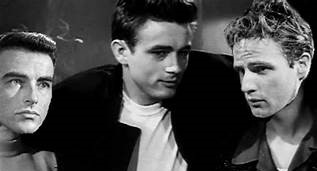
- The METHOD triumvirate of Marlon Brando, Montgomery Clift and James Dean.
- The TOP HAT triumvirate of Erik Rhodes, Eric Blore and Edward Everett Horton
- Alan Ladd, the Paramount star who hid his queerness under a career-long addiction to alcohol. He died, aged 50, in 1964, of cerebral edema caused by an acute overdose of alcohol, barbiturates and antidepressants.
- Walter Pidgeon, the man who gave famed procurer for the stars prostitute Scotty Bowers his first trick when Bowers was working as a gas station attendant on Hollywood Boulevard.
- Clifton Webb, Cole Porter and Monty Wooley were at the center of queer life in roaring twenties New York. They were lifelong close friends and all three had major Hollywood careers. Webb became a star at 50 with Laura while Wooley played himself opposite Cary Grant’s portrayal of Porter in Night and Day (1946) – a Cole Porter so scrubbed of sexuality that Grant might as well be playing a gifted mannequin – a queer icon rewritten as a heterosexual fantasy with the volume turned way down.
- Laird Cregar was a closeted gay man in the 1940s studio system. Large-bodied and coded as a cultured villain, he died at 31 after crash-dieting to become a romantic lead. His death is the hinge point where queerness, body pressure, and mortality converge.
- What Laird Creger was to the 1940s, large-bodied, Oscar nominated, Whatever Happened to Baby Jane actor Victor Buono was to the 1960s – the rotund queer-coded villain.
- The large-bodied queer trope has continued to the present day thanks to such stars as Divine (Harris Glenn Milstead), James Coco, Harvey Fierstein and Bruce Vilanch.
- Cary Grant had a long-term relationship with actor Randolph Scott – they shared a home in the Los Feliz area of LA for two years (1932-1934). Grant also had an affair with Oscar-winning, costume designer Orry-Kelly.
- Laurence Olivier had a long-term relationship with Danny Kaye
- Anthony Perkins had a relationship with fellow actor Tab Hunter in the late 1950s. They double-dated some of Hollywood’s most beautiful actresses during this period.
- Husband and wife Vincent Price and Coral Browne.
- Alan Bates was romantically linked with British actors Peter Wyngarde and Nickolas Grace, as well as with British Olympic Figure Skating champion John Curry.
- Director George Cukor, probably the most famous gay man in Hollywood during this period, played a pivotal role in fostering the lavender relationship of Katherine Hepburn and Spencer Tracy. Hepburn and Tracy cared deeply for one another, but their relationship was a scam set up by their studio, MGM, to squash rumors of their homosexuality. The couple lived in a cottage on the Cukor estate during their time in Hollywood.
- Dirk Bogarde gradually evolved to a more OUT persona as his career developed, although he never officially broached the subject.
- Alec Guinness, Dennis Price, Charles Laughton, John Gielgud, and Laurence Harvey were all known to be gay throughout their careers. Their adoring public may have sensed something. Still, hey, they were English (by way of Lithuania and South Africa in Harvey’s case), so like Olivier, a bit of affectation came with the territory.
- Rock Hudson, the classic Hollywood closet case. Everyone in town knew the story – including the sham marriage – but the public was clueless until a diagnosis of advanced AIDS forced his hand in coming out, with only a few more weeks to live, in the summer of 1985. His case, though, was a milestone in exposing the double standards at work in Hollywood and is in no small way responsible for the strides that gay actors have made in the film world today.
BEHIND THE CAMERA: THE GAY DIRECTORS
- James Whale, George Cukor, Irving Rapper, Edmund Goulding, Mitchell Leisen, Vincente Minnelli, Charles Waters and Dorothy Arzner, who showcased their gay sensibilities to varying degrees and whose careers took divergent paths:
- Arzner, the lone lesbian in the group and way ahead of her time, played a pivotal role in establishing the queer Katherine Hepburn persona with the 1933 movie Christopher Strong. However, her legacy is mostly pre-code, and she retired in 1940.
- Minnelli, who was married to gay icon Judy Garland, managed to have a stellar Hollywood career with little to no interference from his studio (MGM). The fact that he was known primarily as a director of musicals and directed what may be the greatest one of all – Meet Me in St. Louis – helped his cause. Whale and Cukor, however, suffered for their sexual preference.
- Waters, who also directed musicals at MGM, was Minnelli without the style. However, he did give Grace Kelly a nice sendoff in High Society, and he received a best director nomination for the 1953 Leslie Caron vehicle Lili.
- Cukor was fired from Gone with the Wind after a few weeks of filming. We will never know the real reason, but no matter how many times Olivia de Havilland vehemently denied it, the rumors about William Haines and Clark Gable, and Cukor’s knowledge of what happened between them, still carry an air of truth today.
- As for Whale, being the most OUT of the great Hollywood directors and being in a well-known relationship with Warner Bros. producer David Lewis didn’t help, especially when tastes changed, and his penchant for high camp lost favor with the public as the thirties progressed.
- Like George Cukor, Leisen, Goulding, and Rapper were often labeled women’s directors, a term that was both derogatory and frequently used as a coded reference to homosexuality. Goulding and Rapper each made numerous films with Bette Davis during their years at Warner Bros., while over at Paramount, Leisen—formerly a production designer for Cecil B. DeMille—brought a distinctive visual elegance to his work and directed Olivia de Havilland in two of her five Oscar‑nominated performances – she won for the second.
- Leisen was both fortunate and unfortunate in being entrusted with some of the finest original screenplays Hollywood produced during this era. Easy Living (1937) and Remember the Night (1940) were written by Preston Sturges, while Billy Wilder and Charles Brackett penned Midnight (1939). At this point in their careers, both Sturges and Wilder were eager to direct their own scripts, and they were openly critical of Leisen’s handling of their material. Sturges’ favorite complaint was that Leisen was “fussy.” At the same time, Wilder dismissed him as a “window dresser,” a jab at what he saw as Leisen’s overly precious attention to costume and art direction. Two decades later, when film critic Andrew Sarris put forward his auteur theory – where the director is king of the castle – he followed Wilder’s lead and downgraded Leisen, together with Goulding, and Rapper, to the verge of ignominy. Fortunately, in the new millennium these directors have seen their fortunes rise as younger, more enlightened and more sympathetic film historians have championed their cause.
- Director Alfred Hitchcock liked to cast queer actors such as Judith Anderson, Anthony Perkins, Farley Granger and John Dall as queer villains. Only queer actor Raymond Burr did not have a queer-coded part as the villain Lars Thorwald in Rear Window
- The 1950s and 1960s gave us gay directors such as Nicholas Ray, Tony Richardson, Andy Warhol, Chuck Wein, John Schlesinger and Lindsay Anderson. Ray directed two of the seminal 1950s (and Los Angeles) queer movies, In a Lonely Place (1950) and Rebel Without a Cause (1955), the latter of which featured Sal Mineo’s Plato as Hollywood’s first adolescent gay character.
- Meanwhile, Broadway theatre director Morton DaCosta showered his meager (three) Hollywood films with a very gay theatrical style, so much so that his feature debut, Auntie Mame, is regarded by many as a camp classic.
GAY HOLLYWOOD POWER COUPLES
- Gay Hollywood power couples existed then, as they do now. Composer/arranger Roger Edens and his partner of many years, the writer, Leonard Gershe, made the deliciously urbane and witty Audrey Hepburn-Fred Astaire-Stanley Donen helmed, Funny Face in 1957.
GAY COMPOSERS
- In addition to Edens, other famous gay composers mostly thrived in their musical closets, from Aaron Copland’s Oscar-winning score for William Wyler’s The Heiress to songwriter Hugh Martin’s (with his songwriting partner Ralph Blane) timeless songs for Judy Garland in Meet Me in St. Louis, to Leonard Bernstein’s only foray into film scoring in On the Waterfront.
During the Hays Code years, there were two branches of filmmaking where being gay, if not an advantage, was undoubtedly the norm, and a third branch, where, well, it’s difficult to know.
- COSTUME DESIGN: It may surprise you that the allure of the Costume Department to the gay sensibility applies to both sexes. Edith Head and Irene Sharaff, Hollywood’s most outstanding female costume designers, were gay. As for the men, well, you can just run through the list: Gilbert Adrian, Milo Anderson, Travis Banton, Bill Blass, Howard Greer, Charles Le Maire, Jean Louis, Moss Mabry, Anthony Mendleson (in London), Bernard Newman, Orry-Kelly, Walter Plunkett, Howard Shoup, Bill Thomas, William Travilla, Arlington Valles and many, many more. Some were in lavender marriages, but all expressed their gayness in their on-screen work.
- CHOREOGRAPHY: While Fred Astaire and his longtime companion Hermes Pan choreographed the unforgettable dance sequences in Top Hat (1935), Fred’s career was bookended by the stunning work of another gay choreographer, Eugene Loring, in Funny Face (1957). Meanwhile, gay choreographer Jack Cole’s contribution to the musical numbers Put the Blame on Mame and Amado Mio from Gilda and Diamonds are a Girl’s Best Friend from Gentlemen Prefer Blonds is the essential ingredient in making these movies immortal.
- PRODUCTION DESIGN – ART & SET DIRECTION: Gay historians have often found it easy to trace the sexual histories of Hollywood’s more glamorous professions — actors, writers, costume designers, composers, songwriters, and choreographers. By contrast, the behind‑the‑scenes world of production design, art direction, and set decoration, though long infused with queer sensibility, has remained more elusive. Many of its practitioners led discreet, private lives, leaving little documentation of their sexuality.
- There are notable exceptions. In 1965, three legendary art directors — Cecil Beaton, George James Hopkins, and Gene Allen — shared the Academy Award for their work on My Fair Lady (1964). All three were openly gay men -Allen towards the end of his life.
- Hopkins was in an intimate relationship with director William Desmond Taylor and was in the deceased’s apartment, for questioning, on Alvarado Street, on the morning after Taylor’s unsolved 1922 murder. He had a long career at Warner Brothers (1941-1967), his name appearing on such films as Casablanca, Mildred Pierce, A Streetcar Named Desire, Strangers on a Train, Auntie Mame, and the aforementioned My Fair Lady. He was nominated for 13 Oscars and won four.
- Legendary British stage designer and Princess Margaret’s confidante, Oliver Messel (he designed her Caribbean island getaway in Mustique), was Oscar-nominated for one of his few forays into Film, Suddenly Last Summer. He was also responsible for the film’s costume designs, having done so on a handful of previous films, such as Romeo and Juliet (1936) and The Thief of Bagdad (1940).
- Likewise, it is widely acknowledged that Cedric Gibbons, despite three lavender marriages (including one to actress Dolores del Río), was queer. As head of MGM’s art department from 1924 to 1956, Gibbons not only helped define the studio’s visual identity but also co-founded the Academy of Motion Picture Arts and Sciences and designed the Oscar statuette itself. Fittingly, he remains — excluding Walt Disney’s short‑subject record — the most honored individual in Oscar history, with 39 nominations and 11 wins.
- Rumors have long surrounded Hans Dreier, who led Paramount’s art department from 1927 to 1950, and Van Nest Polglase, head of RKO’s art department from 1932 to 1942 and later at Columbia until 1946. Dreier, working with director Josef von Sternberg and cinematographer Lee Garmes, helped craft the iconic Marlene Dietrich look of the early 1930s, as seen in films such as Morocco (1930) and Shanghai Express (1932).
- Polglase, meanwhile, oversaw Carroll Clark’s sleek Art Deco designs for the Astaire–Rogers’s musicals (1933–1939) and supervised Perry Ferguson’s groundbreaking work on Citizen Kane (1941). His career, however, was tragically curtailed by struggles with alcoholism.
AND FINALLY…CINEMATOGRAPHY:
- Among the many branches of filmmaking, cinematography has historically been dominated by straight white men. Yet examining the studio era through the lens of queer-coded films reveals intriguing patterns. For most cinematographers listed (see Table 9), their involvement with queer cinema was limited to a single movie. However, a few standouts emerge: at Warner Bros., Harry Stradling (who began his career at MGM) and Ernest Haller distinguished themselves, contributing to six and four queer-coded films, respectively. Their prominence reflects Warner Bros.’ significant role in this arena, accounting for roughly a quarter of the movies identified. Russell Metty at Universal also clocks in at five. Other notable figures include Charles Lang at Paramount, Burnett Guffey at Columbia and William Daniels at MGM and Universal, each of whom is credited with three queer-coded works. Hitchcock’s trusted collaborator, Robert Burks’ name also appears three times, while in England, Douglas Slocombe achieved the same tally – Slocombe would go on to photograph four additional queer-coded movies in the New Hollywood (1968-1980) era covered in Essay 2, bringing his grand total to seven. John Alton, Arthur Edeson, George Folsey, Boris Kaufman, Harold Rosson and Harry J. Wild are mentioned twice. This distribution suggests that while queer-coded cinema was not a consistent focus for most cinematographers, specific individuals—often tied to studios with a higher output of such films—played a more sustained role in shaping its visual language.
LGBTQ+, BUT NOT READY FOR HOLLYWOOD
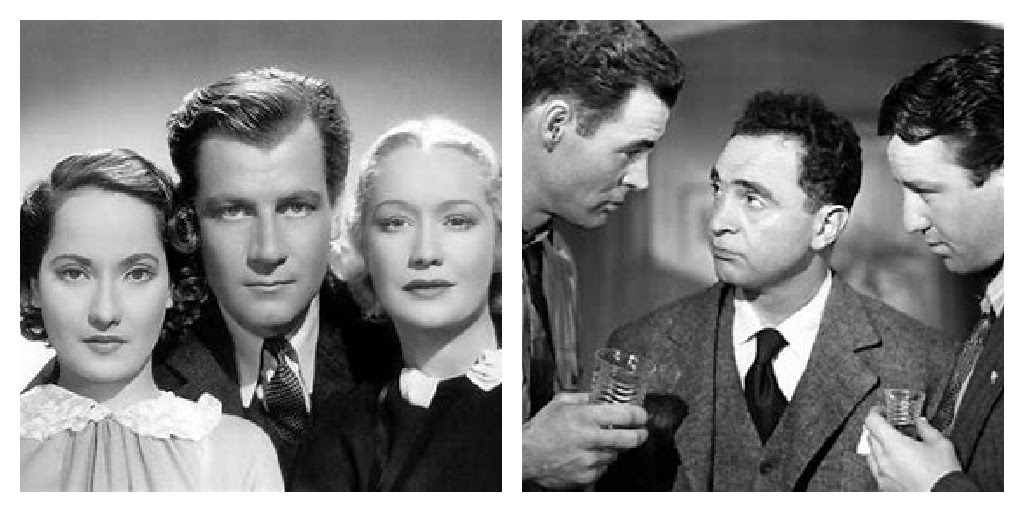
Finally, two movies were based on Queer material, but because of the times in which they made their respective debuts – 1934 on Broadway for Lillian Hellman’s play The Children’s Hour and 1945 for Richard Brooks’s novel The Brick Foxhole – American movie screens were not ready to hear the words homosexual, gay, queer or lesbian.
As a result, Hellman herself reworked The Children’s Hour into a heterosexual triangle. Directed by William Wyler under the title These Three for Samuel Goldwyn, it was a significant success. Wyler later reworked the material using Hellman’s original storyline in 1961 to lesser effect.
With a screenplay by John Paxton, The Brick Foxhole was adapted into the 1947 Oscar-nominated movie Crossfire by director Edward Dmytryk, featuring a stellar cast that included Robert Young, Robert Mitchum, Robert Ryan, and Sam Levene. The book’s homophobia, however, was replaced by antisemitism; the country’s ability to sympathize with certain minority groups only extended so far in the late 1940s. We will hear from Richard Brooks again. Initially, as a screenwriter for the Jules Dassin film Brute Force and then as the director of the queer films Cat on a Hot Tin Roof (1958) and Looking for Mr Goodbar (1977), the latter being one of the most virulently homophobic bait-and-switch scenarios ever committed to film.
Germany: LGBTQ+ No Longer

Young Torless: Although this essay focuses primarily on LGBTQ+ films from Hollywood and, to a lesser extent, the United Kingdom, it also references occasional works from other countries, including Italy, France and Sweden. Two German adaptations of classic gay Bildungsromane, however, were so thoroughly stripped of their queer themes that they cannot reasonably be classified as part of Queer Cinema. The Confusions of Young Törless, a 1906 novel by Austrian writer Robert Musil, is a foundational work of early modernist literature and is often discussed in queer studies because of its exploration of adolescent desire, power, and moral ambiguity. However, Young Torless, the 1966 movie adaptation by director Volker Schlondorff strips the material of all its queer content.
Madchen in Uniform (Girls in Uniform), a landmark lesbian film from 1931 – three years before the scope of this article – was based on the play by Christa Winsloe. However, the 1958 remake, with Romy Schneider, is bereft of any gay feeling.

STUDIO BREAKDOWN
85 Queer Films Made Under The Hays Code
Among the Hollywood Studios, Warner Bros. is the clear winner in producing and distributing LGBTQ+ movies under the Hays Code, accounting for 24% of the films listed. MGM comes in second with 12%, followed by Columbia in third position with 9%. Seventy-four of the movies are from the U.S. – 75, if you include the U.S.-Canadian production The Fox (total: 88%) with nine from the United Kingdom (9%), two from France, one from Sweden, and one from Italy.
- Warner Bros (including Warner-Pathé and Warner Bros. Seven Arts): 20
- MGM: 10
- Columbia (including Horizon-Sam Spiegel and British Lion) 8
- Universal (including Universal-International): 7
- Twentieth Century Fox (TCF): 6
- RKO: 6
- Paramount: 5
- United Artists (including The Mirisch Company): 3
- Allied Artists: 1
- Embassy Pictures: 1
- Film-Makers Distribution: 1
- Filmways: 1
- Internet Archive: 1
- Monterey Productions (Howard Hawks): 1
- Republic Pictures: 1
- Selznick International: 1
- Transatlantic (Alfred Hitchcock and Sidney Bernstein) 1
- Rank (including Anglo Allied Pictures): 2
- Ealing: 1
- Janus Films: 1
- Joseph Janni Productions: 1
- Romulus Films: 1
- Titanus – CCFC Films: 1
- Vantage Films: 1
- Woodfall Films: 1
- Cinédis: 1
- AB Svensk Filmindustri; 1
SOURCE MATERIAL
Of the eighty-five movies listed, one is a cinema verité, and the rest are narrative features. Of these, 15 (20%) are original screenplays, while 59 (80%) were adapted from another medium.
The source material during this period came from a rich collection of gay playwrights and novelists: Carson McCullers, Gavin Lambert, Tennessee Williams, William Inge, Patricia Highsmith, Oscar Wilde, Patrick Dennis, and Herman Melville.
85 QUEER FILMS MADE UNDER THE HAYS CODE
Six of the movies listed won BEST PICTURE, while a further ten were nominated in the BEST PICTURE category.
LGBTQ+ CHARACTER: is the queer character in the movie and, in parentheses, the ACTOR who plays him/her.
LGBTQ+ is anyone in front of (actor) or behind (director | screenwriter | source of material, usually the novel or play on which the movie is based | production designers and costume designers – the latter two function sometimes being served by the same individual) who was known to be queer in real life.
1. The Bride of Frankenstein (1935)
A-
James Whale
(APPROVED)
LGBTQ+ CHARACTER
*Dr. Pretorius (Ernest Thesiger)
LGBTQ+
DIRECTOR: James Whale
ACTOR: Ernest Thesiger
Susan Sontag: Notes on Camp: 1964: The Partisan Review
You thought it (camp) meant a swishy little boy with peroxided hair, dressed in a picture hat and a feather boa, pretending to be Marlene Dietrich? Yes, in queer circles they call that camping. … You can call [it] Low Camp…
Susan Sontag: The Partisan Review 1964
High Camp is the whole emotional basis for ballet, for example, and of course of baroque art … High Camp always has an underlying seriousness. You can’t camp about something you don’t take seriously. You’re not making fun of it; you’re making fun out of it. You’re expressing what’s basically serious to you in terms of fun and artifice and elegance. Baroque art is basically camp about religion. The ballet is camp about love …
Susan Sontag: The Partisan Review 1964
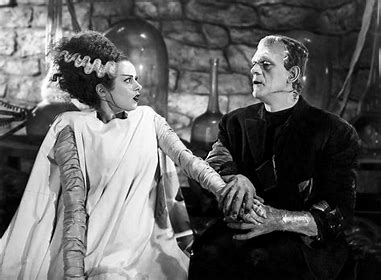
James Whale’s Bride of Frankenstein remains one of the cinema’s purest expressions of what Susan Sontag would later define as high camp. Elsa Lanchester becomes an instant icon in the title role, crowned with the most inventive coiffure in film history. Opposite her, the wonderfully mannered Ernest Thesiger—openly gay and once sketched by John Singer Sargent in 1911—delivers his definitive performance as Dr. Pretorius, the slyly queer mentor who coaxes Frankenstein back into forbidden creation.
Whale arrived in Hollywood on the strength of R. C. Sherriff’s Journey’s End, and Carl Laemmle quickly signed him to a five‑year Universal contract. What followed was one of the studio’s most artistically fertile eras. In rapid succession, Whale directed Waterloo Bridge, Frankenstein, The Old Dark House, The Invisible Man, and ultimately The Bride of Frankenstein—a run that helped define Universal’s golden age of horror and elevated the genre’s visual and thematic sophistication.
His momentum faltered with The Road Back (1937), Erich Maria Remarque’s sequel to All Quiet on the Western Front. The film’s troubled reception marked a turning point, and by 1941 Whale’s Hollywood career had effectively concluded.
The premise of Bride of Frankenstein draws on Mary Shelley’s 1818 novel Frankenstein and serves as a direct continuation of Whale’s 1931 adaptation, expanding the myth with wit, melancholy, and unmistakable queer sensibility.
Cinematography: John J. Mescall
Music: Franz Waxman
Universal Pictures
NOW STREAMING ON AMAZON PRIME VIDEO, APPLE TV+, YOUTUBE
2. Top Hat (1935)
A+
Mark Sandrich
(APPROVED)
LGBTQ+ CHARACTERS
*Horace Hardwick (Edward Everett Horton)
*Bates (Eric Blore)
LGBTQ+
ACTOR: Eric Blore
ACTOR: Edward Everett Horton
ACTOR: Erik Rhodes
CHOREOGRAPHER: Hermes Pan
COSTUME DESIGNER: Bernard Newman
More plural personalities
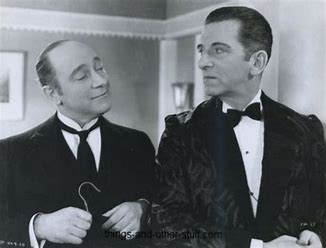
HORACE HARDWICK (EDWARD EVERETT HORTON) ON FIRST MEETING BATES (ERIC BLORE) in “TOP HAT”
The Best of the Astaire-Rogers movies.
Of the nine films Fred Astaire and Ginger Rogers made at RKO in the 1930s, Top Hat is their finest—and easily their most unabashedly queer. Eric Blore gives his butler that trademark air of superior fussiness, while Edward Everett Horton, not yet overusing his patented double take, supplies the sort of fluttery exasperation that became a queer‑coded Hollywood staple.
Irving Berlin contributes one of his strongest scores, and the “Cheek to Cheek” number—choreographed by Astaire with his longtime collaborator, and alleged lover, Hermes Pan—captures the pair at their absolute peak. Gay actor Erik Rhodes, returning after The Gay Divorcee (1934), steals every scene as Alberto Beddini, the preening Italian couturier whose malapropisms are as flamboyant as his wardrobe. Rhodes spent most of his career on Broadway; his Hollywood work outside these two films is largely forgettable, but here he’s indelible.
The production design, executed by Carroll Clark under the supervision of Van Nest Polglase, represents Hollywood Art Deco at its most extravagant and aspirational. The original screenplay by Allan Scott and Dwight Taylor (from a story by Taylor) gives the whole confection its airy scaffolding, while David Abel’s cinematography bathes it in a luminous, impossible elegance.
RKO
OSCAR NOMINATION: BEST PICTURE
SONGS (IRVING BERLIN)
- No Strings (I’m Fancy-Free)
- Isn’t This a Lovely Day (to be Caught in the Rain)
- Top Hat, White Tie and Tails
- Cheek to Cheek
- The Piccolino
ASTAIRE-ROGERS AT RKO
- Flying Down to Rio (1933)
- The Gay Divorcee (1934)
- Roberta (1935)
- Top Hat (1935)
- Follow the Fleet (1936)
- Swing Time (1936)
- Shall We Dance (1937)
- Carefree (1938)
- The Story of Vernon and Irene Castle (1939)
NOW STREAMING ON AMAZON PRIME VIDEO, APPLE TV+, YOUTUBE
3. Sylvia Scarlett (1935)
B-
George Cukor
(APPROVED)
LGBTQ+ CHARACTER
*Sylvia/Sylvester Scarlett (Katherine Hepburn)
LGBTQ+
DIRECTOR: George Cukor
ACTOR: Cary Grant
ACTRESS: Katherine Hepburn
COSTUME DESIGNER: Bernard Newman
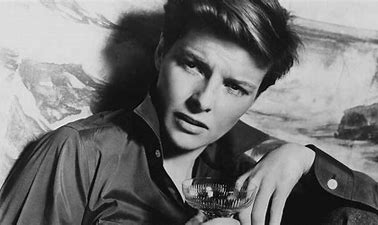
Depressed after his wife’s death and drowning in gambling debts, Henry Scarlett (Edmund Gwenn) flees France for England with his teenage daughter, Sylvia (Katharine Hepburn), in tow. Because Henry intends to resume his petty smuggling—this time sneaking bolts of lace into England to dodge import taxes—Sylvia disguises herself as a boy, christening the persona “Sylvester” to throw the authorities off their trail. On the Channel ferry, they encounter Jimmy Monkley (Cary Grant), a charming grifter whose survival instincts are so sharp that he promptly turns Henry in to save his own skin. By the time they reach Southampton, the duo has become a trio.
This is the first film in which Grant’s Cockney persona truly registers, and he nearly walks off with the picture. Its themes of gender play and sexual fluidity were far ahead of their time, and audiences didn’t know what to make of it; RKO reportedly lost $363,000, and Hepburn was swiftly branded “box office poison,” a stigma she wouldn’t shake until signing with MGM in 1940.
The film’s reputation has steadily improved, and today it wears its queerness with pride. Hepburn continues her drag performance long after the plot no longer requires it, and in one memorable moment she is kissed by a woman. It remains the only film in which Hepburn—a gay actress—so overtly channels her own sexuality on screen.
It was the first of four Hepburn–Grant pairings, followed by Howard Hawks’s Bringing Up Baby (1938), George Cukor’s Holiday (also 1938), and the triumphant Philadelphia Story (1940), which revitalized Hepburn’s career and showcased all three artists at their peak.
Adapted from Compton Mackenzie’s 1918 novel, the film also features Brian Aherne as an Englishman briefly smitten with “Sylvester,” only to lose interest the moment the boy reverts to Sylvia. Mel Berns, head of RKO’s makeup department, created Hepburn’s striking hair and makeup design—work of a piece with the sophistication he later brought to Citizen Kane and Notorious.
Cinematography: Joseph H. August
RKO
NOW STREAMING ON AMAZON PRIME VIDEO AND ON APPLE TV+
4. Stage Door (1937)
A-

Gregory La Cava
(APPROVED)
LGBTQ+ CHARACTER
*Jean (Ginger Rogers)
*Kay (Andrea Leeds)
*Linda (Gail Patrick)
*Eve (Eve Arden)
LGBTQ+
ACTRESS: Katherine Hepburn
Adapted by Morrie Ryskind and Anthony Veiller from the play by Edna Ferber and George S. Kaufman, and directed by Gregory La Cava, Stage Door follows a group of aspiring actresses living at the Footlights Club, a shabby New York boarding house crackling with ambition and wisecracks. At the center are Katharine Hepburn’s Terry, the privileged newcomer whose arrival unsettles the house’s fragile equilibrium, and Ginger Rogers’s Jean, the sharp‑tongued, streetwise lodestar of the group—and Terry’s reluctant roommate. Andrea Leeds provides the film’s emotional core as Kay, a once‑promising actress whose career has stalled and whose hope is wearing thin.
The supporting ensemble is a delight: Constance Collier as Miss Luther, the club’s grandly outdated acting coach; Gail Patrick, sleek and sardonic; Eve Arden, forever draped in a cat; and early turns from Lucille Ball and Ann Miller, all playing young women clawing for a break.
In this intensely homosocial world, it’s easy to detect threads of queer coding—particularly in the tenderness between Rogers and Leeds, and in the wry, conspiratorial dynamic between Arden and Patrick. La Cava, fresh off My Man Godfrey (1936), directs with a light, improvisatory touch, and Hepburn and Rogers spark beautifully off each other. Leeds’s performance is the only element that feels rooted in an older, more declamatory 1930s style—ironically, she was the film’s sole acting Oscar nominee, earning a Best Supporting Actress nod. The film itself was also nominated for Best Picture, Best Director, and Best Adapted Screenplay.
And presiding over the theatrical chaos is Adolphe Menjou as Anthony Powell, the suave impresario whose charm is matched only by his opportunism.
Cinematography: Robert De Grasse
RKO
Streaming on Apple TV+, Amazon Prime and YouTube
5. Bringing Up Baby (1938)
A-

Howard Hawks
(APPROVED)
LGBTQ+ CHARACTER
*David Huxley (Cary Grant)
LGBTQ+
ACTOR: Cary Grant
ACTRESS: Katherine Hepburn
COSTUME DESIGNER: Howard Greer
In Howard Hawks’s Bringing Up Baby, Cary Grant answers the front door wearing a filmy negligée because Katharine Hepburn has hidden all his clothes. When Hepburn’s aunt (May Robson) demands an explanation, he throws up his hands and exclaims, Because I just went gay all of a sudden ! — leaping into the air on the word gay. The film never again suggests that Grant’s character is gay, queer, or homosexual, which raises the linguistic question: how common was gay as a synonym for homosexuality in 1938?
The answer is that the usage existed but was not yet mainstream. By the late 1930s, gay, meaning “homosexual,” circulated widely in queer subcultures but remained largely unknown to the general public, who still heard the word as “carefree” or “frivolous.” Grant’s line therefore functions as a sly double entendre—innocent enough to slip past censors, unmistakable to those in the know.
Grant plays a paleontologist who becomes entangled with a scatterbrained heiress (Hepburn) and a leopard named Baby. The film represents the peak of Hollywood’s slapstick era, with Grant taking several classic tumbles. Adapted by Dudley Nichols and Hagar Wilde from Wilde’s short story, first published in Collier’s Weekly on April 10, 1937, it remains one of Hawks’s most anarchic and subversive comedies.
Cinematography: Russell Metty
RKO
REMADE WITH BARBRA STREISAND AND RYAN O’NEILL BY PETER BOGDANOVICH AS “WHAT’S UP DOC” IN 1972.
STREAMING: YouTube, Amazon Prime, Apple TV+
6. The Women (1939)
A-
George Cukor
(APPROVED)
LGBTQ+ CHARACTER
*Nancy Blake (Florence Nash)
LGBTQ+
DIRECTOR: George Cukor
ACTRESS: Marjorie Main
COSTUME DESIGNER: Gilbert Adrian
ART-SET DIRECTION: Cedric Gibbons
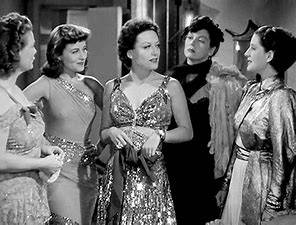
The Women is the first American studio film with an entirely female cast, and its commitment to that conceit runs deep: every piece of artwork on screen was created by women, and the screenplay—by Anita Loos and Jane Murfin—was adapted from Claire Boothe Luce’s 1936 Broadway hit. Even the animals are female! Behind the camera, however, 1939 Hollywood reasserts itself: the crew is almost entirely male, though the production is steered by the industry’s most accomplished gay director, George Cukor, working just a month after his dismissal from Gone with the Wind for, as some contemporaries whispered, being “too gay” for David O. Selznick’s comfort.
The film’s only overtly lesbian figure—an “old maid” who lives in slacks and radiates a dry, knowing independence—is played by Florence Nash, not Katharine Hepburn, though the costume might suggest otherwise. Nash’s presence adds a sly, subversive note to a film otherwise devoted to the romantic and social entanglements of Park Avenue women.
Cinematography: Joseph Ruttenberg and Oliver T. Marsh
MGM
NOW STREAMING ON AMAZON PRIME, APPLE TV+, YOUTUBE
7. The Wizard of OZ (1939)
A-
Victor Fleming
(APPROVED)
LGBTQ+ CHARACTER
*Cowardly Lion (Bert Lahr)
LGBTQ+
COSTUME DESIGN: Gilbert Adrian
ART-SET DIRECTION: Cedric Gibbons
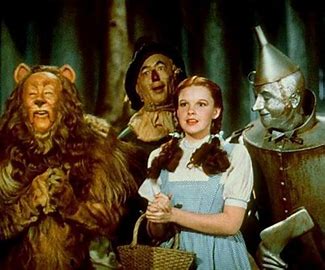
The Wizard of Oz (1939) tells the story of Dorothy Gale, a Kansas farm girl swept away by a tornado to the magical Land of Oz. With her dog Toto and three companions—a Scarecrow, a Tin Man, and a Cowardly Lion—she follows the Yellow Brick Road to the Emerald City, hoping the Wizard can send her home. Along the way, they confront the Wicked Witch of the West, only to discover that the power to return was within Dorothy all along.
Judy Garland’s Dorothy is the mother of us all. Before Barbra, before Liza, before Madonna, before Lady Gaga—there was Judy. Her performance in Oz struck a chord that transcended orientation: vulnerable yet resilient, innocent yet knowing, and anchored by that miraculous voice. Over the Rainbow, written by Harold Arlen and Yip Harburg, remains the greatest movie song ever written, and Garland delivers it with a purity that still feels like a lifeline.
The film’s visual splendor—shot in Technicolor by Harold Rosson, framed by sepia‑toned Kansas bookends—was shaped under director Victor Fleming, who took over Gone with the Wind after George Cukor’s dismissal. Queer cinema can be a small world. And yes, Bert Lahr’s Cowardly Lion reads unmistakably gay; it’s almost a wonder MGM didn’t hand him a lavender mane.
With Jack Haley as the Tin Man and Ray Bolger as the Scarecrow.
As for the phrase Friends of Dorothy, its origins are murky, but the logic is clear enough. Garland wasn’t gay, but queer men recognized something in her: a shared sense of outsiderness, a capacity for survival, a voice that could lift you out of whatever Kansas you were stuck in. Dorothy’s longing for a place “over the rainbow” became a metaphor for a life not yet possible—but desperately hoped for.
Adapted from the novel by L. Frank Baum.
MGM
NOW STREAMING ON AMAZON PRIME VIDEO, APPLE TV+, MAX (YOUTUBE)
8. Rebecca (1940)
A+
Alfred Hitchcock
(APPROVED)
LGBTQ+ CHARACTER
*Mrs. Danvers (Judith Anderson)
LGBTQ+
ACTOR: Laurence Olivier
ACTRESS: Judith Anderson
REBECCA IS ONE OF HITCHCOCK’S SEVEN PERFECT FILMS.
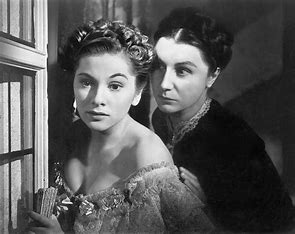
Hitchcock often cast gay actors in LGBTQ+ roles, such as Judith Anderson in Rebecca, Anthony Perkins in Psycho, and John Dahl and Farley Granger in Rope.
While working as a paid companion to the formidable Mrs. Van Hopper (Florence Bates) in Monte Carlo, a shy young woman (Joan Fontaine) meets the aristocratic widower Maxim de Winter (Laurence Olivier). After a whirlwind courtship, he proposes, and the two marry before returning to his ancestral estate, Manderley. There, the new Mrs. de Winter finds herself overshadowed by the memory of Maxim’s first wife, Rebecca, whose death remains shrouded in mystery. Presiding over the house is Mrs. Danvers (Judith Anderson), the glacial, obsessive housekeeper who worships Rebecca’s memory and undermines her successor at every turn.
Rebecca marked the Hollywood arrival—courtesy of Gone with the Wind producer David O. Selznick—of the man who was, or would soon become, the greatest director in the history of cinema. Hitchcock’s touch is everywhere: the psychological unease, the shifting power dynamics, the sense of a heroine swallowed by a house that remembers more than it reveals.
Fontaine gives a superb performance, proving she shared the same deep well of talent as her sister, Olivia de Havilland. The supporting cast is equally rich: George Sanders as the insinuating Jack Favell, Rebecca’s cousin, Reginald Denny as Frank Crawley, Maxim’s estate manager and Gladys Cooper as Maxim’s sister.
Selznick International
Oscar-winning cinematography by George Barnes.
Music by Franz Waxman.
Adapted from the novel by Daphne du Maurier.
Hitchcock’s cameo: 2:06:57 He is the man in a bowler hat and trenchcoat who crosses paths with George Sanders.
NOW AVAILABLE FOR STREAMING ON YOUTUBE (Cine Moi)
9. The Maltese Falcon (1941)
A-
John Huston
(APPROVED)
LGBTQ+ CHARACTERS
*Joel Cairo (Peter Lorre)
*Kasper Gutman (Sydney Greenstreet)
*Wilmer Cook (Elisha Cook Jr)
LGBTQ+
COSTUME DESIGNER : Orry-Kelly
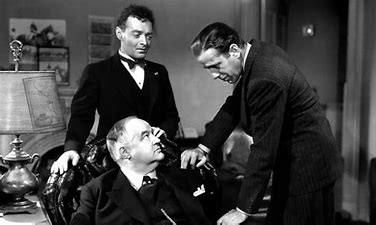
After several years as a screenwriter, John Huston made a smashing directorial debut with his adaptation of Dashiell Hammett’s 1930 novel. The story had already been filmed once, in 1931, as a pre‑Code vehicle for Ricardo Cortez and Bebe Daniels, but Huston’s version quickly eclipsed it and is now considered the definitive take. Humphrey Bogart got his breakthrough role as Sam Spade, the hard‑boiled San Francisco private detective navigating a trio of unscrupulous adventurers—Mary Astor, Sydney Greenstreet, and Peter Lorre—all in pursuit of a jewel‑encrusted falcon statuette.
The film’s queer coding is unmistakable. Peter Lorre’s Joel Cairo is openly gay by 1941 standards—perfumed, fastidious, and treated by Spade with a mixture of contempt and wary amusement. Sam will slap Cairo, but never punch him; the distinction is deliberate. Wilmer (Elisha Cook Jr.) is repeatedly called “the gunzel,” a term that originally meant a kept boy or homosexual, marking him as Kasper Gutman’s (Sydney Greenstreet) protégé in more ways than one. If Wilmer is Gutman’s boy, then Gutman himself is hardly straight. Splendid, dear boy.
Bogart would remain a major star until his death in 1957.
One of the quintessential film noirs, The Maltese Falcon hasn’t aged quite as gracefully as some of its contemporaries—largely because its plot is a glorious tangle that barely holds together. But the performances are a feast: Mary Astor gives a superb turn as Brigid O’Shaughnessy, a Celtic Tiger avant la lettre, and the queer triumvirate of Lorre, Greenstreet, andCook Jr. brings up the rear with style.
Cinematography
Arthur (Casablanca) Edeson.
Warner Bros.
NOW STREAMING ON AMAZON PRIME VIDEO, APPLE TV+, YOUTUBE
10. The Man Who Came to Dinner (1942)
A-
William Keighley
(APPROVED)
LGBTQ+ CHARACTER
*Sheridan Whiteside (Monty Wooley)
LGBTQ+
ACTOR: Monty Wooley
SOURCE MATERIAL: Alexander Woollcott (The character of Whiteside is modeled on the famously acerbic gay theatre critic)
COSTUME DESIGNER: Orry-Kelly
I am not only walking out on this case, Mr. Whiteside, I am leaving the nursing profession. I became a nurse because all my life, ever since I was a little girl, I was filled with the idea of serving a suffering humanity. After one month with you, Mr. Whiteside, I am going to work in a munitions factory. From now on, anything I can do to help exterminate the human race will fill me with the greatest of pleasure. If Florence Nightingale had ever nursed YOU, Mr. Whiteside, she would have married Jack the Ripper instead of founding the Red Cross! (sic)
Nurse Preen (Mary Wickes) in THE MAN WHO CAME TO DINNER
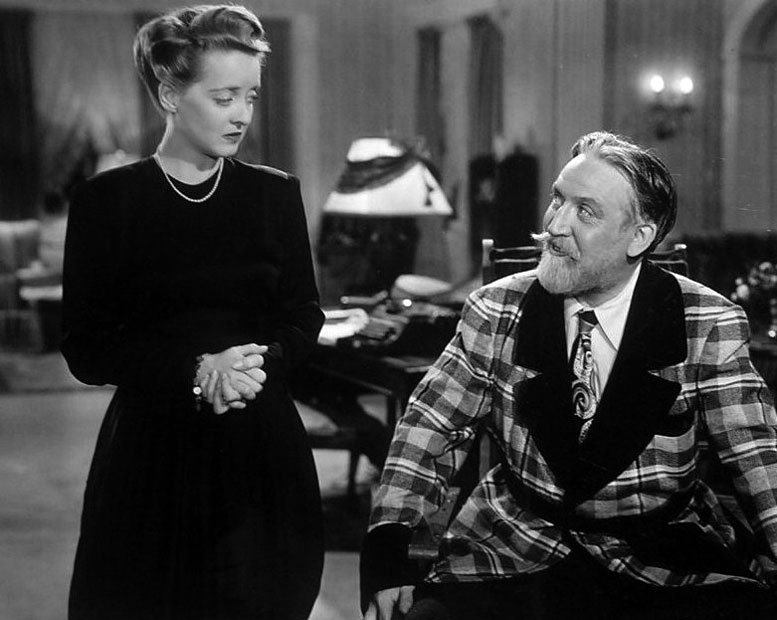
Monty Woolley delights both himself and his audience as the impossibly pompous Sheridan Whiteside in William Keighley’s excellent 1941 adaptation of the George S. Kaufman–Moss Hart play The Man Who Came to Dinner. While passing through small‑town Ohio on a cross‑country lecture tour, Whiteside slips on the icy steps of the Stanley home—where he is meant to dine as a publicity gesture—and promptly breaks his hip. He then commandeers their house for the entire Christmas season, terrorizing the family with his demands, insults, and parade of eccentric visitors.
Whiteside is famously modeled on Kaufman and Hart’s friend, the acerbic—and very gay—theatre critic Alexander Woollcott, and Woolley plays him with a delicious blend of hauteur and malicious glee. Bette Davis is perfection as his long‑suffering yet deeply loyal secretary, one of her rare comedic turns and a reminder of how deft she could be when allowed to play light.
The supporting cast is a joy: Ann Sheridan, slyly parodying her own star persona; Richard Travis as the earnest newspaperman who captures Davis’s heart; the irrepressible Jimmy Durante, belting out Did You Ever Have the Feeling That You Wanted to Go, And Still Have the Feeling That You Wanted to Stay?; Mary Wickes as Nurse Preen, who endures Whiteside’s abuse with mounting martyrdom; Reginald Gardiner doing a wicked parody of Noël Coward; and Billie Burke and Grant Mitchell as the hapless Mr. and Mrs. Stanley, whose home becomes a battleground of theatrical chaos.
Cinematography: Tony Gaudio
Warner Bros.
NOW STREAMING ON AMAZON PRIME VIDEO, APPLE TV+, YOUTUBE
11. Casablanca (1942-1943)
A+

Michael Curtiz
(APPROVED)
LGBTQ+ CHARACTERS
*Rick (Humphrey Bogart)
*Captain Renault (Claude Rains)
LGBTQ+
COSTUME DESIGN: Orry-Kelly
ART-SET DIRECTION: George James Hopkins
This is going to be the beginning of a beautiful friendship
Rick to Captain Renault Casablanca
After Ilsa (Ingrid Bergman) and Victor Laszlo (Paul Henreid) are safely airborne and Major Strasser (Conrad Veidt) lies dead on the tarmac, Rick (Humphrey Bogart) and Captain Renault (Claude Rains) walk off together into the mist. It’s the moment when the film shifts from romantic tragedy to something more quietly heroic, and Rick turns to Louis to deliver one of the most famous closing lines in cinema history—a benediction, a farewell, and the beginning of a new alliance. But is it Love?
THREE LOVE STORIES ARE GOING ON IN CASABLANCA: ISLA-RICK AND ISLA-VICTOR, AND THEN THERE IS THE LOVE STORY BETWEEN RICK AND CAPTAIN RENAULT.
Casablanca unfolds in the Moroccan port city of the same name, with most of the action centered at Rick’s Café Américain, the nightclub owned by the film’s reluctant hero, Rick Blaine (Humphrey Bogart). The plot ignites when an old flame, Ilsa Lund (Ingrid Bergman), arrives unexpectedly with her husband, Victor Laszlo (Paul Henreid), the Resistance leader the Nazis are desperate to capture. Rick must decide whether to put aside his lingering heartbreak and help Victor escape so he can continue the fight against fascism.
But Casablanca contains not one love story, but three: Ilsa and Rick, Ilsa and Laszlo, and—running quietly beneath the surface—the charged, conspiratorial bond between Rick and Captain Renault (Claude Rains). By the time they walk off together into the mist and Rick delivers that immortal final line, it’s clear the tension has been there from the beginning. Their “honeymoon,” we are told, will be in Camp Brazzaville—a notorious homosexual haven in the colonial imagination, the Palm Springs of its day.
Dooley Wilson provides the film’s emotional heartbeat as Sam, the piano player whose rendition of Herman Hupfeld’s “As Time Goes By” becomes the movie’s leitmotif. Max Steiner wove the melody into his score, though the song itself predated the film by over a decade, having been written for the 1931 Broadway musical Everybody’s Welcome.
Written on the fly by the fabulous Epstein twins—Philip and Julius—along with Howard Koch, and directed by Michael Curtiz with what can only be described as divine precision, Casablanca remains one of Hollywood’s most romantic and enduring achievements.
The film premiered in New York on November 26, 1942, timed to coincide with the Allied invasion of North Africa. Its Los Angeles and national release followed on January 23, 1943, aligning with the Churchill–Roosevelt Casablanca Conference. Under AMPAS rules, this made the film eligible for the 1943 Academy Awards. At the 16th Oscars, held at Grauman’s Chinese Theatre on March 2, 1944, it won Best Picture (Hal B. Wallis, producer), Best Director (Curtiz), and Best Adapted Screenplay (the Epstein brothers and Koch).
When Best Picture was announced, Jack Warner famously rushed to the stage to accept the award, leaving Wallis—its actual producer—stranded in the aisle. Wallis never forgave him. He soon resigned from Warner Bros. and established his own production company under the Paramount banner.
Adapted from the unproduced play Everybody Comes to Rick’s by Murray Burnett and Joan Alison, Casablanca remains a miracle of studio-era alchemy: accidental, improvised, and somehow perfect.
Cinematography: Arthur Edeson
Warner Bros.
NOW STREAMING ON AMAZON PRIME VIDEO, APPLE TV+, Max (YOUTUBE)
12. The Seventh Victim (1943)
C

MARK ROBSON
(APPROVED)
LGBTQ+ CHARACTERS
*Jacqueline Gibson (Jean Brooks)
*Frances Fallon a friend of Jacqueline (Isabell Jewell)
LGBTQ+
SCREENWRITER: DeWitt Bodeen
The Seventh Victim (1943) is an uneven, plot‑heavy, yet blessedly brief noir‑horror hybrid about a missing woman, a Satanic cult, and the ache of repressed identity. More overtly than in Cat People, gay screenwriter DeWitt Bodeen threads a queer subtext through the film—subtle but unmistakable—rooted in themes of isolation, coded desire, and existential despair.
Mary Gibson (Kim Hunter), a young woman at a Catholic boarding school, learns that her sister Jacqueline (Jean Brooks) has stopped paying her tuition and vanished. Mary travels to Greenwich Village (for reasons we can all infer) and finds herself entangled in a web of secrets involving a cult called the Palladists and a gallery of strange, wounded figures: Hugh Beaumont as Jacqueline’s enigmatic husband; Tom Conway, reprising his Dr. Louis Judd from Cat People; and Isabell Jewell, playing one of Jacqueline’s few confidantes. Jacqueline herself emerges as a tragic figure—suicidal, estranged, and hunted by the cult, which demands her death for betraying their secrecy. In its queerness, the film oscillates between the baroque and the faintly ridiculous, but its mood of doom is unmistakable.
Produced by Val Lewton for RKO, with shadow‑soaked cinematography by Nicholas Musuraca and a score by Roy Webb, the film marked the screen debut of Hunter and the directorial debut of Mark Robson.
The film’s offscreen history is as haunted as its narrative. Isabell Jewell died by suicide in 1972, while Jean Brooks and Tom Conway both struggled with alcohol abuse disorder; their careers cut short, they both died young. The melancholy that clings to The Seventh Victim feels, in retrospect, almost prophetic.
RKO
STREAMING ON AMAZON and APPLE TV+
13. Meet Me in St. Louis (1944)
A+

Vincente Minnelli
(APPROVED)
LGBTQ+
DIRECTOR: Vincente Minnelli
ACTRESS: Marjorie Main
SONGWRITER: Hugh Martin
MUSICAL ARRANGER: Roger Edens
ART-SET DIRECTION: Cedric Gibbons
COSTUME DESIGN: Irene Sharaff
Produced by Arthur Freed for MGM, this greatest of all movie musicals contains no explicit gay plot, yet it radiates queerness from every frame. With the extraordinarily stylish direction of Vincente Minnelli, three classic songs by gay songwriter Hugh Martin (with his partner Ralph Blane), musical arrangements by the indispensable Roger Edens, and the glorious costumes of Irene Sharaff, the film has GAY written all over it. A favorite of gay men since its December 1944 premiere, it features Judy Garland in her first fully adult role—and she looks breathtaking in Sharaff’s designs, set against Lemuel Ayers’s lovingly detailed early‑20th‑century interiors and George Folsey’s sumptuous Technicolor cinematography.
Structured as a series of seasonal vignettes beginning in the summer of 1903, the film follows a year in the life of the Smith family of St. Louis, leading up to the opening of the 1904 World’s Fair. Irving Brecher and Fred F. Finklehoffe adapted the screenplay from Sally Benson’s stories originally published in The New Yorker. The cast is a dream ensemble: Mary Astor and Leon Ames as the parents; Garland, Lucille Bremer, Joan Carroll, and Margaret O’Brien as the children; Tom Drake as the boy next door; June Lockhart as a neighbor; Harry Davenport as the grandfather; and Marjorie Main as the family’s stalwart cook.
Garland gets to introduce three of her most iconic songs, all by Martin and Blane:
- The Trolley Song
- The Boy Next Door
- Have Yourself a Merry Little Christmas
The last, sung to a luminous Margaret O’Brien, is arguably the greatest Christmas song ever written.
Upon release, Meet Me in St. Louis became the second‑highest‑grossing film of 1944 (after Going My Way) and MGM’s most successful musical of the decade.
Garland and Minnelli married in June 1945, and Liza was born the following year. But this period also marked the beginning of Garland’s struggles with depression and addiction, which strained both her marriage and her career. Minnelli’s numerous affairs with men further destabilized the relationship, and the couple divorced in 1951.
MGM
NOW STREAMING ON AMAZON PRIME VIDEO, APPLE TV+ and YOUTUBE
14. The Uninvited (1944)
B-
Lewis Allen
(APPROVED)
LGBTQ+ CHARACTERS
*Pamela Fitzgerald (Ruth Hussey)
*The Ghost of Mary Meredith (Lynda Grey, uncredited)
*Stella Meredith (Gail Russell)
*Miss Holloway (Cornelia Otis Skinner)
LGBTQ+
ACTRESS: Cornelia Otis Skinner
COSTUME DESIGNER: Edith Head
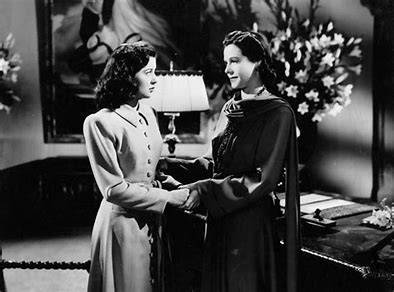
A queer ghost story with so many lesbian characters it’s hard to keep count—my best estimate is four (three living, one dead). The Uninvited was a major hit in 1944 and remains wonderfully entertaining today. The film opens with lesbian number one, Pamela Fitzgerald, played by Ruth Hussey. Pamela and her brother Rick (Ray Milland, then at the height of his stardom) fall in love with a deserted house on the Cornwall coast. Director Lewis Allen introduces them in a way that initially suggests they’re newlyweds—naughty indeed—until Hussey’s very boyish haircut tips us off. Heavens, no!
Once installed, the siblings discover a room that is several degrees colder than the rest of the house. The chill belongs to the ghost of lesbian number two, Mary Meredith, who—like Hitchcock’s Rebecca four years earlier—died under mysterious circumstances after falling from a nearby cliff. Mary seems determined to lure her daughter Stella (Gail Russell, heartbreakingly luminous before alcoholism took its toll) to the same fate. Yet the connection between mother and daughter feels more erotic than maternal, and Stella responds to it with unsettling pleasure. Good grief: lesbian number three.
It also emerges that Mary had a female lover in life, bringing us to lesbian number four: Miss Holloway, played with deliciously sinister flair by gay writer‑actress Cornelia Otis Skinner. And then there is a second ghost, Carmel, more benevolent and more maternal, whose voice we hear but whose face we never see. She might be lesbian number five, but the evidence is thin.
The film offers occasional shivers, but the real pleasure lies in watching Hussey and Skinner interpret their queer‑coded roles—Hussey with a light, comedic touch, Skinner with a variation on Judith Anderson’s Mrs. Danvers. What dazzles today is Charles Lang’s immaculate, Oscar‑nominated black‑and‑white cinematography and Victor Young’s haunting theme for Stella, later transformed into the standard Stella by Starlight with lyrics by Ned Washington. The costumes, naturally, are by the great gay designer Edith Head.
As for Ray Milland’s Rick—well, he is a music critic. Hmmm.
Adapted by Dodie Smith and Frank Partos from Dorothy Macardle’s novel Uneasy Freehold.
PARAMOUNT
The Uninvited is unavailable for streaming. However, the DVD can be purchased at Amazon.
LAURA | DOUBLE INDEMNITY | MURDER MY SWEET | MILDRED PIERCE
| ESSAY ONE – TABLE 3 85 Queer Films Made Under the Hays Code THE FOUR GREAT FILM NOIRS OF THE MID-1940s ARE ABLAZE WITH QUEER ENERGY |
| LAURA Otto Preminger (1944) Based on the 1943 novel of the same name by Vera Caspary LIKE MOST OF THE GREAT FILM NOIRS FROM THE FORTIES, LAURA BEGINS WITH CLIFTON WEBB’S NARRATION, AND THE NARRATIVE UNFOLDS IN FLASHBACK Remade by Burt Reynolds as Sharkey’s Machine in 1981 |
| DOUBLE INDEMNITY Billy Wilder (1944) The first James M. Cain masterpiece to be adapted for the screen, based on his 1943 novel of the same title, which appeared as an eight-part serial for Liberty magazine in February 1936. LIKE MOST OF THE GREAT FILM NOIRS FROM THE FORTIES, DOUBLE INDEMNITY BEGINS WITH FRED MACMURRAY’S NARRATION, AND THE NARRATIVE UNFOLDS IN FLASHBACK One of the quintessential LA movies THE FIRST MOVIE TO SHOW THE SIGHTS OF LOS ANGELES The Dietrichson House in Glendale (actually in the Beachwood Canyon area) is where Walter first meets Phyllis (and her ankle bracelet). The Market in Los Feliz, where Walter and Phyllis have clandestine meetings. Walters’s apartment on Melrose Avenue. The corner of Franklin and Vermont, where Walter drops off Lola (Jean Heather), Phyllis’s stepdaughter. She suspects that her mother is up to no good. Walter and Lola are lying on the grass behind the Hollywood Bowl as a concert shimmers in the distance. Downtown Los Angeles, where the Pacific All-Risk insurance offices are located. Remade as Body Heat by Lawrence Kasdan in 1981. |
| MURDER MY SWEET Edward Dmytryk (1944) Based on Raymond Chandler’s 1940 novel, Farewell My Lovely. The second book and the first movie to feature private detective Philip Marlowe. LIKE MOST OF THE GREAT FILM NOIRS FROM THE FORTIES, MURDER MY SWEET BEGINS WITH POWELL’S NARRATION, AND THE NARRATIVE UNFOLDS IN FLASHBACK One of the quintessential LA movies Remade, under the book’s original title, by director Dick Richards, with Robert Mitchum, in 1975 |
| MILDRED PIERCE Michael Curtiz (1945) The second James M. Cain masterpiece to be adapted for the screen, based on his 1941 novel of the same name. LIKE MOST OF THE GREAT FILM NOIRS FROM THE FORTIES, MILDRED PIERCE BEGINS WITH CRAWFORD’S NARRATION, AND THE NARRATIVE UNFOLDS IN FLASHBACK One of the quintessential LA movies THE SECOND MOVIE TO SHOW THE SIGHTS OF LOS ANGELES Mildred’s original home, located at 1143 Corvallis Street, where all the houses looked alike, is actually 1143 North Jackson Street, at the intersection of East Stocker Street in Glendale. Next is Monty Beragon’s house on 26652 Latigo Shore Drive in Malibu. The house was built in 1929 and, at the time of filming, was occupied by director Anatole Litvak. Destroyed during the winter storms of 1983, a new house now sits on the site. Remade for HBO Max by writer/director Todd Haynes in 2011, starring Kate Winslet, Evan Rachel Wood, and Guy Pierce. |
15. Laura (1944)
A+
Otto Preminger
(APPROVED)
LGBTQ+ CHARACTER
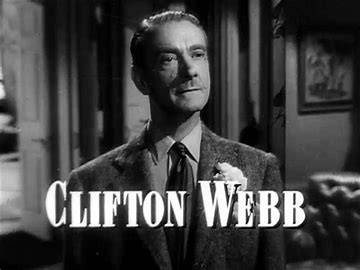
*Waldo Lydecker (Clifton Webb)
LGBTQ+
ACTOR: Clifton Webb
ACTOR: Vincent Price
ACTRESS: Judith Anderson
I shall never forget the weekend Laura died. A silver sun burned through the sky like a huge magnifying glass. It was the hottest Sunday in my recollection. I felt as if I were the only human being left in New York. For with Laura’s horrible death, I was alone. I, Waldo Lydecker, was the only one who really knew her. And I had just begun to write Laura’s story when – another of those detectives came to see me. I had him wait. I could watch him through the half-open door. I noted that his attention was fixed upon my clock. There was only one other in existence, and that was in Laura’s apartment in the very room where she was murdered
Clifton Webb as Waldo Lydecker in Laura.
Detective Mark McPherson (Dana Andrews) is investigating the murder of Laura Hunt (a magnificent Gene Tierney in a star‑making performance), a young advertising executive found dead from a shotgun blast just inside her apartment door. His first stop is the apartment of newspaper columnist Waldo Lydecker (Clifton Webb, who became a Hollywood star at fifty), an imperious, effete—read: homosexual—older man who has appointed himself Laura’s mentor and gatekeeper. McPherson also questions Laura’s parasitic playboy fiancé, Shelby Carpenter (Vincent Price), a kept man tethered to her wealthy socialite aunt, Ann Treadwell (Judith Anderson).
One night, the detective falls asleep in Laura’s apartment beneath her portrait. He awakens to the sound of a key in the lock—and is stunned to see Laura herself walk in. A dress in her closet, belonging to one of her models, Diane Redfern, reveals the truth: the woman assumed to be Laura was Redfern, lured there for a clandestine rendezvous with the unfaithful Carpenter while Laura was away in the country. With Laura alive, the urgency to unmask the killer intensifies.
One of the reasons often cited for the firing of the film’s original director, Rouben Mamoulian, was his treatment of Webb—his chilly, dismissive attitude toward a seasoned stage actor whose sexuality he reportedly disdained. Hollywood lore has inflated this into the primary cause of his dismissal, but the more likely explanation is that Mamoulian was steering the material in a direction Darryl Zanuck found untenable. Mamoulian is, after all, more famous for the films he was fired from (Laura, Oklahoma!, Cleopatra) than for the ones he completed. Zanuck handed the project to producer Otto Preminger, and the result was a stroke of sheer, unforgettable genius.
Adapted from Vera Caspary’s novel by Jay Dratler, Samuel Hoffenstein, Elizabeth Reinhardt, and an uncredited Ring Lardner Jr., the film features Oscar‑winning cinematography by Joseph LaShelle—trumping even John Seitz’s equally stunning work on Double Indemnity—and a haunting, all‑time‑great score by David Raksin.
TCF
NOW STREAMING ON AMAZON PRIME VIDEO, APPLE TV+, YOUTUBE
16. Double Indemnity (1944)
A+
Billy Wilder
(APPROVED)
LGBTQ+ CHARACTERS
*Walter Neff (Fred MacMurray)
*Barton Keyes (Edward G. Robinson)
LGBTQ+
ACTRESS: Barbara Stanwyck
COSTUME DESIGNER: Edith Head
MY FAVORITE FILM NOIR OF THE FORTIES.
WERE NEFF AND KEYES QUEER FOR EACH OTHER?
Walter Neff, a successful insurance salesman for Pacific All-Risk Insurance, returns to his office building in downtown Los Angeles late one night. Clearly in pain, he sits at his desk and tells the whole story into a Dictaphone for his colleague Barton Keyes, a claims adjuster.
One of the greatest film noirs produced during Hollywood’s mid‑forties–to‑fifties golden age, Double Indemnity (1944) is a crime thriller directed by Billy Wilder, co‑written by Wilder and Raymond Chandler, and produced by Buddy DeSylva. The screenplay adapts James M. Cain’s 1936 serial (later published as a 1943 novel), and the result is a model of hard‑boiled precision.
The film stars Fred MacMurray as Walter Neff, an insurance salesman who falls under the spell of Phyllis Dietrichson (Barbara Stanwyck, in one of her most iconic roles), the platinum‑wigged black widow who lures him into a plot to murder her husband and collect on a policy’s double‑indemnity clause. Edward G. Robinson is superb as Barton Keyes, the claims adjuster whose job is to sniff out fraudulent claims—and whose moral clarity becomes the film’s true compass.
Double Indemnity refers to a clause in particular life insurance policies that doubles the payout when the death is accidental.
All three actors are magnificent, with Stanwyck and Robinson giving performances worthy of Oscars. Stanwyck was nominated but lost to Ingrid Bergman in Gaslight, while MacMurray and Robinson were inexplicably overlooked.
Robinson’s absence from the Best Supporting Actor lineup that year is arguably the most egregious snub in Oscar history
Wilder later said, in multiple interviews, that the real love story in the film is between Walter and Keyes. You can feel their bond in every scene, culminating in that devastating final moment between them. By contrast, the dynamic between Neff and Phyllis is all power, manipulation, and erotic calculation—never love.
The cinematography is by John F. Seitz, who also shot Wilder’s The Lost Weekend and Sunset Boulevard. His work here—venetian‑blind shadows, cigarette‑lit confessionals, and that unforgettable grocery‑store rendezvous—helped define the visual language of noir.
Paramount Pictures
NOW STREAMING ON AMAZON PRIME VIDEO, APPLE TV+, YOUTUBE
17. Murder My Sweet (1944)
B+
Edward Dmytryk
(APPROVED)
LGBTQ+ CHARACTER
*Lindsay Marriott (Douglas Walton)
LGBTQ+
COSTUME DESIGNER: Edward Stevenson
He smells nice!
(Elevator Boy about Marriott)
YOU’D BETTER PUT YOUR FLAPS DOWN, OR YOU’LL TAKE OFF
(Marlow to Marriott)
I’M NOT IN THE HABIT OF GIVING PEOPLE GROUNDS FOR BLACKMAIL, MR. MARLOWE
(Marriott)
Murder, My Sweet was released under its original book title, Farewell, My Lovely, in the United Kingdom, but was retitled for its United States release. It was the first film to feature author Raymond Chandler’s primary character, the hard-boiled private detective Philip Marlowe and here, I think, is a good time to dig a little deeper and list those actors who have played Marlowe down through the years:
ESSAY ONE- TABLE 4
85 Queer Films Made Under the Hays Code
PHILIP MARLOWE INTERPRETATIONS
| YEAR | MOVIE TITLE | PHILIP MARLOWE |
| 1944 | Murder My Sweet | Dick Powell |
| 1946 | The Big Sleep | Humphrey Bogart |
| 1947 | Lady in the Lake | Robert Montgomery |
| 1969 | Marlowe | James Garner |
| 1973 | The Long Goodbye | Elliott Gould |
| 1975 | Farewell My Lovely | Robert Mitchum |
| 2022 | Marlowe | Liam Nesson |
Dick Powell is in excellent company here, and he acquits himself admirably. He also deserves credit for being the first actor to play Philip Marlowe on screen and for making a surprisingly smooth transition from Warner Bros. crooner to hard‑boiled private eye. It can’t have been easy, especially since director Edward Dmytryk and screenwriter John Paxton twist the plot into knots worthy of Howard Hawks’s The Big Sleep. The supporting cast is uniformly strong—Esther Howard, Anne Shirley, Claire Trevor, Otto Kruger, Miles Mander, and the marvelous Mike Mazurki—but nothing here quite matches Humphrey Bogart’s legendary bookstore flirtation with Dorothy Malone in Hawks’s masterpiece.
Which brings us to the film’s LGBTQ+ character. His name is Lindsay Marriott, played by character actor Douglas Walton. He appears in only two scenes before being dispatched in true queer‑coded fashion. We sense his queerness even before he enters: the elevator boy who has let him up to Marlowe’s office remarks, “He smells nice.” And then Marriott materializes—mincing around the office in a fabulous overcoat and ascot, as jittery as Bette Davis without a cigarette. Despite his protests, he is being blackmailed into making a money‑for‑jewels exchange. It’s all rather sad, and very much of its era.
Dmytryk and the film’s producer, Adrian Scott, were members of the Hollywood Ten and served jail time for their Communist Party affiliations and for refusing to capitulate to HUAC. Blacklisted, Dmytryk eventually reversed course and named names—including that of director Jules Dassin—which allowed his career to recover, though at a steep moral cost. Scott refused to cooperate, moved to England like many in his situation, and never regained his Hollywood footing. Anne Shirley, who married Scott and retired from acting after this film, sent him a “Dear John” letter requesting a divorce, which she obtained in 1948 after four years of marriage. She lived the rest of her life quietly in Los Angeles.
CINEMATOGRAPHY
Harry J. Wild
RKO
NOW STREAMING ON AMAZON PRIME VIDEO, APPLE TV+, YOUTUBE
18. Mildred Pierce (1945)
A+
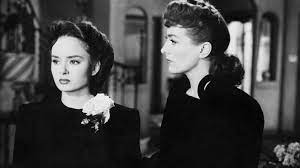
Michael Curtiz
(APPROVED)
LGBTQ+ CHARACTER:
*Ida Corwin (Eve Arden)
*Monte Beragon (Zachary Scott)
LGBTQ+
COSTUME DESIGNER: Milo Anderson
ART–SET DIRECTION: George James Hopkins
Joan Crawford plays Mildred, and Ann Blyth plays Veda—the most ungrateful daughter in cinema history—in Mildred Pierce, director Michael Curtiz’s masterful adaptation of James M. Cain’s 1941 novel, from an Oscar‑nominated screenplay by Ranald MacDougall (with several uncredited contributors). It was Crawford’s first starring role for Warner Bros. after leaving MGM, and she deservedly won the 1945 Academy Award for Best Actress.
Mildred Pierce is the centerpiece of the mid‑1940s Cain triptych, flanked by Billy Wilder’s Double Indemnity (Paramount, 1944) and Tay Garnett’s The Postman Always Rings Twice (MGM, 1946). All three films hook you instantly with their propulsive plots and showcase some of the decade’s finest acting and direction—making Cain one of the best‑served novelists in Hollywood history.
The film opens on the Malibu (or possibly Santa Monica) pier with the murder of Monte Beragon (Zachary Scott), Mildred’s second husband. The sequence ends with a magnificent close‑up: Crawford’s Mildred reflected in a window, swathed in fur. The police inform her that her first husband, Bert Pierce (Bruce Bennett), is the prime suspect—he owns the gun, has a motive, and doesn’t deny the crime. Mildred insists he is too gentle to kill anyone and begins recounting her story in flashback.
Mildred and Bert are an unhappily married couple in Glendale. After Bert’s business collapses—thanks to his oily partner Wally Fay (Jack Carson)—Mildred must sell her baked goods to support the family. Bert accuses her of loving their daughters more than him. When his mistress, Maggie Biederhof (Lee Patrick), calls during a quarrel, the marriage collapses.
Mildred keeps custody of sixteen‑year‑old Veda, a bratty social climber, and ten‑year‑old Kay (Jo Ann Marlowe), a genial tomboy. Because they live in working‑class Glendale rather than adjacent, aristocratic Pasadena, Veda lives in a state of perpetual shame. Mildred tries to appease her with material comforts, taking a job as a waitress and eventually parlaying her skills into a wildly successful chain of chicken‑and‑waffle restaurants. She runs the business with her friend Ida—played by Eve Arden in her only Oscar‑nominated role. Arden’s dry, queer‑coded delivery makes Ida the film’s voice of reason, and her scenes with Mildred carry a subtle emotional charge that suggests feelings deeper than friendship.
Mildred meets Pasadena playboy Monty Beragon and, though she doesn’t love him, marries him to ease Veda’s entry into high society. Monty, however, is not wealthy; Mildred begins embezzling from her own business to cover his family’s debts and Veda’s extravagances. None of it satisfies Veda, whose appetite for status is bottomless.
Brilliantly filmed in high Germanic style by a cadre of Viennese émigré geniuses—Curtiz, production designer Anton Grot and composer Max Steiner, in addition to cinematographer Ernest Haller, and art director George James Hopkins—Mildred Pierce is one of the great noirs of the 1940s. Curtiz’s blend of high melodrama and near‑camp makes the film a queer classic. In addition to Arden’s Ida, there is another queer‑coded presence: Zachary Scott’s Monty, whose languid feyness constantly raises the possibility that his sexual interests extend beyond women.
And then there is the film’s magnificent lack of subtlety in the health department. In pre‑1960 Hollywood, a single cough is a death sentence. Poor Kay coughs once—just once—and we know she’s doomed. She survives the family trip to Lake Arrowhead only to return to Glendale in an oxygen tent, setting up one of the film’s most unforgettable scenes. When Kay takes her final breath, the nurse rushes to turn off the oxygen before Mildred or Veda can react. It’s both heartbreaking and, in its abruptness, darkly hilarious.
Like Robert Aldrich’s Whatever Happened to Baby Jane?, Mildred Pierce plays as drama and camp simultaneously, with no contradiction between the two. That’s part of its enduring magic.
And yes—Butterfly McQueen appears in a brief but peerless burst of high camp as Mildred’s maid, hired and costumed (of course) by Veda. Delicious doesn’t begin to cover it.
WARNER BROS.
NOW STREAMING ON AMAZON PRIME VIDEO, APPLE TV+, YOUTUBE
19. The Picture of Dorian Gray (1945)
(A)
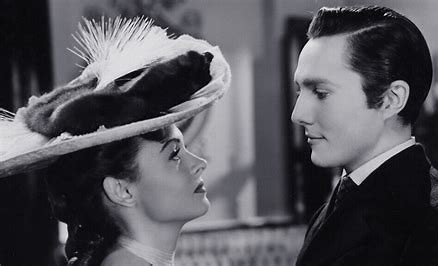
Albert Lewin
(APPROVED)
LGBTQ+ CHARACTERS
*Dorian Gray (Hurd Hatfield)
*Basil Hallward (Lowell Gilmore)
LGBTQ+
SOURCE MATERIAL: The Picture of Dorian Gray, a novel by Oscar Wilde.
ACTOR: Hurd Hatfield
ACTOR: Lowell Gilmore
COSTUME DESIGNER: Arlington Valles
ART-SET DIRECTION: Cedric Gibbons
We all know the story: a beautiful young man, Dorian Gray, wishes that his portrait might age in his place. As he plunges into a life of corruption and hedonism, the painting grows monstrous while Dorian himself remains eerily untouched—until the accumulated weight of his sins finally destroys him.
After serving as Irving Thalberg’s closest assistant and winning an Oscar for producing Mutiny on the Bounty, Albert Lewin became a producer at Paramount following Thalberg’s death at 37. A man of pronounced literary ambition, Lewin soon stepped into writing and directing, debuting with a middling adaptation of Somerset Maugham’s The Moon and Sixpence. But back at MGM, he created his masterpiece: a superb adaptation of Oscar Wilde’s The Picture of Dorian Gray, with the impossibly beautiful Hurd Hatfield as Dorian. Hatfield’s performance—so subtle it borders on the mask‑like—has always felt exactly right. He’s like Tyrone Power with the emotional temperature dialed down to zero.
Lewin handles the material with exquisite control, and the film stands as one of MGM’s finest achievements of the 1940s. The production design is sumptuous, and Harry Stradling’s Oscar‑winning black‑and‑white cinematography is breathtaking—erupting into color for the climactic close‑up of Ivan Le Lorraine Albright’s grotesque portrait, now housed at the Art Institute of Chicago.
The cast is superb. George Sanders is perfection as Lord Henry Wotton—Wilde’s heterosexual stand‑in—scattering epigrams like rose petals. Angela Lansbury, in her second Oscar‑nominated performance in as many years, is heartbreaking as Sybil Vane, the young woman whose destruction seals Dorian’s fate. Richard Fraser is excellent as her vengeful brother, and Peter Lawford and Donna Reed look impossibly fresh and luminous.
And then there is Basil Hallward, Dorian’s closest friend and the man who paints the fateful portrait. He is played by gay actor Lowell Gilmore, who—like Hatfield—deserved far better from Hollywood. His quiet ache gives the film its emotional center, the one place where Wilde’s original queer longing still flickers through the studio gloss.
MGM
NOW STREAMING ON AMAZON PRIME VIDEO, APPLE TV+, YOUTUBE
20. Gilda (1946)
A-
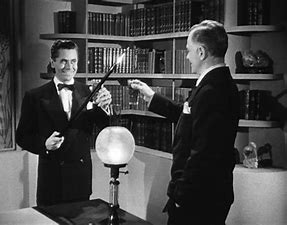
Charles Vidor
(APPROVED)
LGBTQ+ CHARACTERS
*Johnny Farrell (Glenn Ford)
*Ballin Mundson (George Macready)
LGBTQ+
CHOREOGRAPHER: Jack Cole
COSTUME DESIGNER: Jean Louis
WERE FARRELL AND MUNDSON QUEER FOR EACH OTHER?
Feast your eyes on Charles Vidor’s stylish direction, Rudolph Maté’s lush black‑and‑white cinematography (unusual for a noir, and all the more intoxicating for it), the slinky Jean Louis gowns, and—above all—Rita Hayworth as Gilda, one of Hollywood’s most iconic creations.
Although Glenn Ford and George Macready always insisted that they believed their characters were gay, Vidor disagreed. The plot and motivations are so convoluted that Gilda becomes difficult to place neatly on the queer spectrum. But it’s queer enough—emotionally, aesthetically, atmospherically—to contain two of the most significant musical numbers in cinema history: “Put the Blame on Mame” and “Amado Mio.” Hayworth performs both in grand, smoldering style (dubbed by Anita Ellis), with choreography by Jack Cole, the father of theatrical jazz dance. The songs, written by Doris Fisher and Allan Roberts, are pure Hollywood alchemy.
The result is a film that may defy tidy interpretation, but it never fails to seduce. Gilda is noir as fever dream—glamorous, unstable, erotically charged, and impossible to forget.
The original screenplay, written by Jo Eisinger, Marion Parsonnet, and Ben Hecht (uncredited), is based on a story by E.A. Ellington.
COLUMBIA PICTURES
NOW STREAMING ON AMAZON PRIME VIDEO, APPLE TV+, YOUTUBE
21. The Strange Love of Martha Ivers (1946)
(A)

Lewis Milestone
(APPROVED)
LGBTQ+ CHARACTERS
*Martha (Barbara Stanwyck)
*Walter (Kirk Douglas)
LGBTQ+
ACTRESS: Barbara Stanwyck
ACTRESS: Lizabeth Scott
COSTUME DESIGNER: Edith Head
One of the great film noirs of the 1940s, The Strange Love of Martha Ivers introduces us to three people bound together by the events of a single violent night—and then shows how that secret warps the rest of their lives. In 1920s Iverstown, young Martha Ivers lives under the tyrannical rule of her wealthy aunt. One stormy night, the aunt is killed. Martha, her timid tutor‑in‑training Walter, and streetwise runaway Sam are all present—but the truth of who struck the fatal blow becomes the film’s central moral fault line. Walter’s ambitious father seizes the moment, crafting a version of events that protects Martha and positions Walter for a future in politics. Sam, the only outsider, flees town.
Years later, Sam (Van Heflin) drifts back into Iverstown by accident. He finds Martha (Barbara Stanwyck) now married to Walter, running the family empire with icy poise. Walter (Kirk Douglas, in his astonishing film debut) is now the district attorney—alcoholic, brittle, and terrified of the secret that underpins his entire life. Sam’s return destabilizes the marriage. Martha sees in him a chance at escape—or rekindled passion. Walter sees a threat that could expose everything. A fourth character, Toni (Lizabeth Scott), a vulnerable ex‑con that Sam befriends, grounds the story emotionally and gives him a moral anchor (see below).
Stanwyck gives one of her most controlled, lethal performances, and Douglas’s debut is remarkable—he plays Walter as a man who has been dying for years, a man whose entire identity has fused itself to Martha’s. His devotion is not heterosexual love but a closeted emotional dependency, a need to be chosen, needed, and kept. Stanwyck’s Martha, meanwhile, is one of the great queer‑coded femmes of the 1940s. Her attraction to Sam is less romantic than territorial—she wants him as a symbol of the freedom she was denied. She is dominant, strategic, emotionally armored. She occupies the “masculine” role in the marriage: she controls the money, the politics, the narrative.
Lizabeth Scot was the quintessential baritone babe, in more ways than one – in addition to having a deep, smoky voice à la Kathleen Turner, she was widely rumored to be gay, and producer Hal Wallis, the producer of this movie, had to spend a fortune to keep her name out of the gutter press. Eventually, in 1955, her peak years behind her, Confidential magazine published a sensational exposé labeling her as a “strange girl, even for Hollywood,” and strongly implied that she had relationships with women—coded in the article as spending her time with “baritone babes,” a euphemism for lesbians. Scott filed a libel lawsuit against the magazine but later dropped the case. Her career never recovered.
Directed with great style by Lewis Milestone.
Screenplay by Robert Rossen based on an original motion picture story by John Patrick.
Cinematography: Victor Milner.
Paramount
Now streaming on Apple TV+, Amazon Prime and YouTube.
22. Brute Force (1947)
B+
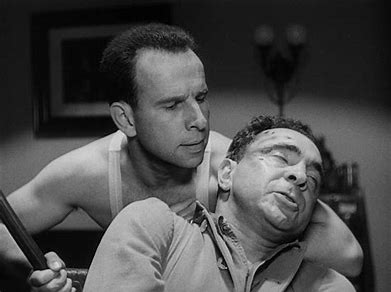
Jules Dassin
(APPROVED)
LGBTQ+ CHARACTER
*Captain Munsey (Hume Cronyn)
Brute Force was one of several superb noirs director Jules Dassin made in the postwar years, alongside Thieves’ Highway, The Naked City, and Night and the City—the latter a rare, atmospheric noir set in London. Dassin had gone to England because rumors were circulating that he was about to be investigated by HUAC, the House Un‑American Activities Committee. When he returned to the United States, the worst happened: he was named by a recanting Edward Dmytryk, and his Hollywood career ended almost overnight.
An expertly told prison‑break thriller, anchored by an above‑average original screenplay by future director Richard Brooks – whose novel The Brick Foxhole had been adapted the same year into Crossfire, with screenwriter John Paxton and director Edward Dmytryk shifting the book’s theme of homophobia to antisemitism for the film – taut direction by Dassin, and great work by a breakthrough star and bunch of reliable character actors.
Our LGBTQ+ character here is the hateful Captain Munsey, a sadist whose queerness is coded through voice, gesture, and obsession. He speaks in a slightly higher octave than the rest of the male cast, is the prison’s lone aesthete, and is fastidious about his appearance—there’s even a beautifully choreographed shaving sequence that borders on erotic ritual. There’s no doubt about it: Munsey is a raving homosexual, and a very nasty one. Hume Cronyn, a consummate actor, plays this queerness to the hilt.
Cronyn has portrayed several gay characters on stage and screen over the years, and even helped gay writer Arthur Laurents adapt Rope for Hitchcock. His performance here is never insulting; instead, it’s chillingly precise. We’re constantly on edge, waiting for him to summon another unfortunate inmate to his office for yet another round of torture.
But Cronyn isn’t the only magnetic presence. A superb Burt Lancaster, fresh off his star‑making turn in producer Mark Hellinger’s The Killers, returns to Hellinger territory as Joe Collins, a prisoner who can no longer endure Munsey’s brutality and begins plotting a breakout. His fellow inmates are played by a remarkable ensemble: Charles Bickford, Sam Levene, Jeff Corey, Whit Bissell, and Art Smith, who—as the prison’s alcoholic doctor—gets to break the fourth wall and deliver a direct appeal to the audience as the closing credits begin to roll.
Brute Force is tough, tense, and unmistakably political, but it’s also one of the most fascinating queer‑coded noirs of the 1940s—its villain a study in repression, sadism, and the dangers of power in the wrong hands.
CINEMATOGRAPHY: William Daniels
UNIVERSAL
NOW STREAMING ON AMAZON PRIME VIDEO, APPLE TV+, MAX (YOUTUBE)
23. Red River (1948)
A-
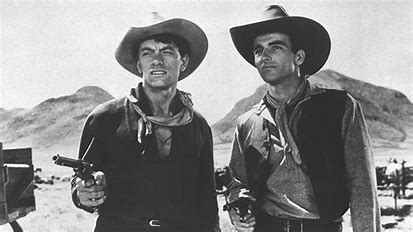
Howard Hawks
(APPROVED)
LGBTQ+ CHARACTERS
*Matt Garth (Montgomery Clift)
*Cherry Valance (John Ireland)
LGBTQ+
ACTOR : Montgomery Clift
One of the greatest Westerns ever made, Red River takes us along the infamous Chisholm Trail on the first cattle drive from Texas to Kansas. Directed by Howard Hawks, it features John Wayne in one of his most emblematic roles as Thomas Dunson, the iron‑willed rancher who launches the drive, and Montgomery Clift as Matt Garth, his adopted son and eventual rival. Their clashes—beautifully shaped in the screenplay by Borden Chase and Charles Schnee—give the film its emotional backbone.
The year was 1948, and Clift was exploding into stardom. In Red River, his film debut, he holds his own against Wayne with astonishing poise. That same year he dazzled audiences in Fred Zinnemann’s The Search and, soon after, as the painfully shy gentleman caller in William Wyler’s The Heiress. But Red River is where he first announced himself as a new kind of American leading man—sensitive, intelligent, and quietly erotic.
And then there’s the flirtation. Clift’s scenes with John Ireland as gunslinger Cherry Valance are among the most overtly homoerotic moments in any classic Western. Their gun‑comparison scene—Mine’s bigger, Let’s see—is legendary, a moment of queer electricity that Hawks lets play without comment. The two men become inseparable, their bond a sly counterpoint to Dunson’s authoritarian masculinity.
The supporting cast is superb: Walter Brennan, Noah Beery Jr., Joanne Dru, and Coleen Gray. Both Dru and Gray are unusually vivid presences for a Western of this era, giving the film not one but two memorable female characters. The stunning black‑and‑white cinematography is by Hawks’s favorite cameraman, Russell Harlan, whose images of dust, sky, and cattle feel mythic. The rousing score is by Dimitri Tiomkin, and the editing by Christian Nyby gives the film its muscular rhythm.
Adapted from Borden Chase’s 1946 story The Chisholm Trail in The Saturday Evening Post, Red River remains a towering achievement—part epic, part psychological drama, and part queer Western avant la lettre.
MONTEREY PRODUCTIONS (Howard Hawks)
United Artists
NOW STREAMING ON AMAZON PRIME VIDEO, APPLE TV+, YOUTUBE
24. Rope (1948)
A-
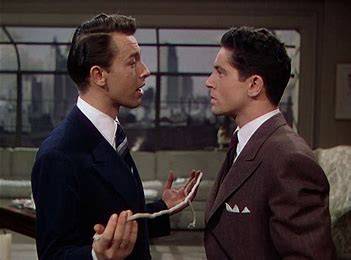
Alfred Hitchcock
(APPROVED)
Filmed in 8 x 10-minute takes.
LGBTQ+ CHARACTERS
*Rupert Cadell (James Stewart)
*Brandon Shaw (John Dall)
* Phillip Morgan (Farley Granger)
LGBTQ+
ACTOR: John Dall
ACTOR: Farley Granger
SCREENWRITER: Arthur Laurents
COSTUME DESIGNER: Gilbert Adrian
HITCHCOCK’S FIRST FILM IN COLOR
Hitchcock’s famous experiment feels like an idea that could have been sketched on a napkin over coffee with Eisenstein. Two masters of cinema, having reinvented the medium more than once, understood that film is a marriage of two complementary forces:
- Mise‑en‑scène — production design, costume, camera placement and movement, and the choreography of actors within the frame.
- Editing — the sculpting of that mise‑en‑scène into meaning.
But Hitchcock wanted to know: What happens if you remove editing altogether? What if a film were built almost entirely from mise‑en‑scène—no montage, no rhythmic cutting, just the camera gliding through space like an omniscient guest at a party? Would it feel like a filmed stage play? A voyeur with a movie camera sitting in the audience?
There was, of course, a technical problem: a reel of film only lasted ten minutes. Hitchcock solved this by gliding the camera into the back of an actor’s jacket or an inanimate object—furniture, a dark corner—allowing for a hidden cut and a fresh reel. The illusion of a single, continuous take was preserved.
Adapted from Patrick Hamilton’s play by actor‑writer Hume Cronyn, with a screenplay by gay writer Arthur Laurents, the story draws on the infamous Leopold and Loeb case of the early 1920s. Farley Granger and John Dall, both queer actors, are perfect as Phillip Morgan and Brandon Shaw, two young aesthetes—read: a homosexual couple—who strangle a former prep‑school classmate in their Manhattan penthouse. They do it as an intellectual exercise, a Nietzschean demonstration of superiority. After hiding the body in a large antique chest, they host a dinner party, using the chest as the buffet table. The Manhattan skyline glows behind them like a silent accomplice.
The guests, blissfully unaware, include the victim’s father (Sir Cedric Hardwicke) and aunt (Constance Collier). His mother is home with a cold. Also present are David’s fiancée (Joan Chandler) and her former lover (Douglas Dick), who was once David’s closest friend. The boys’ inspiration for the murder comes from their prep‑school housemaster, publisher Rupert Cadell—played by James Stewart, excellent in a role that darkens his usual persona. Rupert once discussed Nietzsche’s Superman with them, which they interpreted as approval. Brandon, in particular, believes Rupert will admire their “work of art.” The film strongly hints that Rupert was also their former lover.
The result is an astonishing achievement—one of Hitchcock’s most daring films. And yet, for all its brilliance, you can feel the constraint: half the language of cinema is off‑limits. Hitchcock is working with only the right (spatial) side of his brain, denying himself the left (temporal) side that montage provides. The tension between those two impulses—freedom and restriction—gives Rope its strange, hypnotic power.
CINEMATOGRAPHY: Joseph Valentine and William Skall
Transatlantic Pictures (Hitchcock and Sidney Bernstein)
Warner Bros.
Cameo one: 0:01:51: Just after Hitchcock’s credit towards the end of the opening sequence, walking alongside a woman.
Cameo two: 0:55:00 Through the window, we see a red flashing neon sign of his trademark profile
NOW STREAMING ON AMAZON PRIME VIDEO, APPLE TV+, YOUTUBE
25. Kind Hearts and Coronets (1949)
A+
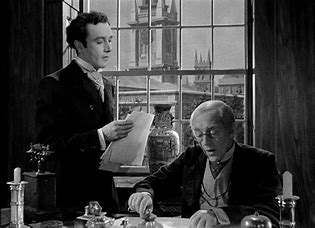
Director Robert Hamer
The PCA demanded cuts when the movie was released in US in 1950. These were measured in seconds rather than minutes, and involved a subtle toning down of immorality and intimations that Louis’ crimes did not go unpunished. The cuts have been fully restored.
Produced by: Michael Balcon and Michael Relph
Production Company: Ealing Studios
US Distributor: Eagle-Lion Films
LGBTQ+ CHARACTER
*Lady Agatha D’Ascoyne (Alec Guinness)
LGBTQ+
DIRECTOR: Robert Hamer
ACTOR: Alec Guinness
ACTOR: Dennis Price
SCREENWRITER: Robert Hamer
COSTUME DESIGNER: Anthony Mendleson
MY FAVORITE BRITISH MOVIE
Kind Hearts and Coronets (1949) is the most delicious confection ever produced by Michael Balcon and Michael Relph’s Ealing Studios, and it remains my favorite British film. Robert Hamer’s exquisitely intelligent, razor‑dry direction—paired with the screenplay he co‑wrote with John Dighton (The Man in the White Suit, Roman Holiday)—flows like dark chocolate over a perfectly constructed sundae.
At its center is the sublimely urbane Dennis Price as Louis Mazzini, a lowly draper’s assistant who discovers he is distantly in line for a dukedom. Enraged by the aristocratic D’Ascoyne family’s cruel treatment of his mother—she eloped with a mere musician—Louis becomes a serial killer of the most elegant variety, systematically eliminating all eight D’Ascoynes who stand between him and the title of Duke of Chalfont, up to and including the sitting 8th Duke, Ethelred.
Alec Guinness, of course, has the time of his life playing all eight D’Ascoynes. In a brief flashback involving the elopement of Louis’s parents, he even appears as a ninth – Duke Ethelred’s the 8th’s father, Ethelred the 7th – giving us three generations and both sexes, each rendered with a sly, affectionate mockery of Edwardian upper‑class professions and pretensions. By the time Louis is employed by the banker Lord Ascoyne D’Ascoyne—the first of his casualties—the banker’s son, Young Ascoyne, has already died in a boating accident.
The names of Louis’s eight victims and their method of dispatch are as follows:
| ESSAY ONE – TABLE 5 85 Queer Films Made Under the Hays Code Alec Guinness plays all nine D’Ascoynes. | |
| The House of D’Ascoyne Chalfont | Cause of Death |
| Ethelred D’Ascoyne, the 8th Duke of Chalfont | Hunting accident |
| The Reverend, Lord Henry D’Ascoyne | Poisoned |
| The General, Lord Rufus D’Ascoyne | Bomb |
| The Admiral, Lord Horatio D’Ascoyne | Goes down with his ship |
| The Banker, Lord Ascoyne D’Ascoyne | Louis’s employer, and final victim, dies of shock on learning that he is the last D’Ascoyne standing. |
| Lady Agatha D’Ascoyne, Ethelred’s sister, a militant lesbian suffragette | Louis shoots down her hot air balloon while she is distributing leaflets over London. Death by blunt force trauma. |
| Young Ascoyne D’Ascoyne, a philanderer | Death by drowning – after Louis tampers with the floodgates |
| Young Henry D’Ascoyne, an amateur photographer and the only good egg in the basket. | Death by Explosion – after Louis tampers with his darkroom chemicals |
Guinness’s virtuosity is dazzling, but Price remains the film’s true star. He is aided immeasurably by his two magnificent leading ladies. Joan Greenwood, with that incomparable plum‑rich voice, is dazzling as Sybella, a minx whose every utterance is simultaneously an aphrodisiac and a condemnation. Valerie Hobson, never better, plays Edith D’Ascoyne—the pure‑hearted widow of Young Henry—whom Louis coolly sets his sights on marrying. And then there is the great Miles Malleson, who steals scenes as the hangman, fretting over how one ought to behave in the presence of a duke.
The screenplay was adapted from Roy Horniman’s 1907 novel Israel Rank: The Autobiography of a Criminal, with its strong antisemitic elements wisely excised. Douglas Slocombe’s black‑and‑white cinematography marks a visual high point for Ealing—crisp, elegant, and perfectly attuned to the film’s tone of genteel savagery.
Kind Hearts and Coronets is a masterpiece of style, irony, and moral mischief—an immaculate blend of charm and cruelty that has never lost its bite.
POINTS OF INTEREST
Both Robert Hamer and Dennis Price suffered from alcoholism, and both of their careers peaked with this movie.
Valerie Hobson found herself in a life-imitating art scenario when she stood by her husband, the disgraced politician John Profumo, during the 1963 scandal.
Leeds Castle in Kent was used as the family home of Chalfont.
The film’s title comes from the antepenultimate stanza of the poem Lady Clara Vere de Vere by Lord Alfred Tennyson, published in 1842: However it be / it seems to me, / ‘Tis only noble to be good. / Kind hearts are more than coronets, / And simple faith than Norman blood,
NOW STREAMING ON AMAZON PRIME VIDEO, APPLE TV+, YOUTUBE
26. Adam’s Rib(1949)
(A)
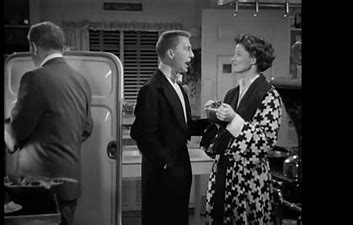
George Cukor
(APPROVED)
LGBTQ+ CHARACTER
*Kip Lurie (David Wayne)
LGBTQ+
DIRECTOR: George Cukor
ACTOR: Spencer Tracy
ACTRESS: Katherine Hepburn
ACTRESS: Hope Emerson
COSTUME DESIGNER: Walter Plunkett
ART-SET DIRECTION: Cedric Gibbons
MY FAVORITE TRACY-HEPBURN MOVIE
Spencer Tracy and Katharine Hepburn—Adam and Amanda Bonner—play married lawyers who find themselves on opposite sides of a sensational case. Doris Attinger (Judy Holliday) has shot her unfaithful husband (Tom Ewell) after catching him with his mistress. What follows is a courtroom duel that becomes a referendum on gender, marriage, and equality. One of the film’s most memorable moments comes when Amanda calls a female weightlifter (Hope Emerson) to the stand and has her hoist Adam into the air, a literal demonstration of female strength. By the end, the Bonners reconcile, acknowledging that equality in law and love is far more complicated than either wanted to admit.
Screenwriters Ruth Gordon and Garson Kanin populate their comedy with a gallery of unforgettable supporting players—Holliday, Emerson, Ewell, Jean Hagen—and, as Amanda’s best friend, David Wayne as Kip Lurie, the Bonners’ next‑door neighbor and a Broadway composer.
Kip is one of the great queer‑coded characters of the Hays Code era. With his closely cropped hair (so fashionable today) and flamboyant manner, he is the constant target of Adam’s barbed put‑downs, such as Adam’s statement that it would not be hard to turn Kip into a woman since he is halfway there already. Yet Kip pursues Amanda with dogged determination, even composing a song for her—“Farewell, Amanda,” written by Cole Porter, no less. Thanks to Wayne’s inspired performance, Kip stands as one of Hollywood’s most memorable gay characters of the period, coded but unmistakable.
The screenplay earned an Oscar nomination for Gordon and Kanin.
There’s also a wonderful bit of Hollywood lore woven into the film’s production. Hepburn, Cukor, Gordon, and Kanin deliberately shaped Judy Holliday’s scenes to showcase her comedic brilliance—essentially turning Adam’s Rib into an audition reel for Harry Cohn, the powerful head of Columbia Pictures. Their gambit worked. Cohn relented and cast Holliday as Billie Dawn in Born Yesterday, the role she originated on Broadway. Two years later, under Cukor’s direction, she won the Academy Award for Best Actress.
CINEMATOGRAPHY: George Folsey
MGM
NOW STREAMING ON AMAZON PRIME VIDEO, APPLE TV+, YOUTUBE
27. All About Eve (1950)
A+
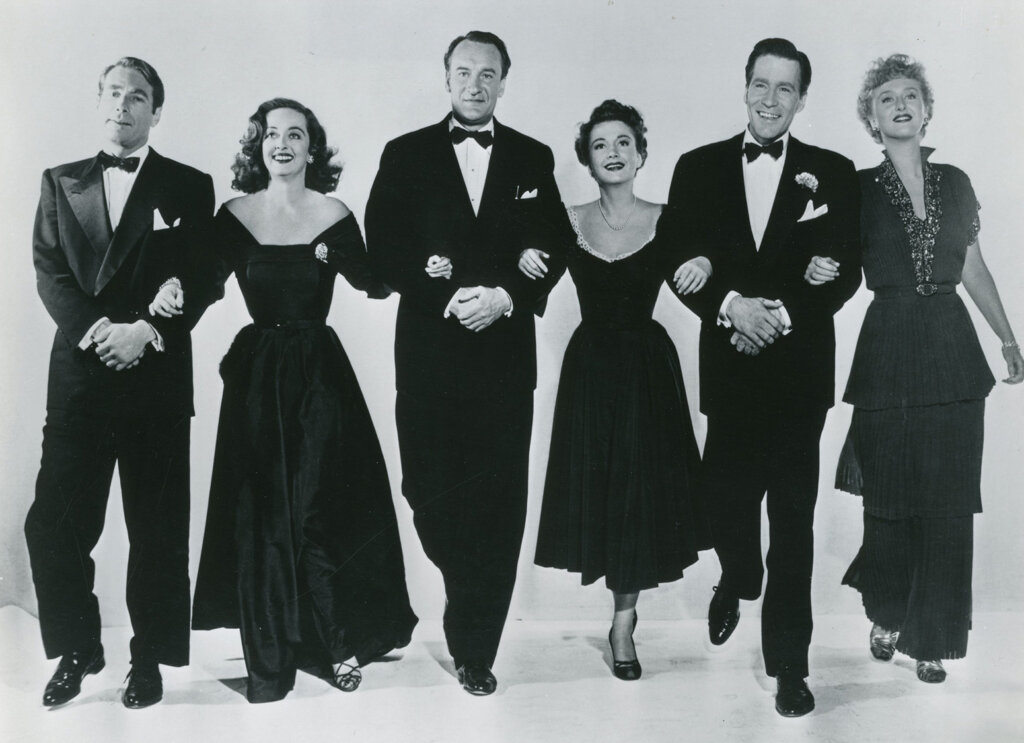
Joseph L. Mankiewicz
(APPROVED)
LGBTQ+ CHARACTERS
*Eve Harrington (Anne Baxter)
*Addison DeWitt (George Saunders)
LGBTQ+
COSTUME DESIGNER: Edith Head
COSTUME DESIGNER: Charles LeMaire
EVERYONE’S FAVORITE BETTE DAVIS MOVIE
Anne Baxter plays the scheming understudy Eve Harrington, while George Sanders plays the influential drama critic Addison DeWitt. Both Eve and Addison are gay, and Addison blackmails Eve, letting her know how much they have in common:
That I should want you at all suddenly strikes me as the height of improbability, but that, in itself, is probably the reason. You’re an improbable person, Eve, and so am I. We have that in common. Also, a contempt for humanity, an inability to love and be loved, insatiable ambition – and talent. We deserve each other…and you realize, and you agree how completely you belong to me?
Addison DeWitt (George Sanders) to Eve Harrington (Anne Baxter) in All About Eve
Director Joseph L. Mankiewicz’s masterpiece is based on one of the greatest screenplays ever written (by Mankiewicz from Mary Orr’s short story The Wisdom of Eve). It highlights the most extraordinary, cherished, quoted, and imitated performance of all time by Hollywood’s most outstanding actress, Bette Davis, as Margo Channing.
One of the best casts ever assembled for a motion picture, Left to Right, as pictured above: Gary Merrill, Bette Davis, George Sanders, Anne Baxter, Hugh Marlowe, and Celeste Holm. Also featured were Thelma Ritter (getting the first of her six best supporting actress nominations), Gregory Ratoff, Barbara Bates, and, making quite an impression in her second major part (after The Asphalt Jungle over at MGM), Marilyn Monroe.
Cinematography by Milton Krasner
TCF
NOW STREAMING ON AMAZON PRIME VIDEO, APPLE TV+, YOUTUBE
28. Caged (1950)
C-
John Cromwell
(APPROVED)
LGBTQ+ CHARACTERS
*Evelyn Harper, the sadistic matron (Hope Emerson)
*Kitty Stark, the murderous shoplifter (Betty Garde)
*Ruth Benton, the reformist prison superintendent (Agnes Moorhead)
LGBTQ+
ACTRESS: Hope Emerson
ACTRESS: Agnes Moorehead
Hype the New Fish
Betty Garde, on seeing Eleanor Parker for the first time
Marie Allen, a naïve 19‑year‑old newlywed (Eleanor Parker), enters prison after serving as an unwitting accessory to robbery. What begins as a brief sentence becomes a brutal education: the system grinds her down, corrupt guards exploit her vulnerability, and fellow inmates teach her the hard pragmatism required to survive. By the end, the innocent girl who walked in has been reshaped into a wary, cynical convict—proof that the institution destroys far more effectively than it rehabilitates.
As Hollywood’s first major women‑in‑prison drama, John Cromwell’s Caged lays out the genre’s foundational – read lesbian – archetypes. Hope Emerson embodies the sadistic, physically imposing matron; Agnes Moorehead offers the counterweight as the reform‑minded warden fighting a losing battle against bureaucracy; and Betty Garde provides the seasoned inmate whose hard‑won wisdom becomes Marie’s only lifeline. The film’s intentions are earnest, but like many social‑problem pictures of the era, its message‑movie sincerity and coded depictions of sexuality have not aged gracefully.
The screenplay by Virginia Kellogg and Bernard C. Schoenfeld, based on their own story, was grounded in Kellogg’s firsthand research inside women’s prisons. The Academy recognized the film’s impact with Oscar nominations for both Parker and Emerson.
Cinematography: Carl E. Guthrie
Warner Bros.
NOW STREAMING ON AMAZON PRIME VIDEO, APPLE TV+, YOUTUBE
29. Young Man with a Horn (1950)
(B)
Michael Curtiz
(APPROVED)
LGBTQ+ CHARACTERS
*Amy North (Lauren Bacall)
*Miss Carson (Katherine Kurasch, uncredited)
LGBTQ+
COSTUME DESIGNER: Milo Anderson
A LESBIAN COUPLE OUTWITS THE HAYS OFFICE
Like Mildred Pierce, this is another Michael Curtiz film that plays beautifully on two levels: earnest melodrama on the surface, high camp simmering underneath. Lauren Bacall is Amy North, the brittle society wife of Kirk Douglas’s tormented trumpeter—a woman whose icy glamour barely conceals the fact that she is a closeted lesbian. But not for long. One evening, she sweeps into their apartment with a stunning “date,” Miss Carson (Katherine Kurasch, uncredited), an elegant artist whose work Amy has clearly been studying with more than casual interest. When Bacall introduces her with the line,“This is my husband, Miss Carson—I told you about her,” the blocking and vocal inflection make it unmistakable: Miss Carson is the real partner in Amy’s life, not Douglas.
Douglas’s character finally snaps. With that trademark jaw tension only he could muster, he delivers the immortal diagnosis: You’re a sick girl, Amy. Having done his heterosexual duty, he flees into the arms of a wholesome, Warner Bros.–era Doris Day, presumably to live happily ever after—as straight characters always do once they escape the gravitational pull of a queer partner in mid‑century Hollywood (and, as The Fox later proved, in Canada as well).
Douglas’s role is loosely inspired by the tragic jazz legend Bix Beiderbecke, and the film itself is adapted from the novel by Dorothy Baker.
With the great Hoagy Carmichael on piano.
Cinematography: Ted McCord
Warner Bros.
NOW STREAMING ON AMAZON PRIME VIDEO AND ON APPLE TV+
30. In a Lonely Place (1950)
A-

Nicholas Ray
(APPROVED)
LGBTQ+ CHARACTER
*Mel Lippman (Art Smith)
*Martha, Laurel’s masseuse (Ruth Gillette, uncredited)
LGBTQ+
DIRECTOR: Nicholas Ray
COSTUME DESIGNER: Jean Louis
In a Lonely Place is one of two masterworks – the other is Rebel Without a Cause – that gay director Nicholas Ray crafted in the first half of the 1950s, and both films bear the unmistakable imprint of a queer sensibility. Each uses the noir framework to probe the social codes and moral pressures that hem in their characters, forcing them into choices shaped less by desire than by the rigid expectations of the world around them. The film is also remarkable for its setting: a cluster of people living in a 1923 Spanish‑Revival apartment complex in West Hollywood—still standing today—known in the film as the Beverly Patio Apartments on North Harper Avenue.
VILLA PRIMVERA
(FICTIONALIZED NAME: BEVERLY PATIO APARTMENTS)
1300-1308 NORTH HARPER AVENUE
WEST HOLLYWOOD, CA 90046
Among its residents:
- Dixon Steele (Humphrey Bogart), a once‑promising screenwriter whose career has stalled. Known for his temper, cynicism, and refusal to play the studio game, he invites a young hat‑check girl, Mildred Atkinson (Martha Stewart), home to summarize a novel he’s meant to adapt. She leaves alive—but is found murdered the next morning. Dix becomes the prime suspect.
- Laurel Gray (Gloria Grahame), Dix’s neighbor, provides him with an alibi. She’s glamorous, self‑possessed, and emotionally bruised from past relationships—a woman who has spent her life protecting men, not loving them.
- Mel Lippman (Art Smith), Dix’s loyal, long‑suffering agent, is queer‑coded through his gentleness, emotional caretaking, and unwavering devotion to a self‑destructive client.
- Martha (Ruth Gillette), Laurel’s masseuse, is also clearly queer‑coded—hyper‑protective of Laurel, and in one memorable massage scene whispering “Relax” in an intimate, undulating tone that signals a closeness outside the film’s heterosexual frame. Gillette is uncredited.
Laurel’s testimony clears Dix, and the two fall into a passionate, almost reckless romance. On the surface, they are lovers; underneath, Dix is a man incapable of performing stable heterosexual masculinity while Laurel slips once again into the role of caretaker. Bogart is superb, but it is Gloria Grahame who is the revelation – this is widely considered to be the finest performance of her career and she is sensational. As Laurel, she brings a weary, deeply nuanced vulnerability that perfectly balances Bogart’s aggressive volatility. She moves through the film with bruised intelligence—alert, perceptive, and increasingly aware that the man she is falling for may be someone she will one day have to flee.
There is a gorgeous moment in a nightclub when Dix and Laurel are sitting at a piano. Hadda Brooks is at the keyboard singing the Ray Noble classic I Hadn’t Anyone ‘Till I Met You. It’s the last time that they are truly happy together – before she sees his violent side – and the scene haunts you well after the movie has ended.
Gloria Grahame and Nicholas Ray were married from 1948 to 1952, and their marriage was faltering during the making of this movie. Many, including myself, think that the two relationships mirrored one another. Grahame later married Ray’s son, Anthony, in 1960. They divorced in 1974. She passed away in 1981 from breast cancer. She was 57.
The film’s haunting score is by George Johann Carl Antheil an American avant-garde composer, pianist, author, and inventor whose modernist musical compositions explored the sounds – musical, industrial, and mechanical – of the early 20th century. In 1941, Antheil and the actress Hedy Lamarr developed a radio guidance system for Allied torpedoes that used a code (stored on a punched paper tape) to synchronize frequency changes, referred to as frequency hopping, between the transmitter and receiver. It is one of the spread spectrum techniques that became widely used in modern telecommunications. This work led to their induction into the National Inventors Hall of Fame in 2014. He is mentioned in F. Scott Fitzgerald’s Tender is the Night. He died of a heart attack in 1959. He was 58.
One of the essential movies of the 1950s.
Screenplay by Andrew P. Solt and Edmund H. North from the novel by Dorothy B. Hughes
Cinematography: Burnett Guffey
Columbia Pictures
Streaming on Apple TV+, Amazon Prime and YouTube.
31. A Streetcar Named Desire (1951)
A+
Elia Kazan
(APPROVED)
LGBTQ+ CHARACTER
*The Boy, Blanche’s late husband, a suicide.
LGBTQ+
ACTOR: Marlon Brando
SCREENWRITER: Tennessee Williams
SOURCE MATERIAL: Tennessee Williams (adapted from his play A Streetcar Named Desire)
ART-SET DIRECTOR: George James Hopkins
HOLLYWOOD’S BEST STAGE TO SCREEN ADAPTATION
TWO OF THE GREATEST PERFORMANCES IN MOVIE HISTORY
A Streetcar Named Desire (1951), directed by Elia Kazan and adapted from Tennessee Williams’ Pulitzer Prize-winning play, tells the story of Blanche DuBois, a fading Southern belle who moves in with her sister, Stella, and her brutish brother-in-law, Stanley Kowalski, in New Orleans. Blanche’s fragile illusions clash with Stanley’s raw vitality, leading to psychological breakdown and tragedy.
Arguably, the best play-to-film adaptation of all time, with two outstanding performances: Vivien Leigh as Blanche and Marlon Brando as Stanley. In two of her terrific monologues, Blanche reveals that the boy she married was gay and killed himself:
But I was unlucky. Deluded. There was something about the boy. A nervousness, a tenderness……an uncertainty. And I didn’t understand. I didn’t understand why this boy, who wrote poetry…. didn’t seem able to do anything else. He lost every job. He came to me for help. I didn’t know that. I didn’t know anything…. except that I loved him…. unendurably. At night I pretended to sleep. I heard him crying. Crying the way a lost child cries.
Blanche DuBois (VIVIEN LEIGH): A Streetcar Named Desire.
I killed him. One night…..we drove out to a place called Moon Lake Casino. We danced the Varsouviana. Suddenly, in the middle of the dance, the boy I married broke away from me…..and ran out of the casino. A few minutes later…..a shot. I ran. All did. All ran and gathered about the terrible thing at the edge of the lake. He’d stuck a revolver into his mouth…..and fired. It was because…..on the dance floor…..unable to stop myself, I’d said: “You’re weak. I’ve lost respect for you. I despise you.” And then…..the searchlight which had been turned on the world….was turned off again. And never…..for one moment since, has there been any light stronger than…Than this…..yellow lantern.
Blanche DuBois (VIVIEN LEIGH): A Streetcar Named Desire.
Cinematography: Harry Stradling
Warner Bros.
NOW STREAMING ON AMAZON PRIME VIDEO, APPLE TV+, YOUTUBE
32. Strangers on a Train (1951)
A-
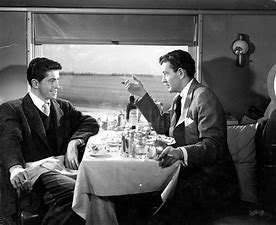
Alfred Hitchcock
(APPROVED)
LGBTQ+ CHARACTER
*Bruno Antony (Robert Walker)
LGBTQ+
ACTOR: Farley Granger
SOURCE MATERIAL: Patricia Highsmith (based on her novel “Strangers on a Train”)
ART–SET DIRECTOR: George James Hopkins
HITCHCOCK TACKLES HIGHSMITH
Hitchcock reverses his usual casting dynamics here: gay actor Farley Granger plays the straight man, while straight actor Robert Walker gives one of cinema’s great queer‑coded performances. Unfortunately, Granger’s character finds his happy ending in the arms of the not‑so‑electrifying Ruth Roman, who—along with Anne Baxter in I Confess—was reportedly among Hitchcock’s least favorite actresses. Walker died at thirty‑two, only weeks after the film’s release, making his performance all the more haunting.
The plot is classic Highsmith perversity. Architect and tennis star Guy Haines (Granger) wants to divorce his unfaithful wife, Miriam (Kasey Rogers), so he can marry Anne Faulkner (Roman). On a train to meet Miriam, he encounters Charles Bruno (Walker), a charming sociopath who proposes a “perfect” exchange of murders: Bruno will kill Miriam if Guy kills Bruno’s father. Guy laughs it off, but Bruno follows through, strangling Miriam while Guy is in Mexico. From that moment on, Bruno expects Guy to complete the pact.
The source material comes from Patricia Highsmith, a gay writer whose fascination with queer sociopathy would later crystallize in her five Tom Ripley novels. Ripley has been adapted repeatedly—René Clément’s Purple Noon (1960) with Alain Delon, Anthony Minghella’s The Talented Mr. Ripley (1999) with Matt Damon, and most recently the superb black‑and‑white Netflix limited series written and directed by Steve Zaillian and starring Andrew Scott.
Strangers on a Train was a major hit, ending Hitchcock’s brief slump after Under Capricorn (1949) and Stage Fright (1950). It contains some of his most indelible sequences—the tennis match, the lighter in the drain, the deranged carousel climax. Walker is extraordinary, proving—as he had in the gentle, romantic The Clock (1945) opposite Judy Garland—that he was capable of remarkable range. His death remains one of Hollywood’s great losses. Marion Lorne steals her single scene as Bruno’s mother, matching her son’s eccentricity beat for beat. And Patricia Hitchcock, in her most substantial film role, is lively and appealing as Roman’s younger sister.
Granger is competent, but unlike in Rope, where his sensitivity and tension are perfectly used, here he never quite convinces as a straight leading man. That absence of star wattage weakens the film’s emotional stakes. For all its brilliance—and it has brilliance to spare—Strangers on a Train does not make the cut for Hitchcock’s seven perfect films.
Cinematography: Robert Burks
This would be the first of 12 movies in which Robert Burks and Alfred Hitchcock collaborated, including Burks’ Oscar-winning film, To Catch a Thief (1955). Their partnership from 1951 to 1964 ranks among the most significant director-cinematographer collaborations in Hollywood history, paralleling Hitchcock’s close relationships with his gifted composer, Bernard Herrmann (eight movies from 1955 to 1964), and his skilled editor, George Tomasini (nine movies from 1954 to 1964). Only Hitchcock’s professional relationship with his wife, screenwriter Alma Reville, lasted longer (nineteen films from 1926 to 1953).
Warner Bros.
Hitchcock’s cameos:
Cameo one: 0:02:22 – He’s on the book’s cover that Farley Granger is reading. Cameo two: 0:10:34 – He’s seen boarding a train with a double bass as Farley Granger gets off in his hometown. The double bass is no accident since Hitchcock fills the movie with doubles and criss-crosses.
The criss-cross plot of I’ll Kill Yours if You Kill Mine was used again by director Danny DeVito in “Throw Mama from a Train” (1987).
NOW STREAMING ON AMAZON PRIME VIDEO, APPLE TV+, YOUTUBE
33. Gentlemen Prefer Blondes (1953)
B+
Howard Hawks
(APPROVED)
LGBTQ+ CHARACTERS
*The Boys in the Gym.
LGBTQ+
CHOREOGRAPHER: Jack Cole
COSTUME DESIGNER: William Travilla
Gentlemen Prefer Blondes (1953) pairs Marilyn Monroe and Jane Russell at their most irresistible as two showgirls en route to Paris. Lorelei Lee (Monroe) is engaged to a wealthy mama’s boy whose father sends a detective to expose her, while Dorothy Shaw (Russell) happily collects admirers wherever she goes. Romance, comedy, and musical spectacle blend effortlessly, but the film’s queer sensibility is what gives it its lasting sparkle.
In one of the film’s most deliciously coded numbers, Russell belts out Ain’t There Anyone Here for Love? while surrounded by a gym full of hyper‑sculpted men who are far more interested in flexing for each other than noticing her. Russell pretends not to understand why she’s invisible, but the performance gives us the unmistakable wink‑wink: she understands perfectly. Meanwhile, Monroe is busy pursuing a different kind of treasure—diamonds—leading to the film’s showstopper, “Diamonds Are a Girl’s Best Friend,” one of the most iconic musical sequences ever put on film.
As with Gilda and its legendary numbers “Put the Blame on Mame” and “Amado Mio,” an essential ingredient in the magic of Gentlemen Prefer Blondes is Jack Cole’s choreography, which gives the film its sleek, modern, unmistakably queer physical vocabulary.
Adapted from the play by Anita Loos and Joseph Fields, and from the Broadway musical by Jule Styne and Leo Robin, the film remains one of Howard Hawks’s most stylish and subversively playful achievements.
Cinematography: Harry J. Wild
TCF
NOW STREAMING ON AMAZON PRIME VIDEO, APPLE TV+, YOUTUBE
34. Calamity Jane (1953)
(B)
David Butler
(APPROVED)
LGBTQ+ CHARACTER
*Calamity Jane (Doris Day)
LGBTQ+
COSTUME DESIGNER: Howard Shoup
BEST QUEER SONG IN A MOVIE
“MY SECRET LOVE”
(Music Sammy Fain, Lyrics Paul Francis Webster)
Calamity Jane is a Technicolor Western musical starring Doris Day as the legendary frontierswoman and Howard Keel as Wild Bill Hickok. Set in Deadwood, Dakota Territory, the film blends comedy, romance, and song as Jane’s brash, buckskin‑clad persona collides with her emerging vulnerability, culminating in her discovery of love and a hard‑won sense of self.
Doris Day was always more delightful in her tomboy Warner Bros. roles than in the “professional virgin” parts Universal later saddled her with. As Calamity Jane, she reaches the apex of her queer energy: cropped hair, swaggering gait, buckskins, and a readiness to draw a gun on anyone who mocks her. She may be in love with Howard Keel’s Wild Bill, but she has no intention of surrendering her gender‑bending freedom. That inner conflict—between the persona she’s built and the feelings she can no longer deny—erupts in one of the most emotionally direct musical moments in Hollywood history. Day’s soaring performance of the Sammy Fain–Paul Francis Webster classic “Secret Love” becomes a full‑throated cri de cœur, instantly recognizable to anyone who has ever lived with a truth they weren’t yet allowed to speak.
Original screenplay by James O’Hanlon.
Cinematography by Wilfrid M. Cline
Warner Bros.
NOW SCREENING ON AMAZON PRIME VIDEO, APPLE TV, YOUTUBE
35. I Vitelloni (1953)
A-

Federico Fellini
(SUBMITTED: APPROVED WITHOUT CUTS)
LGBTQ+ CHARACTER
*Sergio Natali (Achille Majeroni)
Federico Fellini’s I Vitelloni follows five young men in their early twenties—Moraldo (Franco Interlenghi), Alberto (Alberto Sordi), Fausto (Franco Fabrizi), Leopoldo (Leopoldo Trieste), and Riccardo (Riccardo Fellini, the director’s brother)—as they drift aimlessly through life in a provincial seaside town, suspended somewhere between adolescence and adulthood.
This was Fellini’s third feature as a director, made after his screenwriting collaborations with Rossellini and just before his international breakthrough with La Strada. The film blends neorealist observation with a wistful, autobiographical tone, all buoyed by a lush Nino Rota score. Like Fellini’s later memory films, it evokes a vivid sense of place—clearly inspired by his Rimini childhood, even though it wasn’t shot there.
One of the film’s most striking moments involves an aging stage actor (Achille Majeroni) who makes a tentative advance on Leopoldo during a stormy night by the beach. Often cited as one of the earliest depictions of a gay character in Italian cinema, the scene is subtle but historically significant, especially within the constraints of early‑1950s Italian filmmaking.
Franco Fabrizi takes acting honors as the newly married and shockingly unfaithful Fausto; Alberto Sordi contributes a memorable pre–Some Like It Hot tango in drag; and Franco Interlenghi’s brooding Moraldo—serving as the film’s moral center and narrator—leaves a lasting impression.
The title I Vitelloni comes from a regional Italian slang term meaning “overgrown calves,” used metaphorically to describe idle, immature young men who refuse to grow up. Fellini knew the Romagnol expression from his youth, and it perfectly captures the film’s blend of affection and exasperation toward its drifting protagonists.
I Vitelloni went on to become one of Fellini’s most influential works. Its portrait of restless young men shaped later films such as Scorsese’s Mean Streets (1973), George Lucas’s American Graffiti (1973), Philip Kaufman’s The Wanderers (1979), and Joel Schumacher’s St. Elmo’s Fire (1985). Barry Levinson’s Diner (1982) shares its spirit as well, though Levinson has said he hadn’t seen Fellini’s film before making it.
In 1963, Stanley Kubrick listed I Vitelloni among his ten favorite films—a testament to its enduring impact.
Oscar nomination for Best Original Screenplay.
Cinematography: Otello Martelli
Janus Films
Now Streaming on Apple TV+, Amazon Prime Video and HBO Max.
36. Johnny Guitar (1954)
(B)
Nicholas Ray
(APPROVED)
LGBTQ+ CHARACTERS
*Vienna (Joan Crawford)
*Emma Small (Mercedes McCambridge)
LGBTQ+
DIRECTOR: Nicholas Ray
A LESBIAN DUEL IN THE SUN!
On the outskirts of a wind‑swept Arizona cattle town, Vienna (Joan Crawford)—an aggressive, strong‑willed saloonkeeper—maintains a precarious hold on power. She supports the coming railroad, which the local cattlemen fiercely oppose, and she allows The Dancin’ Kid (Scott Brady), her former lover, and his gang to frequent her establishment. The townsfolk, led by the rigid John McIvers (Ward Bond) and inflamed by Emma Small (Mercedes McCambridge), Vienna’s rival for the Dancin’ Kid’s affections, are determined to drive her out. Vienna stands her ground, aided by the mysterious Johnny Guitar (Sterling Hayden), a drifter with a past and a guitar who arrives for a scheduled meeting with her. McIvers gives Vienna, Johnny, the Dancin’ Kid, and his men twenty‑four hours to leave town. A showdown is inevitable—but this time, the real duel is between Vienna and Emma, the first all‑female gunfight in the history of the Western.
The result is high camp on the range, powered by two of Hollywood’s most volcanic performers. A Western with two female leads is a rarity; a Western in which the emotional and moral stakes hinge on their rivalry is practically unheard of. Crawford and McCambridge play to the gallery under Nicholas Ray’s stylized, almost operatic direction, making the film essential viewing within queer cinema, the Western genre, and the Ray canon.
Johnny Guitar was adapted from Roy Chanslor’s novel by Philip Yordan, who served as a front for the blacklisted poet and screenwriter Ben Maddow. Maddow had adapted Intruder in the Dust and The Asphalt Jungle (earning an Oscar nomination) before being declared persona non grata in Hollywood for his left‑wing affiliations.
A critical and commercial disappointment in America, the film was embraced in Europe, most notably by the young French critics Jean‑Luc Godard and François Truffaut in Cahiers du Cinéma. Its reputation has only grown since. In his 1988 film Women on the Verge of a Nervous Breakdown, gay Spanish director Pedro Almodóvar paid explicit homage to Johnny Guitar in the scene where Pepa (Carmen Maura), a voice artist, dubs Crawford’s Vienna into Spanish—a perfect tribute to one of cinema’s great camp operas.
Cinematography: Harry Stradling
Republic Pictures
NOW STREAMING ON AMAZON PRIME VIDEO, APPLE TV+, YOUTUBE
37. Rebel Without a Cause (1955)
A+
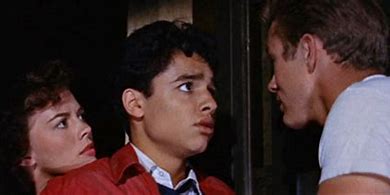
Nicholas Ray
(APPROVED)
LGBTQ+ CHARACTER
*Plato (Sal Mineo)
LGBTQ+
DIRECTOR: Nicholas Ray
ACTOR: James Dean
ACTOR: Sal Mineo
ACTOR: Nick Adams
COSTUME DESIGNER: Moss Mabry
Sal Mineo’s Plato is Hollywood’s first adolescent gay character.
ONE OF THE QUINTESSENTIAL LA MOVIES.
Rebel Without a Cause (1955), directed by Nicholas Ray and starring James Dean, is a landmark of American cinema and a definitive portrait of teenage alienation. Dean’s Jim Stark—new in town, angry, tender, and searching—forms an improvised family with Judy (Natalie Wood, in her first adult role) and Plato (Sal Mineo), two equally lost souls. Over the course of a single, turbulent night, the trio navigates desire, violence, and the desperate need to belong, ending in tragedy beneath the shadow of the Griffith Park Observatory.
Wood, Dean, and Mineo form a fragile nuclear family, with Mineo’s Plato standing as Hollywood’s first adolescent gay character—coded, heartbreaking, and unmistakable. Dean gives his most emblematic performance under Ray’s soaring, expressionistic direction. Jim Backus and Ann Doran play his bewildered parents; William Hopper is Judy’s rigid father; and future Oscar nominees Dennis Hopper and Nick Adams appear among the gang at the infamous “Chicken Run.”
The film’s widescreen color cinematography is by the great Ernest Haller (Gone with the Wind, Mildred Pierce, Whatever Happened to Baby Jane?), whose saturated palette turns Los Angeles into a mythic emotional landscape. The original score is by Leonard Rosenman, who also scored Dean’s other 1955 film, Elia Kazan’s East of Eden—together, the two scores essentially “invent” the James Dean sound.
The script by Stuart Stern was based on an original treatment by Irving Shulman, with story concepts developed by Shulman and Ray. The result is one of the quintessential Los Angeles movies: a fever dream of mid‑century youth culture, queer longing, and emotional volatility that still feels startlingly modern.
Warner Bros.
NOW STREAMING ON AMAZON PRIME VIDEO, APPLE TV+, YOUTUBE
38. The Big Combo (1955)
B-
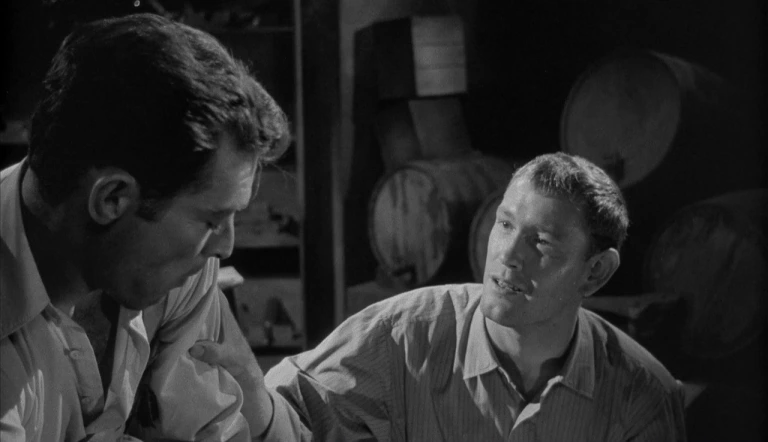
Joseph H. Lewis
(NEGOTIATIONS DURING PRODUCTION – THE FINAL VERSION SUBMITTED BY ALLIED ARTISTS WAS APPROVED)
The PCA raised objections to several scenes in the movie involving brutality and violence. Ultimately, however, Fante and Mingo outwitted the Hays Office.
LGBTQ+ CHARACTERS
*Fante (Lee Van Cleef)
*Mingo (Earl Holliman)
LGBTQ+
ACTOR: Earl Holliman
The cops will be looking for us in every closet.
Fante (LEE VAN CLEEF) to Mingo (EARL HOLLIMAN) in The Big Combo
Lt. Leonard Diamond (Cornel Wilde) has spent years trying to bring down crime boss Mr. Brown (Richard Conte), but he lacks the evidence to make anything stick. His superiors order him off the case, yet Diamond persists, driven by equal parts justice and personal obsession. Brown rules through calculated brutality, aided by his two henchmen, Fante and Mingo—played by Lee Van Cleef and Earl Holliman.
Fante and Mingo are unmistakably a gay couple. Everyone on screen seems to know it, and no one questions it. They share a bedroom (separate beds, of course), move as a unit, and radiate a mutual devotion that somehow slipped past the Hays Office. Their chosen profession only heightens their fascination—and, frankly, their sex appeal. It remains one of the most daring queer representations in 1950s American cinema.
Arguably Joseph H. Lewis’s greatest film and a cornerstone of classic noir, The Big Combo is also a showcase for John Alton’s extraordinary black‑and‑white cinematography—those sculpted shadows, those shafts of light, that unforgettable torture scene. Conte, Wilde, and Jean Wallace (Wilde’s wife at the time) all deliver strong performances, as does Brian Donlevy. The film also marks the final screen appearance of Helen Walker, so memorable opposite Tyrone Power in Edmund Goulding’s Nightmare Alley. David Raksin provides the moody, memorable score.
The screenplay is by Philip Yordan.
The title refers to the crime syndicate run by Mr. Brown—his “big combo,” the machine Diamond is determined to dismantle.
Allied Artists
NOW STREAMING ON AMAZON PRIME VIDEO, APPLE TV+, YOUTUBE
39. Les Diaboliques (1955)
A-
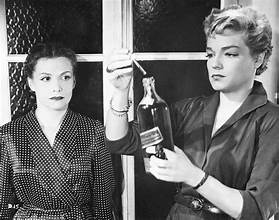
Henri-Georges Clouzot
The film was NOT submitted to the Hays Office and was distributed by UMPO WITHOUT a seal of approval.
LGBTQ+ CHARACTERS
*Nicole (Simone Signoret)
*Christina (Véra Clouzot)
At a second‑rate boys’ boarding school outside Paris, the tyrannical Michel Delassalle(Paul Meurisse) rules through cruelty and humiliation. The school itself belongs to his wife, Christina (Véra Clouzot, the director’s wife), a frail, devout Catholic émigrée from Venezuela who teaches Spanish and suffers from a chronic heart condition. Michel mocks her illness, mistreats the students, and openly carries on an affair with Nicole Horner (Simone Signoret), another teacher he also abuses. Yet rather than hostility, Christina and Nicole share a wary, intimate bond—rooted in their mutual hatred of Michel and, as the film strongly suggests, something deeper.
Unable to endure Michel’s brutality any longer, Nicole devises a plan to murder him. Christina, terrified but desperate, eventually agrees. Luring Michel to Nicole’s apartment with the threat of divorce, Christina drugs him, and together the women drown him in a bathtub. They hide the body in a trunk, transport it back to the school, and dump it in the unused swimming pool, expecting it to surface and suggest an accident. But when the pool is drained, the corpse has vanished. From that moment on, the film becomes a masterclass in dread.
Co‑written and directed by Henri‑Georges Clouzot, Les Diaboliques (released in the U.S. as Diabolique) won Best Foreign Film from both the New York Film Critics Circle and the National Board of Review, and by late 1956 had become the highest‑grossing French film ever released in the United States. It is also one of the most successful queer films of all time: though coded, the emotional and psychological intimacy between Christina and Nicole is unmistakable.
Based on the 1952 novel The One Who Was No More by Pierre Boileau and Thomas Narcejac, the film famously slipped out of Alfred Hitchcock’s grasp—Clouzot optioned the rights just hours before Hitchcock tried to buy them. Ironically, the film helped inspire Psycho (1960); novelist Robert Bloch called Les Diaboliques his all‑time favorite horror film. And Hitchcock’s Vertigo (1958) would later be adapted from another Boileau‑Narcejac novel.
Les Diaboliques remains a landmark of psychological horror, celebrated for its atmosphere, its audacious twist ending (no spoilers here), and its enduring influence on the genre—and on queer cinema.
With Charles Vanel as the detective.
Cinematography: Armand Thirard.
Cinédis in Europe
UMPO (United Motion Picture Organization) in the US
Now streaming on Apple TV+, Amazon Prime Video, HBO Max and The Criterion Collection.
40. Written on the Wind (1956)
A-
Douglas Sirk
(APPROVED)
LGBTQ+ CHARACTER
*Kyle Hadley (Robert Stack)
LGBTQ+
ACTOR: Rock Hudson
COSTUME DESIGNER: Bill Thomas
Douglas Sirk’s Written on the Wind is a lush, fever‑bright melodrama about a Texas oil dynasty rotting from within. The Hadley family—wealthy, powerful, and emotionally stunted—spirals toward collapse as old resentments and forbidden desires collide.
At the center is Kyle Hadley (Robert Stack), a self‑destructive alcoholic terrified of his own inadequacy, and his sister Marylee (Oscar‑winner Dorothy Malone), a restless, sexually frustrated wild child whose longing curdles into spite. Kyle’s deepest emotional attachment is to his childhood friend Mitch Wayne (Rock Hudson), not to his elegant new wife Lucy Moore (Lauren Bacall). Convinced that Lucy is secretly in love with Mitch—and tormented by the discovery of his low sperm count—Kyle unravels. Meanwhile, Marylee’s obsession with Mitch intensifies, pushing the siblings toward a tragic, operatic showdown.
Sirk elevates the melodrama into something mythic: blazing Technicolor courtesy of cinematographer Russell Metty, symbolic décor that mirrors the characters’ inner storms, and performances pitched at the edge of hysteria. Beneath the glamour lies a razor‑sharp critique of American wealth, repression, and the emotional bankruptcy of privilege. The result is one of Hollywood’s great melodramas—baroque, psychologically acute, and unforgettable in its final, iconic images.
Robert Stack received his only Oscar nomination for this role.
Adapted from the novel by Robert Wilder.
Universal
Now streaming on AMAZON PRIME VIDEO
41. The Bad Seed (1956)
B+
Nature brought her here, and nature took her away!
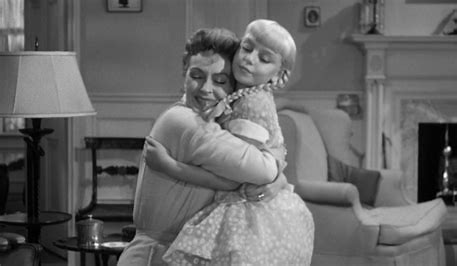
Mervyn LeRoy
LANDMARK
(APPROVED: BUT WITH A NEW ENDING!)
RHODA HAD TO BE PUNISHED FOR HER ACTIONS
LGBTQ+ CHARACTER
*Little Claude Daigle is killed off-camera as the film begins.
LGBTQ+
COSTUME DESIGNER: Moss Mabry
DIRECTOR MERVYN LEROY’S HIGH WIRE ACT
When Mervyn LeRoy first saw Maxwell Anderson’s play The Bad Seed, he instructed screenwriter John Lee Mahin to adapt it with minimal changes. His main task became toning down the performances—no small feat, given that the central character is Rhoda Penmark, a little girl in a pinafore dress and blonde pigtails who embodies pure, unblinking evil.
LeRoy brought most of the Broadway cast to the screen intact: Nancy Kelly (Oscar‑nominated for Best Actress) as Christine Penmark, the mother slowly unraveling as she realizes the truth about her daughter; Patty McCormack (Best Supporting Actress nominee) as Rhoda, the eight‑year‑old sociopath who murders her classmate Claude Daigle for winning the penmanship medal she believes is rightfully hers; William Hopper as Col. Kenneth Penmark, Rhoda’s father, conveniently away for most of the film; Eileen Heckart (Best Supporting Actress nominee) as Hortense Daigle, Claude’s grief‑stricken, alcohol‑soaked mother; Frank Cady as Henry Daigle; Henry Jones as Leroy Jessup, the caretaker who knows too much; Evelyn Varden as Monica Breedlove, the neighbor who spoils Rhoda; and Paul Fix as Christine’s father and Rhoda’s grandfather. The film preserves the play’s theatrical intensity, for better and for campier.
In many ways, The Bad Seed is a quintessential gay‑movie experience. It runs cartwheels around every definition of camp outlined by Susan Sontag. The film is a high‑wire act for both director and actors, and Nancy Kelly is ON from the first frame to the last—straddling the twin minefields of camp and drama and somehow managing to deliver both simultaneously. Her performance directly influenced later genre classics such as Robert Aldrich’s Whatever Happened to Baby Jane? and Brian De Palma’s Carrie.
And then there is Patty McCormack, whose sweet‑as‑pie killer has given the queer lexicon immortal lines like Give me those shoes—they’re mine.
How do we know that Little Claude Daigle was gay?
- He won a medal for best penmanship.
- He let a girl beat him up.
- He let a girl beat him up a second time.
Two performances, however, play as straight drama: Eileen Heckart, heartbreaking in both of her big scenes as the dead boy’s mother, and Henry Jones, quietly devastating as the simple caretaker who knows Rhoda’s secret and pays dearly for it. Jones’s character was later lifted almost wholesale and transported to Seattle in the form of Ernie Hudson’s role in The Hand That Rocks the Cradle
THE HAYS CODE AT WORK
The Bad Seed is a clear example of the enduring power of the Hays Code in 1956, resulting in a change in the movie’s ending compared to the stage play.
Stage Play Ending (1954)
- Written by Maxwell Anderson, adapted from William March’s novel.
- Christine learns her biological mother was a serial killer, fueling her fear that Rhoda inherited murderous tendencies.
- In the climax, Christine attempts a murder-suicide, giving Rhoda sleeping pills and then shooting herself.
- Christine dies, but Rhoda survives because Monica Breedlove hears the gunshot and intervenes.
- The play ends with Rhoda unpunished, her father returning home unaware of her crimes.
Film Ending (1956)
- Hollywood censors (the Hays Code) required that evil must be punished.
- Christine attempts suicide but survives.
- Rhoda sneaks out during a thunderstorm to retrieve incriminating evidence (the medal she stole from Claude Daigle).
- Rhoda is struck by lightning and killed, a supernatural punishment imposed to satisfy moral guidelines.
- The film closes with a theatrical curtain-call sequence, even including a comic moment where Nancy Kelly (Christine) spanks Patty McCormack (Rhoda) to soften the tone.
Cinematography: Harold Rosson
Warner Bros.
NOW STREAMING ON AMAZON PRIME VIDEO, APPLE TV+, YOUTUBE
42. Tea and Sympathy (1956)
A-
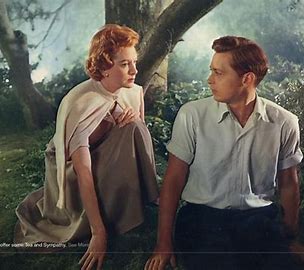
Vincente Minnelli
(APPROVED)
LGBTQ+ CHARACTERS
*Tom Robertson Lee (John Kerr)
*Bill Reynolds (Leif Erickson)
LGBTQ+ DIRECTOR
Vincente Minnelli
“One day, when you talk about this, and you will, be kind.”
Laura Reynolds (Deborah Kerr) in “Tea and Symphony”.
Both John Kerr and Deborah Kerr reprised the roles they created on the Broadway Stage.
Tom Robinson Lee (John Kerr), a sensitive young man at a boys’ prep school, is bullied for failing to conform to the rigid masculine norms of his environment. The only person who shows him genuine compassion is Laura Reynolds (Deborah Kerr), the coach’s wife, whose sympathy gradually blurs into intimacy. Their connection exposes the film’s central tensions around gender expectations, sexuality, and the human need for tenderness.
The contemporary consensus is that even if Laura—presiding over a household of college boys—manages to “save” Tom from his sensitive (read: homosexual) tendencies by seducing him, she cannot save herself from the truth of her own marriage. She is trapped in a loveless union with Bill Reynolds (Leif Erickson), a man whose hyper‑masculinity masks his own suppressed desires. Bill has taken the opposite road from Tom: he performs masculinity so aggressively that it becomes its own kind of confession.
In many ways, the film has aged remarkably well. What could not be spoken under the Hays Code—Deborah Kerr later said the words homosexual, gay, or queer were never uttered during the entire production, not even by gay director Vincente Minnelli—gives the film a beauty and delicacy. The unspoken becomes the emotional text, especially in Kerr’s sublime performance, which remains one of her most nuanced and compassionate.
Adapted from the play by Robert Anderson.
Cinematography: John Alton
MGM
NOW STREAMING ON AMAZON PRIME VIDEO, APPLE TV+, YOUTUBE
43. Funny Face (1957)
A+
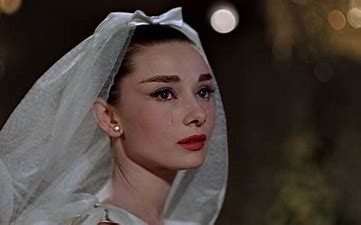
Stanley Donen
(APPROVED)
LGBTQ+ CHARACTER
*Maggie Prescot (Kay Thompson)
LGBTQ+
PRODUCER: Roger Edens
SCREENWRITER: Leonard Gershe
SONGWRITER (COMPOSER): Roger Edens
SONGWRITER (LYRICIST): Leonard Gershe
Choreographer: Eugene Loring
COSTUME DESIGNER: Edith Head
PHOTOGRAPHER: Richard Avedon
AUDREY’S MOST ENCHANTING PERFORMANCE
Funny Face (1957), Stanley Donen’s effervescent musical romantic comedy, contains Audrey Hepburn’s most charming screen performance. Looking impossibly chic in black during the film’s first half, she plays Jo Stockton, a shy Greenwich Village bookshop clerk who is discovered by Fred Astaire’s fashion photographer Dick Avery—a Richard Avedon-inspired figure—and whisked off to Paris for Fashion Week. (All the photographs in the film were shot by Avedon himself.)
Behind the scenes, writer Leonard Gershe and producer Roger Edens were one of Hollywood’s A‑list gay couples of the 1950s and ’60s, though Gershe liked to joke that he “didn’t have enough closet space”—literally or figuratively—for the relationship. Their sensibility permeates the film’s wit, sophistication, and queer-coded glamour.
George and Ira Gershwin’s songs include “How Long Has This Been Going On?” and “S Wonderful.” Audrey does all her own singing and has a lovely, natural voice—one that should have been heard far more prominently in My Fair Lady. The film also cemented her lifelong relationship with her favorite designer, Hubert de Givenchy – their first collaboration was on Billy Wilder’s Sabrina three years earlier – whose costumes helped define her screen persona.
The two major musical set pieces—both written specifically for the film by Edens (music) and Gershe (lyrics)—are unforgettable. “Think Pink” features Kay Thompson’s Maggie Prescott, the lesbian-coded doyenne of the New York fashion world, unveiling her vision for the year ahead with the immortal command: “Think pink… bury the beige!” And “Bonjour, Paris!” sends Audrey, Fred, and Kay dancing through the city in a joyous, witty celebration of their arrival—complete with Gershe’s immortal rhyme of Montmartre with Jean-Paul Sartre.
Cinematography: Ray June
Paramount
NOW STREAMING ON AMAZON PRIME VIDEO, APPLE TV+, YOUTUBE
44. The Strange One (1957)
B+

Jack Garfein
The film was submitted to the Hays Office by Columbia Pictures and, after several lines that more directly implied same-sex attraction were removed, it was released with a full Seal of Approval. The cut lines have now been restored.
LGBTQ+ CHARACTER
*Cadet Perrin “Cockroach” McKee (Paul E. Richards)
The Strange One (1957) is a stark, unsettling film noir set at a Southern military college, where hazing, hierarchy, and moral cowardice create a pressure cooker of cruelty. Directed by Jack Garfein and produced by Sam Spiegel, the film was adapted from Calder Willingham’s novel and stage play End as a Man. It marked the screen debuts of Ben Gazzara, George Peppard, and Julie Wilson, and is notable for being staffed almost entirely by Actors Studio talent—on both sides of the camera. Its portrayal of homoerotic tension and at least one openly gay character was extraordinary for a film released under the Hays Code, which forced Columbia Pictures to make numerous cuts. Those cuts have since been restored.
Cadet Staff Sergeant Jocko De Paris (Gazzara) rules the school through intimidation, his father’s influence, and the institution’s tradition of sanctioned bullying. Everyone either fears him or mistakes his swagger for leadership. One night, he frames George Avery (Geoffrey Horne), the son of the base commander, making it appear that Avery got drunk and collapsed on the quadrangle. Avery is expelled, and De Paris ensures that every cadet involved lies to protect him. Eventually, two freshmen (Peppard and Arthur Storch), De Paris’s roommates (Pat Hingle and James Olson), and the regimental commander (Mark Richman) decide they’ve had enough and move to expose him.
Gazzara is electrifying—exuding a raw, unsettling sensuality that he would only match once more, in Anatomy of a Murder (1959). For all the fine work he did over the decades, he was rarely this hypnotic. Peppard, Hingle, Olson, and Richman are all excellent, and Paul E. Richards brings just the right mix of pathos and menace to Cockroach, the queer cadet who worships De Paris and dreams of becoming a writer.
Garfein, a Holocaust survivor, directs with a cold, clinical intensity. He was married to actress Carroll Baker from 1955 to 1969 and is the father of actress Blanche Baker. The film is beautifully photographed by Burnett Guffey (From Here to Eternity, Bonnie and Clyde) and features a moody jazz score by Kenyon Hopkins.
And yes—the film contains one of the great shower scenes in American cinema. Horsing around naked with your buddies has rarely felt so charged.
The only woman in the cast, Julie Wilson, makes a vivid impression in just a few minutes of screen time, as does the always‑reliable Larry Gates as the base commander, a decade before his immortal slap exchange with Sidney Poitier in In the Heat of the Night (1967).
Columbia Pictures
Now streaming on Apple TV+, Amazon Prime Video and YouTube
45. Touch of Evil (1958)
(A)
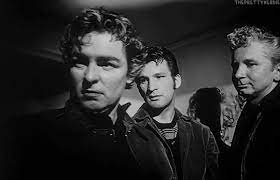
Orson Welles
(NEGOTIATIONS DURING PRODUCTION – THE FINAL VERSION SUBMITTED BY UNIVERSAL WAS APPROVED)
The PCA objected to drug use, the motel assault scene involving Janet Leigh’s character, sexualized menace and interracial marriage references and moral ambiguity surrounding authority figures. Universal negotiated changes, trimmed some material, and secured the Code seal.
LGBTQ+ CHARACTER
*Mexican gang leader (Mercedes McCambridge)
LGBTQ+
COSTUME DESIGNER: Bill Thomas
You’re a mess, honey
Tanya (Marlene Dietrich) in A Touch of Evil
He was some kind of man
Tanya (Marlene Dietrich) in A Touch of Evil
Touch of Evil (1958), directed by Orson Welles, unfolds in a corrupt U.S.–Mexico border town where Mexican narcotics officer Mike Vargas (Charlton Heston) clashes with the monstrous American police captain Hank Quinlan (Welles) after a car bombing. What begins as an investigation spirals into a fever dream of crime, racism, and moral rot, culminating in Quinlan’s spectacular downfall.
And yes—that is an unbilled Mercedes McCambridge as the unnamed, leather‑jacketed, unmistakably lesbian gang leader who gets her kicks watching Janet Leigh’s Mrs. Vargas terrorized in her motel room. It’s one of the film’s many transgressive jolts, smuggled past the censors through Welles’s sheer audacity.
The film is justly famous for its miraculous opening tracking shot—over three minutes of pure cinematic bravura—leading up to the border‑crossing explosion. At the other end of the film lies Marlene Dietrich’s immortal final line, delivered with the weary authority of a woman who has seen everything and judged it wanting. Between those bookends lies one of the great noir nightmares, the third and final masterpiece of Welles’s Hollywood trilogy after Citizen Kane and The Magnificent Ambersons.
The cast is a delirious mix of the iconic and the eccentric: Charlton Heston, Joseph Calleia, Akim Tamiroff, Ray Collins, Zsa Zsa Gabor, Dennis Weaver as the twitchy motel night manager, and Welles himself as the bloated, corrupt Quinlan. Joseph Cotten appears briefly as a coroner, a sly nod to the Mercury Players.
Adapted by Welles, Franklin Coen, and Paul Monash from the novel by Whit Masterson, the film has been restored to something close to Welles’s intended cut, allowing its baroque rhythms and moral complexity to shine.
Cinematography: Russell Metty
Universal-International
NOW STREAMING ON AMAZON PRIME VIDEO, APPLE TV, YOUTUBE
46. Auntie Mame (1958)
B-
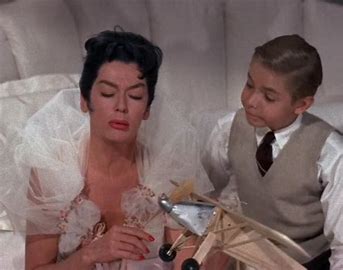
Morton DaCosta
(APPROVED)
LGBTQ+ CHARACTER
*Vera Charles (Coral Browne)
LGBTQ+
DIRECTOR: Morton DaCosta
ACTRESS: Coral Browne
SOURCE MATERIAL: Patrick Dennis, a pseudonym for Edward Everett Tanner III (based on his novel Auntie Mame: An Irreverent Escapade)
COSTUME DESIGNER: Orry-Kelly
ART–SET DECORATION: George James Hopkins
A GAY FEAST IN FRONT AND BEHIND THE CAMERA
Auntie Mame is a Technicolor comedy about a flamboyant New York socialite who becomes guardian to her orphaned nephew. Through wild adventures, financial highs and lows, and constant clashes with conservative values, Mame teaches him—and everyone else in her orbit—to embrace life with humor, generosity, and open‑mindedness.
I must admit I’m not a card‑carrying member of the Rosalind Russell fan club, so the rapture many of my gay friends feel at the mere mention of her Auntie Mame remains something of a mystery to me. But for a large swath of queer viewers, Russell’s performance is gospel. Gay director Morton DaCosta (born Morton Tecovsky and known to friends as “Tec”) directs with a distinctly theatrical hand—sometimes too theatrical—but he would refine that style in his second and penultimate Hollywood outing, The Music Man, four years later.
The film is also notable for its portrayal of the chic, martini‑dry lesbian character Vera Charles, played by gay actress Coral Browne, who steals every scene she’s in. We’ll be meeting Ms. Browne again as we move through the queer‑cinema canon.
Adapted from Patrick Dennis’s 1955 novel Auntie Mame and the stage play by Jerome Lawrence and Robert E. Lee, the film preserves much of the Broadway spirit—no surprise, since Russell originated the role onstage.
Cinematography: Harry Stradling
Warner Bros.
NOW STREAMING ON AMAZON PRIME VIDEO, APPLE TV+, YOUTUBE
47. Cat on a Hot Tin Roof (1958)
B+
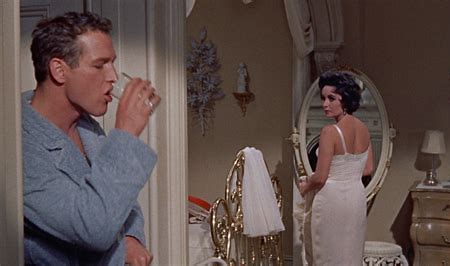
Richard Brooks
(APPROVED)
LGBTQ+ CHARACTER
*Brick Pollitt (Paul Newman)
LGBTQ+
ACTRESS: Judith Anderson
SOURCE MATERIAL: Tennessee Williams (based on his play Cat on a Hot Tin Roof)
Written (with James Poe) and directed by Richard Brooks, this respectable adaptation of the Tennessee Williams play Cat on a Hot Tin Roof opens with Brick Pollitt (Paul Newman, in his superstar breakthrough) holed up in his bedroom, drinking himself numb and mourning the memory of his best friend—read: lover—Skipper, who has recently committed suicide. Brick’s grief is eroticized, idealized, and utterly inaccessible to his wife Maggie, “the Cat,” played with aching sensuality by Elizabeth Taylor. She isn’t getting any, and she knows exactly why, which makes her feel like the cat of the title—restless, hungry, and clawing for survival.
Downstairs, the Pollitt clan gathers for Brick’s father, Big Daddy’s, birthday. Burl Ives, in his most memorable screen performance, plays the patriarch whose hidden terminal illness fuels the family’s scramble for his fortune. Maggie boldly claims she is pregnant—an untruth meant to secure her and Brick’s place in the family—leaving the film on an ambiguous but faintly hopeful note.
Judith Anderson is formidable as Big Mama; Jack Carson plays Brick’s brother Gooper; and Madeleine Sherwood is his awful wife Mae, mother of their five brats. The film softens the play’s queer core, but it can’t erase it. Brick’s paralysis, Maggie’s desperation, and Big Daddy’s frustrated attempts to force the truth into daylight all vibrate with the tension of what Williams wrote and what 1950s Hollywood could not say.
Cinematography: William Daniels
MGM
NOW STREAMING ON AMAZON PRIME VIDEO, APPLE TV+, YOUTUBE
48. Suddenly Last Summer (1959)
C+
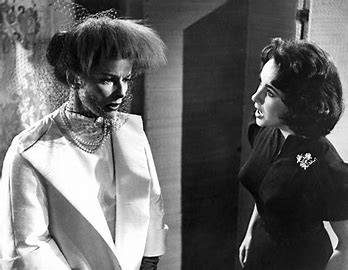
Joseph L. Mankiewicz
(APPROVED)
LGBTQ+ CHARACTER
*Sebastian Venable – we never get to meet him since he has already been torn to pieces and eaten alive, by hordes of young men on a European beach.
LGBTQ+
ACTOR: Montgomery Clift
ACTRESS: Katherine Hepburn
SCREENWRITERS: Gore Vidal and Tennessee Williams
SOURCE MATERIAL: Tennessee Williams (based on his play “Suddenly Last Summer”)
PRODUCTION DESIGNER: Oliver Messel
COSTUME DESIGNER: Oliver Messel
Another Southern Gothic—this time from one of Tennessee Williams’s less‑inspired plays—Suddenly, Last Summer was adapted for the screen by Gore Vidal and Williams himself. We never meet the film’s central gay character, Sebastian Venable; he is already dead when the story begins, his body torn apart and devoured by a mob of young men on a European beach. He had been traveling with his cousin Catherine (Elizabeth Taylor), who has been mentally shattered by the experience and is now prone to reliving the details.
Katherine Hepburn plays Sebastian’s mother, Violet Venable, a regal, venomous matriarch who attempts to bribe a young psychosurgeon (Montgomery Clift) into lobotomizing Catherine to silence her. Violet’s sorest point is that, once her own beauty faded, Sebastian replaced her with Catherine—he used both women as bait to attract the boys he desired.
The film is often risible, but its few pleasures are memorable: Hepburn’s imperious, icy performance as a mother willing to destroy her niece to preserve her son’s memory, and Oliver Messel’s lush tropical production design, complete with carnivorous plants and Venus flytraps that literalize the story’s themes of consumption and predation. Clift, post‑accident, looks ill and fragile, while Taylor is saddled with one of her least effective screen moments in the climactic monologue recounting that terrible summer’s day.
Hepburn, Taylor, and Messel all received Oscar nominations. It was only the second time in Academy history that two actresses from the same film were nominated for Best Actress—the first being nine years earlier, when Bette Davis and Anne Baxter competed for All About Eve, also directed by a certain Mr. Joseph L. Mankiewicz.
Cinematography: Jack Hildyard
Horizon Pictures |Columbia Pictures | Sam Spiegel
NOW STREAMING ON AMAZON PRIME VIDEO, APPLE TV+, YOUTUBE
49. Some Like It Hot (1959)
A+
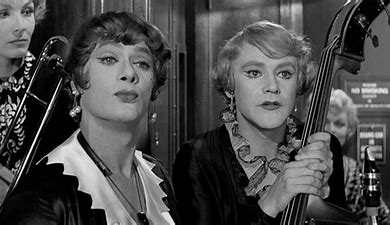
Billy Wilder
(LANDMARK: NOT SUBMITTED FOR APPROVAL)
Some Like It Hot was only the second major‑studio film (after Otto Preminger’s The Moon Is Blue in 1953) to be released without the Hays Office seal. Wilder assumed it didn’t stand a chance. Instead, released unrated through United Artists, it became an instant smash—and helped usher in the end of the Production Code.
LGBTQ+ CHARACTER
*Daphne (Jack Lemmon)
LGBTQ+
COSTUME DESIGNER: Orry-Kelly
MY FAVORITE QUEER COMEDY
In Chicago, 1929, musicians Joe (Tony Curtis) and Jerry (Jack Lemmon) witness the St. Valentine’s Day Massacre. To escape gangster Spats Colombo, they disguise themselves as women—Josephine and Daphne (Jerry refuses to answer to “Geraldine”)—and join an all‑female band heading to Florida.
On the train, they meet singer Sugar Kane (Marilyn Monroe), who dreams of marrying a millionaire. Joe promptly falls for her and later impersonates a Shell Oil heir to win her heart. Jerry, as Daphne, attracts the enthusiastic attention of eccentric millionaire Osgood Fielding III (Joe E. Brown), leading to a cascade of comic complications. When the mob discovers Joe and Jerry’s disguise in Florida, chaos erupt . Meanwhile, Osgood proposes marriage to Daphne—setting up the most perfect closing line in Hollywood history.
Arguably the greatest American screen comedy, Billy Wilder’s classic (co‑written with I.A.L. Diamond) was adapted from two earlier films: the 1935 French comedy Fanfare of Love (Max Bonnet, Michael Logan, Pierre Prévert, René Pujol, and Robert Thoeren) and its 1951 German remake (Logan, Thoeren, and Heinz Pauck). Wilder’s version improves on both, delivering a gag every other minute and one of the great comic performances of all time: Jack Lemmon’s Jerry/Daphne. Lemmon takes the character somewhere no one had dared go before—Jerry doesn’t just pretend to be a woman; he begins to believe he is one. Even better, he has you believing it. Curtis, Monroe, and Joe E. Brown are all superb, but Lemmon walks away with the picture.
Monroe sings a gorgeous version of Gus Kahn’s “I’m Through with Love,” one of her loveliest screen moments.
Cinematography: Charles Lang
United Artists
NOW STREAMING ON AMAZON PRIME VIDEO, APPLE TV+, MAX (YOUTUBE)
50. Pillow Talk (1959)
(B)
Michael Gordon
(APPROVED)
LGBTQ+ CHARACTERS
*“Rex,” the gay Texan, Brad Allen’s alter ego (Rock Hudson)
*Jonathan Forbes (Tony Randall)
LGBTQ+
ACTOR: Nick Adams
ACTOR: Rock Hudson
COSTUME DESIGNER: Bill Thomas
Directed by Michael Gordon, Pillow Talk was the first of three romantic comedies pairing Doris Day, Rock Hudson, and Tony Randall; the others were Lover Come Back (1961) and Send Me No Flowers (1964). A massive hit, it became the biggest box‑office success of 1959.
Hudson plays Brad Allen, a (supposedly straight) Broadway composer and tireless playboy who shares a party line with Doris Day’s Jan Morrow, a successful interior decorator—and, in the film’s late‑1950s moral universe, a supposed virgin. Brad monopolizes the phone with his endless stream of conquests, while Jan can’t place a single call. Naturally, it’s love, though not at first sight.
To seduce Jan, Brad invents a flamboyant alter ego: a Texas rancher named Rex Stetson. As Rex, he mercilessly teases Jan by showing an interest in effeminate things, slyly implying that Rex might be gay. The result is a deliciously layered conceit:
A gay actor playing a straight man pretending to be gay.
Tony Randall’s Jonathan Forbes is the quintessential late‑’50s “confirmed bachelor”—wealthy, fussy, impeccably dressed, socially polished, and utterly uninterested in women despite claiming to pursue Jan. The film never says he’s gay (it couldn’t), but everything about him fits the era’s coded shorthand: refined, unmarried, romantically inert, and the polar opposite of Hudson’s hyper‑hetero persona. Randall leaned into this archetype throughout his career; in Pillow Talk, it’s practically the point.
Gay actor Nick Adams, as Jan’s suitor Tony Walters, brings a different kind of coding. His scenes with Day have a “best friend” warmth rather than romantic heat. He’s adoring but not sexually assertive—an intentional contrast to Hudson’s swaggering Brad Allen.
Thelma Ritter appears in the fifth of her six Oscar‑nominated performances as Jan’s wisecracking housekeeper, adding her usual comic brilliance.
The Oscar‑winning original screenplay is credited to Russell Rouse, Maurice Richlin, Stanley Shapiro, and Clarence Greene.
This was Doris Day’s only Oscar‑nominated performance.
Cinematography: Arthur E. Arling
Universal
NOW STREAMING ON AMAZON PRIME VIDEO, APPLE TV+, YOUTUBE
51. Ben-Hur (1959)
(B)
William Wyler
(APPROVED)
LGBTQ+ CHARACTERS
*Judah Ben-Hur (Charlton Heston)
*Messala (Stephen Boyd)
LGBTQ+
SCREENWRITER (UNCREDITED): Christopher Fry
SCREENWRITER (UNCREDITED): Gore Vidal
I persuaded the producer, Sam Zimbalist (this was an MGM film and the writer worked not with the director but the producer; later the director, in this case William Wyler, weighed in) that the only way one could justify several hours of hatred between two lads–and all those horses–was to establish, without saying so in words, an affair between them as boys; then, when reunited at picture’s start, the Roman, played by Stephen Boyd, wants to pick up where they left off and the Jew, Heston, spurns him.
Counterpunch: Gore Vidal responds to Charlton Heston. Los Angeles Times, June 17. 1996.
It’s the big one. William Wyler’s Ben‑Hur is the granddaddy of Hollywood religious epics, starring Charlton Heston and Stephen Boyd as childhood friends whose bond curdles into hatred—and then explodes in spectacular fashion to Miklós Rózsa’s pounding score. Some purists still argue that the chariot race in the 1925 Fred Niblo/Ramon Novarro silent version is superior, but Wyler’s remains the definitive cinematic thunderbolt.
And if you believe Gore Vidal, the emotional engine of the film is simple: a lover’s quarrel. Vidal claimed he wrote the reunion scene between Judah Ben‑Hur (Heston) and Messala (Boyd) as if they had once been lovers, with Messala still carrying a torch. Wyler and Boyd were in on the ruse; Heston, famously, was not. Boyd plays the scenes with unmistakable longing, and once you see it, you can’t unsee it. There is far more here than a bromance—if Wyler hadn’t yelled “Cut,” you half‑expect the two men might have embraced in a very different way.
The fact that two gay writers—Vidal and Christopher Fry—gave Karl Tunberg’s script its final polish (both uncredited, with Tunberg receiving sole authorship) and that Fry was at Wyler’s side throughout the Cinecittà shoot lends further credence to Vidal’s claim. The film’s emotional temperature, especially in the early scenes between Heston and Boyd, supports the reading.
The final irony: of the film’s twelve Oscar nominations, only Tunberg went home empty‑handed. The 1959 Oscar for Best Adapted Screenplay went instead to Neil Paterson for Room at the Top.
Adapted from the novel by Lew Wallace.
Cinematography: Robert Surtees
MGM
NOW STREAMING ON AMAZON PRIME VIDEO, APPLE TV+, YOUTUBE
52. Compulsion (1959)
B-

(APPROVED)
LGBTQ+ CHARACTERS
*Artie Straus (Bradford Dillman)
*Judd Steiner (Dean Stockwell)
Set in 1924 Chicago, Compulsion is a fictionalized retelling of the Leopold and Loeb case. Artie (Bradford Dillman) and Judd (Dean Stockwell) are two wealthy law students who consider themselves intellectually superior and decide to commit the “perfect crime.” They kidnap and murder a young boy as a philosophical experiment in superiority and thrill‑seeking. Their plan unravels when Judd accidentally leaves his glasses at the crime scene—an oversight that becomes the key piece of evidence leading to their arrest.
The trial becomes the film’s centerpiece, with Orson Welles—playing a fictionalized version of Clarence Darrow—delivering a passionate argument against the death penalty. His defense focuses on the boys’ psychological immaturity, moral corruption, and emotional deformity rather than pure evil.
Remade as Swoon by Tom Kalin in 1992.
Leopold and Loeb were used as the basis for the lovers in Alfred Hitchcock’s Rope (see above).
Leopold and Loeb were lovers, and both Richard Murphy’s screenplay and Richard Fleischer’s direction infuse the film with a palpable queer subtext. It’s there in the lingering looks, the physical closeness, the emotional dependency, and especially in Judd’s jealousy whenever Artie shows interest in women. Dillman’s Artie is dominant, charismatic, and manipulative; Stockwell’s Judd is submissive, wounded, and yearning. Stockwell, in particular, gives one of his most haunting performances.
Cinematography:
William C. Mellor
TCF
NOW STREAMING ON AMAZON PRIME VIDEO, APPLE TV+, YOUTUBE
53. North by Northwest (1959)
A+
ALFRED HITCHCOCK
(APPROVED)
LGBTQ+ CHARACTER
*Leonard (Martin Landau)
Titles: Saul Bass
Screenplay by: Ernest Lehman
Cinematography: Robert Burks
Edited by: George Tomasini
Original Score: Bernard Herrmann
Distributed by: MGM
Starring: Cary Grant, Eva Marie Saint, James Mason, Martin Landau, Jessie Royce Landis, and Leo G. Carroll
DIRECTOR: Alfred Hitchcock
Produced by Alfred Hitchcock
In New York City, a waiter pages George Kaplan at the Plaza Hotel’s Oak Room after two thugs request him to do so. At that exact moment, advertising executive Roger Thornhill (Cary Grant) summons the same waiter and is mistaken for Kaplan. Kidnapped and taken to the Long Island estate of Lester Townsend, a United Nations diplomat, Thornhill is interrogated by Phillip Vandamm (James Mason), a suave spy posing as Townsend, and his watchful henchman Leonard (Martin Landau). Thornhill escapes, but when the real Townsend is murdered at the United Nations and collapses into Thornhill’s arms just as a photograph is taken, Thornhill becomes the prime suspect. To clear his name, he must travel—literally—north by northwest, from New York to Chicago and finally to the Dakotas.
Screenwriter Ernest Lehman set out to write what he called “the Hitchcock picture to end all Hitchcock pictures,” and he succeeded. The film is a dazzling tale of mistaken identity, with an innocent man pursued across America by a shadowy organization determined to smuggle microfilm—the film’s MacGuffin—containing government secrets out of the country. Grant, in one of his most iconic roles, anchors the film’s blend of suspense, wit, and glamour.
Martin Landau’s Leonard has long been a touchstone in queer Hitchcock analysis. Both Hitchcock and Landau deliberately coded the character with subtle homoerotic undertones. Leonard’s devotion to Vandamm is tinged with jealousy; he is suspicious of Eve Kendall (Eva Marie Saint), Vandamm’s lover, and his protectiveness feels personal as much as professional. Hitchcock dressed Leonard in sharper, sleeker suits than Grant’s Thornhill, signaling refinement and control. Stylish and leonine, he circles Grant like a cat in their electric first scene together. His line about Thornhill—“He’s a well‑tailored one, isn’t he?”—is a sly acknowledgment of male beauty and one of the film’s most frequently cited queer-coded moments.
The late‑1950s Hitchcock team is at its artistic peak. Graphic designer Saul Bass revolutionizes the opening credits with kinetic typography. Eva Marie Saint, as Eve, gives Grace Kelly in Rear Window a run for her money as Hitchcock’s most elegant leading lady, and her chemistry with Grant is palpable. MGM initially selected her wardrobe, but Hitchcock disliked the choices; he and Saint went to Bergdorf Goodman to choose her costumes themselves. Hitchcock’s taste was impeccable—Saint’s wardrobe remains one of the most memorable in Hollywood history.
Jesse Royce Landis, superb as Thornhill’s mother, famously shaved a few years off her age, leading to the long‑held myth that she was younger than Grant. In fact, she was eight years his senior. Leo G. Carroll has several memorable moments as The Professor, a quintessential Hitchcock bureaucrat: calm, paternal, and ruthlessly pragmatic. Though he works for the U.S. government, he allows Thornhill to remain in danger because it serves the larger operation.
North by Northwest is Hitchcock at his most playful and most precise—a masterpiece of glamour, danger, and queer‑coded intrigue.
In fiction, a MacGuffin is an object, device, or event that is necessary to the plot and the characters’ motivation, but is insignificant, unimportant, or irrelevant in itself. “FILM,” Angus MacPhail originated the term for FILM, which Hitchcock adopted. The term was later extended to literature.
Hitchcock’s cameo: 0:02:09.
He misses a bus just after his credit passes off-screen during the opening title sequence.
There are some thrilling set pieces.
- Grant is chased by an airplane in a cornfield on a beautiful day. Nothing is unusual until you see the white trails of plane exhaust in a clear blue sky.
- Grant and Saint escape from James Mason (a superb Hitchcock villain) and Martin Landau on top of Mount Rushmore.
- The bidding scene in the Chicago auction house.
- The gun goes off in the Mount Rushmore gift shop, and the little boy puts his hands to his ears a millisecond before the shot – a rare Tomasini miss that makes the film more fascinating today.
- Grant tries to escape through a brilliant reconstruction of the United Nations, since Hitchcock was not allowed to film there.
- The final risqué shot of the train entering the tunnel as our stars finally consummate their relationship
NOW STREAMING ON AMAZON PRIME VIDEO, APPLE TV+, YOUTUBE
54A. Oscar Wilde(1960)
B-
GREGORY RATOFF
(SUBMITTED: APPROVED WITHOUT CUTS)
FRAMED AS A MORAL TRAGEDY – THE DOWNFALL OF A HOMOSEXUAL
LGBTQ+ CHARACTERS
*Oscar Wilde (Robert Morley)
*Lord Alfred Douglas, also known as “Bosie” (John Neville)
*Robbie Ross (Dennis Price)
LGBTQ+
SOURCE MATERIAL: Oscar Wilde, a gay poet, novelist, diarist, playwright and general bon vivant.
Actor: Dennis Price
THE BEST OF THE TWO FILMS DEALING WITH THE OSCAR WILDE
TRAGEDY RELEASED IN 1960.
Please see Table 6 for a Wilde-to-Wilde comparison.
It is 1892, opening night of Lady Windermere’s Fan. Oscar Wilde (Robert Morley), married to Constance (Phyllis Calvert), begins a relationship with Lord Alfred Douglas—Bosie—played by a far‑too‑mature John Neville. Bosie’s father, the Marquess of Queensberry (Edward Chapman), publicly accuses Wilde of being a homosexual. Wilde sues him for libel, but the case backfires spectacularly when evidence of Wilde’s relationships with men is exposed. He is prosecuted, convicted of gross indecency, and imprisoned, leading to his social and financial ruin.
Neville may be miscast, but Morley is superb. He delivers Wilde’s stream of bon mots with effortless charm while also capturing the tragedy of the man, especially during the trial scenes. The film’s high point is the back‑and‑forth between Wilde and Sir Edward Carson, played with icy brilliance by Ralph Richardson. Their verbal duel is as riveting as any courtroom drama of the era.
The word homosexual is never spoken—this is 1960, after all—but the film does not shy away from the implications. Queensberry leaves a calling card at Wilde’s club accusing him of being a “sodomite” (misspelled somdomite), and the nature of Wilde and Bosie’s relationship is unmistakable through gesture, tone, and framing. Dennis Price is excellent as Robbie Ross, Wilde’s loyal friend and former lover, whileAlexander Knox brings quiet intelligence to Sir Edward Clarke, Wilde’s counsel, who realizes mid‑trial that his client has not been entirely forthcoming.
Robert Morley always maintained that he was too young to play Wilde when he played him on stage, to great success, on the West End and on Broadway in the late 1930s, but he was too old to play him effectively in this movie.
This was the final film directed by actor‑director Gregory Ratoff, who had earlier directed Ingrid Bergman in her Hollywood debut, Intermezzo. Modern audiences may know him best as Max “you sly puss” Fabian in All About Eve.
Adapted by Jo Eisinger (Gilda) from the play Oscar Wilde by Leslie and Sewell Stokes.
Cinematography: Georges Périnal
Vantage Films
TCF in the US
NOW STREAMING ON AMAZON PRIME VIDEO, APPLE TV+, YOUTUBE
54B. The Trials of Oscar Wilde (1960)
C+
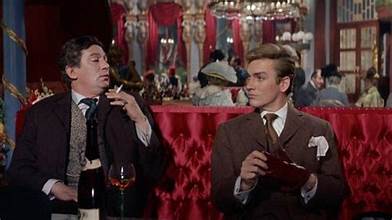
KEN HUGHES
(SUBMITTED: APPROVED WITHOUT CUTS)
FRAMED AS A MORAL TRAGEDY – THE DOWNFALL OF A HOMOSEXUAL
LGBTQ+ CHARACTERS
*Oscar Wilde (Peter Finch)
*Lord Alfred Douglas, also known as “Bosie” (John Fraser)
*Robbie Ross (Emrys Jones)
LGBTQ+
SOURCE MATERIAL: Oscar Wilde, a gay poet, novelist, diarist, playwright and general bon vivant.
ACTOR: John Fraser
Because the story is airbrushed to the point of uncertainty, The Trials of Oscar Wilde, the other 1960 Oscar Wilde film, pales by comparison. Clearly, the more expensive movie, filmed in Technicolor – the cinematographer is Ted Moore – with a large cast, it does, however, boast a better Bosie (John Fraser) and a better Queensbury (Lionel Jeffries). Directed by Ken Hughes, with Peter Finch as Wilde and James Mason as Sir Edward Carson. The film was released by Warwick Films, a partnership between Cubby Broccoli and Irving Allen, one week after Oscar Wilde. Please see Table 6 for a Wilde-to-Wilde comparison. Now Streaming on YouTube.
THE TWO 1960 OSCAR WILDE MOVIES COMPARED
| ESSAY ONE – TABLE 6 85 Queer Films Made Under the Hays Code Oscar Wilde vs. The Trials of Oscar Wilde BOTH FILMS WERE APPROVED BY THE HAYS OFFICE BECAUSE BOTH SHOWED THE DOWNFALL OF OSCAR WILDE, THE DOWNFALL OF A HOMOSEXUAL. BOTH MOVIES WERE FRAMED AS MORAL TRAGEDIES, particularly Oscar Wilde. The Trials of Oscar Wilde suggested that Wilde may have been heterosexual and perfectly happy with Constance, only to be tempted into sexual deviancy by Bosie and other nefarious characters. | |||||
| 1960 movie | Oscar Wilde | The Trials of Oscar Wilde | 1960 movie | Oscar Wilde | The Trials of Oscar Wilde |
| Hays Code Seal of Approval | SUBMITTED: YES APPROVED: YES | SUBMITTED: YES APPROVED: YES | Rating @TheBrownees | B- | C+ |
| SOURCE | Play OSCAR WILDE by Leslie and Sewell Stokes | Unproduced play THE STRINGED LUTE by John Furnell (the pseudonym of Phyllis Macqueen) | WILDE | Robert Morley (straight actor) | Peter Finch (straight actor) |
| ADAPTION | Screenplay by Jo Eisinger | Screenplay by Ken Hughes and Montgomery Hyde | BOSIE | John Neville (straight actor) | John Fraser (gay actor) |
| DIRECTION | Gregory Ratoff | Ken Hughes | MRS. WILDE | Phyllis Calvert | Yvonne Mitchell |
| PRODUCTION | Jo Eisinger for Vantage Films | Harold Huth for Warwick Films (Irvin Allen & Albert R. Broccoli) | ROBBIE ROSS | Dennis Price (gay actor) | Emrys Jones (straight actor) |
| DISTRIBUTION | Wide release in the UK, US and Europe. TCF in the US. | Wide release in the UK, US and Europe. Columbia in the US. | QUEENSBURY | Edward Chapman | Lionel Jeffries |
| BUDGET | $250,000 (black and white) | $400,000 (color) | Sir Edward Carson | Ralph Richardson | James Mason |
| Box office | Modest loss – broke even in some regions | A flop in the US. Did better in Europe. Almost bankrupted Warrick Films and ended the Allern-Broccoli relationship | Sir Edward Clarke | Alexander Knox | Nigel Patrick |
55. The Dark at the Top of the Stairs (1960)
A-
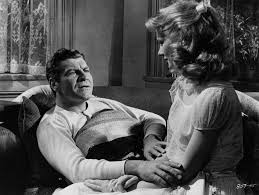
Delbert Mann
(APPROVED)
LGBTQ+ CHARACTER
*Sonny Flood (Robert Eyer)
LGBTQ+
SOURCE MATERIAL: William Inge (adapted from his play The Dark at the Top of the Stairs)
SET DECORATOR: George James Hopkins
Robert Eyer has a few lovely moments as Sonny Flood, the little gay boy who can’t wait to show his uncle Morris (Frank Overton) his picture book of silent movie stars in gay playwright William Inge’s play The Dark at the Top of the Stairs. This beautiful adaptation, directed by Delbert Mann in his interim period between Paddy Chayefsky’s slice-of-life realism and Doris Day’s comedy-romance, from a great script by Harriet Frank Jr. and Irving Ravetch, boasts superb performances by Robert Preston as his dad Rubin, Dorothy McGuire as his mom Cora, Shirley Knight as his sister Reenie, Eve Arden as his aunt Lotte and, above all, Angela Lansbury as Mavis Pruitt, the owner of the local beauty salon who has always loved Rubin.
Cinematography: Harry Stradling
Warner Bros.
The Dark at the Top of the Stairs is unavailable for streaming. However, the DVD can be purchased at Amazon.
56. Spartacus (1960) (B)
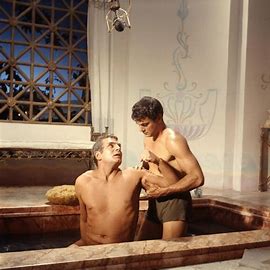
Stanley Kubrick
(NEGOTIATIONS DURING PRODUCTION – THE FINAL VERSION SUBMITTED BY UNIVERSAL WAS APPROVED)
A scene featuring General Marcus Licinius Crassus (Laurence Olivier) and his slave Antoninus (Tony Curtis) was initially cut from the 1960 version by Universal. However, it was saved from the cutting room floor when the epic of the slave revolt was restored in 1991.
LGBTQ+ CHARACTER
*Marcus Licinius Crassus (Laurence Olivier)
LGBTQ+
ACTOR: Laurence Olivier
COSTUME DESIGNER: Bill Thomas
COSTUME DESIGNER: Arlington Valles
And taste is not the same as appetite and, therefore, not a question of morals.
Crassus (LAURENCE OLIVIER) to his boy slave Antoninus (TONY CURTIS),a singer of songs, in Spartacus
The restored Oysters and Snails scene where General Crassus (Laurence Olivier) gently informs his boyish new slave Antoninus (played by Curtis), a singer of songs, that he likes both and will, therefore, be vigorously screwing him for the duration of his “employment”. As Crassus exits his bath, this news is enough to make Antoninus run for the hills and join the growing ranks of Spartacus’ army.
This scene figured prominently in Amy Heckerling’s Clueless when Cher discovers that her dreamboat Christian is gay.
The film was adapted by the formerly blacklisted screenwriter Dalton Trumbo from Howard Fast’s novel, and, although Olivier, Charles Laughton and Peter Ustinov (Oscar for Best Supporting Actor) keep you watching, the film itself, although based on truth, comes across as one hoary cliche after another with poor Jean Simmons having to suffer many insults to both her person and her craft as Kirk Douglas chews the scenery in the title role. It’s no surprise that after the film’s completion, director Stanley Kubrick left Hollywood for good, relocating to England, where he went on to create a series of masterpieces.
Cinematography:
Russell Metty
Universal International
NOW STREAMING ON AMAZON PRIME VIDEO, APPLE TV+, YOUTUBE
57. Psycho (1960)
A+

Alfred Hitchcock
(APPROVED WITHOUT CUTS)
Hitchcock submitted Joseph Stefano’s screenplay first, which, not surprisingly, got a litany of objections from the Hays Office. He then shot the film VERY precisely, using editing, sound and montage so that almost nothing explicit was TECHNICALLY on screen. The blood swirling counter-clockwise down the drain from Janet Leigh’s lifeless body was chocolate sauce!
LGBTQ+ CHARACTER
*Norman Bates (Anthony Perkins)
LGBTQ+ ACTOR
Anthony Perkins
PSYCHO IS ONE OF HITCHCOCK’S SEVEN PERFECT FILMS.
IN THE FINAL SCENE, HITCHCOCK HAS PERKINS BREAK THE FOURTH WALL.
Anthony Perkins’ Norman Bates made him immortal while, at the same time, ending his career in Hollywood. With this fearless performance, he had crossed a line, and there was no way back.
During a Friday afternoon affair in a Phoenix hotel, real estate secretary Marion Crane (Janet Leigh) and her boyfriend Sam Loomis (John Gavin) discuss their inability to get married because of Sam’s debts. Marion returns to work, steals $40,000, and drives to Sam’s home in Fairvale, California. She stops for the night at the Bates Motel, located off the main highway during a heavy rainstorm, and hides the stolen money inside a newspaper. Proprietor Norman Bates(Anthony Perkins) descends from a large house overlooking the motel, registers Marion under an alias, and invites her to dine with him. After Norman returns to his house, Marion overhears him arguing with his mother about his wish to dine with Marion. Marion decides to drive back to Phoenix in the morning to return the stolen money. As she showers, a shadowy figure appears and stabs her to death. Norman cleans up the murder scene, putting Marion’s body, her belongings, and the hidden cash in her car, and sinks it in a swamp.
Hitchcock assembled a small crew from his TV series, Alfred Hitchcock Presents, to film the movie. The most notable change was cinematographer John L. Russell handling the film’s striking black-and-white lensing, a task previously handled by Hitchcock regular Robert Burks. However, Hitchcock regulars George Tomasini, Bernard Herrmann, and Saul Bass remained in post-production. Their contributions to the editing, score, and title sequence, respectively, are all essential to the film’s success.
Never was Hitchcock’s ability to manipulate an audience’s sympathies more evident than in the car in the pond scene. Within just a few minutes of her horrific death, we have forgotten about Janet Leigh. We are now rooting for her killer, Anthony Perkins, and we all breathe a massive sigh of relief when, after a gut-wrenching pause, the car containing Janet’s body (and the $40,000) finally goes under the water.
Norman may not be gay because of his sexual attraction to Marion. However, he is most assuredly queer, thus cementing the fifth letter in our LGBTQ+ acronym. Hitchcock liked to cast Queer actors in Queer parts. A known gay actor who had relationships with several famous male stars of the day, including Rock Hudson and Tab Hunter, Perkins died from complications of AIDS in 1992 after having been married and fathering two children. Norman is a crossdresser who is smothered by an overbearing mother and displays traits associated with traditional feminine behavior, hinting that Norman is repressing his genuine desire for a same-sex partner.
Screenplay by Joseph Stefano based on the novel Psycho by Robert Bloch.
PARAMOUNT PICTURES
Hitchcock’s cameo: 0:06:59. Seen through an office window wearing a Stetson cowboy hat as Janet Leigh comes through the door
NOW STREAMING ON Amazon Prime Video, Apple TV+ and YouTube
58. Purple Noon (1960)
B+
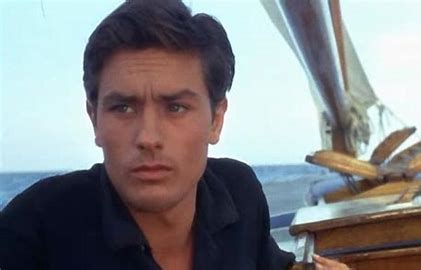
Rene Clement
The film was NOT submitted to the Hays Office. Because of its queer premise, it would have been impossible to secure approval. Shown at film festivals, film societies and arthouse cinemas. Delon’s star presence and positive word of mouth guaranteed an ever-expanding audience as the sixties progressed.
LGBTQ+ CHARACTER
*Tom Ripley (Alain Delon)
LGBTQ+
SOURCE MATERIAL: Patricia Highsmith (based on her novel The Talented Mr. Ripley)
Mr. Greenleaf hires Tom Ripley—an almost impossibly beautiful Alain Delon—to travel to Italy and persuade his son Philippe (Maurice Ronet) to return home to the United States. Once in Italy, Tom becomes inseparable from Philippe, basking in his luxurious lifestyle while quietly resenting his arrogance. Philippe’s fiancée, Marge (Marie Laforêt), is wary of Tom’s presence from the start. When Philippe mocks him one time too many, Tom kills him during a boating trip. He then forges documents, assumes Philippe’s identity, and begins siphoning off his wealth. Tom manipulates friends, lovers, and the authorities with astonishing finesse, maintaining his double life even as Marge’s suspicions deepen.
This first adaptation of queer author Patricia Highsmith’s 1955 novel The Talented Mr. Ripley covers the same narrative ground as Anthony Minghella’s 1999 film starring Matt Damon and the recent eight‑episode Netflix series written and directed by Steve Zaillian and starring Andrew Scott.
What it lacks in the emotional depth and superb supporting cast of Minghella’s version, it compensates for with a hypnotic style all its own, thanks to French two‑time Oscar winner René Clément (Forbidden Games) and his master cinematographer Henri Decaë (The 400 Blows). Italy has rarely looked so sun‑drenched, seductive, and treacherous. And Delon—icy, feline, breathtaking—is sensational. The world had no choice but to take notice. A superstar is born before our eyes.
Score by Nino Rota
CCFC Films (France)
TITANUS FILMS (Italy)
Times Film Corporation (US distribution)
Picked up by RIALTO for Revival House distribution in 1996
NOW STREAMING ON AMAZON PRIME VIDEO, CRITERION COLLECTION(YOUTUBE) AND APPLE TV+
59. Victim (1961)
B+
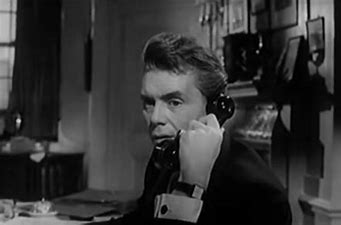
Basil Dearden
LANDMARK
Seal of Approval denied due to its frank treatment of homosexuality. Released by Rank without a seal.
Years later, it received a PG/13 rating from the MPAA.
LGBTQ+ CHARACTERS
*Melville Farr (Dirk Bogarde)
*Boy Barrett (Peter McEnery)
*PH (Hilton Edwards)
LGBTQ+
ACTOR: Dirk Bogarde
ACTOR: Hilton Edwards
DIRK BOGARDE’S BRAVE PERFORMANCE
Dirk Bogarde plays a successful, happily married (to Sylvia Syms) lawyer who is being blackmailed because of a gay affair in his past with Boy Barrett (Peter McEnery).
This film did more to sway public and political opinion on homosexuality in England than any parliamentary discussion. Six years later, in 1967, homosexuality was decriminalized in Great Britain.
I first saw this film in my early teens. It was on Irish television, and I remember my mom saying how brave Dirk Bogarde was to play a gay character since he was a known gay actor (you cannot say that he was an OUT gay actor since this was not possible in 1961). She was right.
Openly gay Irish actor Hilton Edwards (born in London but immigrated to Ireland in his early twenties) has a small but memorable scene as a blind patron of a gay bar whom his younger-sighted friend feeds all the gossip. He could be the blackmailer! Edwards and his life partner, Micheál Mac Liammóire (né Alfred Wilmore, also in London), founded Dublin’s Gate Theatre, which nurtured such talents as Orson Welles, Geraldine Fitzgerald, and James Mason. When I was growing up, they were Ireland’s only homosexual couple. Although fêted by all, their union was always illegal, both actors being long dead before homosexuality was finally decriminalized in Ireland in 1993.
Janet Green and John McCormick wrote the original screenplay.
Cinematography
Otto Heller
Rank Film Distributors of America
NOW STREAMING ON AMAZON PRIME VIDEO, MAX(YOUTUBE),
60. A Taste of Honey (1961)
B+
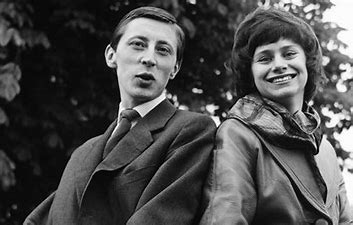
Tony Richardson
The film was NOT submitted to the Hays Office. Because of its queer premise, it would have been impossible to secure approval. Shown at film festivals and film societies. Distributed by Continental Distributing.
LGBTQ+ CHARACTER
*Geoffrey Ingham (Murray Melvin)
LGBTQ+
DIRECTOR: Tony Richardson
ACTOR: Murray Melvin
QUEER KITCHEN SINK REALISM!
Tony Richardson’s adaptation of Shelagh Delaney’s play still shines with undimmed force. Delaney co‑wrote the screenplay with Richardson, who had directed the original Broadway production in 1960. The film stands as one of the defining works of kitchen sink realism, that gritty British genre rooted in working‑class life, emotional candor, and social critique.
Rita Tushingham—who embodied the spirit of British independent cinema from the early to mid‑sixties—plays seventeen‑year‑old Jo, living with her irresponsible mother in a run‑down, post‑industrial corner of Salford in the British Midlands. One day, Jo meets Jimmy (Paul Danquah), a cook on a boat on the Manchester Ship Canal. After a single night together, she discovers she is pregnant.
Determined to keep the baby but unwilling to marry Jimmy, Jo moves in with her best friend Geoff (Murray Melvin), a gentle, soft‑spoken gay man who offers to marry her and help raise the child. The film treats Jo’s pregnancy, interracial romance, and her friendship with a gay man not as sensationalism but as life—messy, funny, painful, and real.
Melvin—openly gay and nearly thirty at the time, though playing a teenager—gives one of the era’s most quietly groundbreaking performances. He was among the first openly gay actors in British cinema, and his portrayal of Geoff remains tender, dignified, and deeply humane. Melvin often worked with Richardson and with director Ken Russell, and his presence here is part of what makes A Taste of Honey so radical. His most memorable movie moment is the card game sequence in Stanley Kubrick’s Barry Lyndon, featuring natural candlelight and Schubert’s Piano Trio in E-flat on the soundtrack (see Essay Two: 85 Queer Films from the New Hollywood (1968-1980).
Dora Bryan is particularly memorable as Tushingham’s self-centered and alcoholic mother.
Cinematography
Walter Lassally
Woodfall Films
NOW STREAMING ON AMAZON PRIME VIDEO, APPLE TV+, MAX (YOUTUBE)
61. The Children’s Hour (1961)
(C)
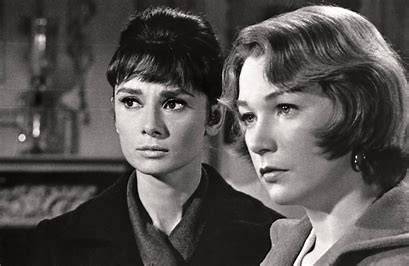
William Wyler
(APPROVED)
LGBTQ+ CHARACTER
*Martha Dobie (Shirley MacLaine)
ITS QUEERNESS RESONATED MUCH MORE EFFECTIVELY WHEN WYLER MADE IT A THINLY DISGUISED HETEROSEXUAL DRAMA IN 1936
When William Wyler and Sam Goldwyn adapted Lillian Hellman’s The Children’s Hour in 1936, the lesbian storyline was transformed into a heterosexual triangle involving Merle Oberon, Miriam Hopkins, and Joel McCrea, with a wonderfully venomous Bonita Granville as the malicious schoolgirl who spreads the lie. Retitled These Three, the film was a considerable success—and despite the enforced heterosexuality, the queer subtext still pulsed beneath the surface. It also launched a remarkable run of classics Wyler would make under the Goldwyn banner.
Cut to 1961. Fresh from the triumph of Ben‑Hur, Wyler decided to remake the story, this time restoring Hellman’s original same‑sex theme. He cast two of Hollywood’s greatest actresses—Audrey Hepburn and Shirley MacLaine—as the schoolmistresses whose lives and careers are destroyed by a student’s vindictive rumor. MacLaine plays Martha, the character who secretly loves her friend and colleague Karen (Hepburn), a love she can neither name nor express. Karen, meanwhile, is in a stable heterosexual relationship with Joe(James Garner), which only deepens Martha’s torment.
But Wyler found himself caught between eras. In 1961, he was not prepared to make an openly gay film, yet he was no longer willing to bury the theme entirely. The result is a strange hybrid: what begins as an act of bravery ends in timidity. The film is all text and no subtext—yet still not bold enough to fully confront the emotional truth at its center. There are moments of real power, especially from MacLaine, but they are isolated flashes. The film ultimately feels like a missed opportunity, one that might have triumphed had Wyler waited another decade.
Fay Bainter, playing the grandmother whose reaction to her granddaughter’s lie sets the tragedy in motion, received an Oscar nomination for Best Supporting Actress. It was her final screen role.
CINEMATOGRAPHY
Franz Planer
The Mirisch Company
United Artists
NOW STREAMING ON AMAZON PRIME VIDEO, APPLE TV+, YOUTUBE
62. Lawrence of Arabia (1962)
(A)

David Lean
(APPROVED)
Director: David Lean
Screenplay: Robert Bolt and Michael Wilson, adapted from TE Lawrence’s autobiography Seven Pillars of Wisdom.
Original Score: Maurice Jarre
Editing: Anne V. Coates
Cinematography: Freddie Young
Horizon Pictures |Columbia Pictures | Sam Spiegel
LGBTQ+ CHARACTER:
*T.E. Lawrence (Peter O’Toole)
*Sherif Ali (Omar Sheriff)
David Lean’s masterpiece Lawrence of Arabia (1962) charts the transformation of British officer T. E. Lawrence from eccentric soldier to legendary leader as he attempts to unite the Arab tribes against the Ottoman Empire during World War I. The film is both a sweeping historical epic and an intimate psychological portrait, exploring the toll that Lawrence’s self‑mythologizing journey exacts on his identity.
Lean’s film is rich in queer subtext, much of it conveyed through Peter O’Toole’s extraordinary performance. His Lawrence is androgynous, introspective, sensitive, and physically delicate—an intentional contrast to the traditional masculine war hero. The film emphasizes Lawrence’s profound alienation: from the British military, from his Arab allies, and ultimately from himself. His relationships with men, particularly Sherif Ali (Omar Sharif), are emotionally charged. Their gazes linger, their silences vibrate with tension, and their partnership carries an intimacy that transcends conventional camaraderie. Those luminous close‑ups of Sharif’s eyes—Lean knew exactly what he was doing—helped earn him a well‑deserved Best Supporting Actor nomination.
T. E. Lawrence’s sexuality has long been debated. Biographers have speculated that he may have been gay or asexual, citing his lack of romantic relationships with women and his writings about pain, submission, and fractured identity. His memoir Seven Pillars of Wisdom contains passages that some scholars interpret as coded expressions of same‑sex desire or masochism. Lean’s film never states anything outright, but the subtext is unmistakable: Lawrence is a man at war not only with empires but with himself.
NOW STREAMING ON AMAZON, APPLE TV+ and YouTube
63. Advice and Consent (1962)
A-
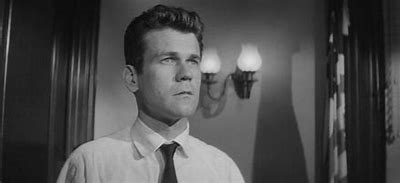
Otto Preminger
(SUBMITTED: APPROVED WITHOUT CUTS)
ANOTHER HAYS CODE TRIUMPH FOR DIRECTOR-PRODUCER OTTO PREMINGER
LGBTQ+ CHARACTER
*Senator Brig Anderson (Don Murray)
LGBTQ+
ACTOR: Charles Laughton
ACTOR: Walter Pidgeon
COSTUME DESIGNER: Bill Blass
THE FIRST LOOK INSIDE AN AMERICAN GAY BAR
Otto Preminger was renowned for his innovative, boundary‑pushing approach to filmmaking, and Advise and Consent is one of his most beautifully written, acted, and directed achievements. It also treats its gay subplot with remarkable tenderness and respect for 1962. Don Murray—consistently superb and chronically underrated—plays a closeted senator being blackmailed during the bruising confirmation battle over a new Secretary of State. Preminger, ever fond of sly casting, pits him against a reactionary Southern senator played by Charles Laughton, a gay actor in his final screen role.
Only the scenes involving the woeful George Grizzard prevent Advise and Consent from achieving full classic status. He gives a master class in bad acting, while the rest of the ensemble—Henry Fonda, Peter Lawford, Burgess Meredith, Walter Pidgeon, Lew Ayres, and Franchot Tone, along with Murray and Laughton—deliver some of the finest work of their distinguished careers.
A minor deduction, too, for requiring us to endure a sadly faded Gene Tierney as a Washington socialite whose sole purpose seems to be explaining, to the ladies‑who‑lunch (and to the viewer), the difference between the House of Representatives and the Senate. It’s a thankless and unnecessary task for an actress of her stature.
Still, when the film focuses on its political machinations and its quietly groundbreaking queer storyline, Advise and Consent remains one of Preminger’s most compelling and forward‑thinking works.
Adapted from the novel by Allen Drury.
Cinematography
Sam Leavitt
Columbia Pictures
NOW STREAMING ON AMAZON PRIME VIDEO, APPLE TV+, YOUTUBE
64. Whatever Happened to Baby Jane? (1962)
A+
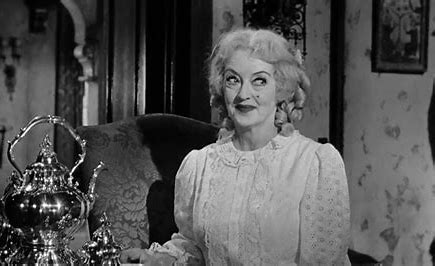
Robert Aldrich
(SUBMITTED: APPROVED WITHOUT CUTS)
LGBTQ+ CHARACTER
*Edwin Flagg (Victor Buono)
LGBTQ+ ACTOR
Victor Buono
Thanks to Lukas Heller’s superb adaptation of the Henry Farrell novel, Robert Aldrich’s What Ever Happened to Baby Jane? works simultaneously as high drama and delirious camp. Hollywood’s two grande dames, Bette Davis and Joan Crawford, are in top form, with Davis getting the showier role as Baby Jane Hudson. But Crawford is equally superb as Blanche—the still, wounded eye at the center of Bette’s hurricane.
Opening flashback: In 1917, Baby Jane is a spoiled vaudeville child star adored by audiences, while her sister Blanche grows up overshadowed. Years later, Blanche becomes a major Hollywood actress, only to be left paralyzed after a mysterious car accident. Jane now washed‑up and mentally unstable, lives with her in a decaying Hollywood mansion, clinging to delusions of a comeback. She psychologically and physically torments Blanche—locking her in rooms, serving grotesque meals, and sabotaging every attempt to reach the outside world.
DAVIS AND CRAWFORD ARE SPECTACULAR TOGETHER!
In the film’s devastating climax, Blanche reveals that she was actually responsible for her own accident, not Jane. But the confession comes too late. Jane’s madness has already spiraled beyond reach. On the beach at Santa Monica, she dances childishly as the police arrive, leaving Blanche near death. The haunting ending underscores Jane’s complete detachment from reality.
Gay actor Victor Buono is perfection as Jane’s would‑be accompanist Edwin Flagg, whose horrified reaction to what he discovers prompts Davis’s immortal line: He hates me. And Australian actress Marjorie Bennett, as his mother Dehlia Flagg, seems to have wandered in from a John Waters movie—glorious, grotesque, and unforgettable.
Baby Jane is gay sensibility incarnate: baroque, hysterical, tragic, and wickedly funny. It remains one of the great queer‑coded Hollywood fever dreams.
Every Davis line is immortal, but some of my favorites are:
You mean all this time we could have been friends?
Because you didn’t eat your din-din,
But you are Blanche, you are in that chair!
Score by Frank De Vol.
CINEMATOGRAPHY: Ernest Haller
Warner Bros.
NOW STREAMING ON AMAZON PRIME VIDEO, APPLE TV+, YOUTUBE
65. That Touch of Mink (1962)
C+
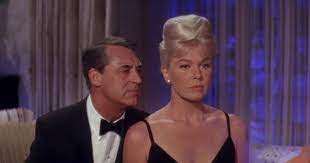
Delbert Mann
(APPROVED)
LGBTQ+ CHARACTERS
*Connie (Audrey Meadows)
*Roger (Gig Young)
LGBTQ+
ACTOR: Cary Grant
ACTOR: Richard Deacon (uncredited)
Between Pillow Talk (1959), Lover Come Back (1961), and Send Me No Flowers (1964), Doris Day paired with Cary Grant in That Touch of Mink, another Stanley Shapiro–co‑written confection. The director is Delbert Mann, a graduate of television and the Paddy Chayefsky school of slice‑of‑life naturalism (Marty, The Catered Affair, The Bachelor Party), who had shown a surprising flair for comedy the previous year with Lover.
When Philip Shayne’s (Grant) Rolls‑Royce splashes Cathy Timberlake (Day) on her way to a job interview, we know this love‑hate relationship can only end with a wedding ring. Unfortunately, there is minimal chemistry between the stars. This is one of Grant’s few bad performances; he looks as though he’d rather be anywhere than with Miss Day. Their scenes together in Bermuda are, at best, awkward—and at worst, downright creepy.
On the plus side, the film is gorgeously photographed by Russell Metty, and it features a fabulous fashion show courtesy of Bergdorf Goodman and ace costume designer Bill Thomas. And Shapiro gives us not one but two funny queer subplots.
The first involves a perpetually soused Gig Young as Roger, Philip’s neurotic financial adviser, and his psychiatrist, Dr. Gruber (Alan Hewitt). Because Gruber leaves the room just as Roger begins relaying crucial information about Cathy, he becomes convinced that Roger is about to embark on an affair with Philip. This misunderstanding leads to the film’s famous final scene involving Roger, a baby carriage, and an astonished Dr. Gruber—who, incidentally, is using Roger for insider stock tips.
However, when he thinks that Roger is gay, he immediately calls his broker to discard the previous purchase because Roger is now of unsound mind.
He also goes back to Vienna for a refresher course.
The second involves Audrey Meadows as Connie, Cathy’s overprotective, man‑hating (read: closeted lesbian) roommate who works at the automat across the street from Philip and Roger’s office. Meadows never overplays it; it’s a sweet, funny performance that adds texture to the film’s queer‑coded world.
And although uncredited, gay actor Richard Deacon has a memorable moment as Mr. Miller, Connie’s prissy supervisor. Deacon virtually patented this role in countless TV series and small film parts throughout the 1960s, 1970s, and early 1980s.
The original screenplay is by Stanley Shapiro and Nate Monaster.
Universal
NOW STREAMING ON AMAZON PRIME VIDEO, MAX(YOUTUBE),
66. Billy Budd (1962)
(C)
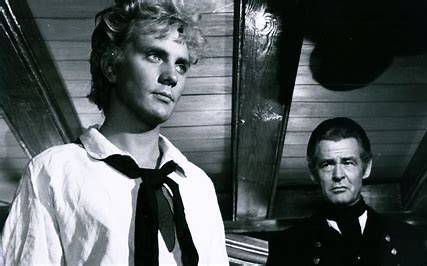
Peter Ustinov
(APPROVED)
LGBTQ+ CHARACTERS
*Billy Budd (Terence Stamp)
*John Claggart (Robert Ryan)
*Peter Ustinov (Edward Vere)
LGBTQ+
SOURCE MATERIAL: Herman Melville (based on his novel “Billy Budd Foretopman” )
SCREENWRITER: DeWitt Bodeen
COSTUME DESIGNER: Anthony Mendleson
Melville’s deep feelings for Nathaniel Hawthorne were immortalized in letters written between the two men from 1850 to 1852.
This historical drama–adventure was produced, directed, and co‑written (with Robert Rossen and DeWitt Bodeen) by Peter Ustinov. Based on Coxe and Chapman’s stage adaptation of Herman Melville’s short novel—considered by many his second masterpiece after Moby‑Dick—Billy Budd tells a stark moral tale set aboard a British naval vessel.
Billy Budd, a strikingly handsome young sailor, accidentally kills his false accuser, the Master‑at‑Arms John Claggart (Robert Ryan), after Claggart’s relentless persecution pushes him beyond endurance. Captain Edward Vere (Ustinov), recognizing Billy’s lack of intent, nevertheless insists that the law governing mutiny requires him to sentence Billy to death. The tragedy lies in Vere’s tortured adherence to duty over justice.
Ustinov cast a then‑unknown Terence Stamp as Billy, and the effect was seismic. Stamp’s beauty, innocence, and radiance electrify the film; he became an overnight sensation, making an otherwise modest production hugely profitable. He received a Best Supporting Actor nomination for 1962, losing to Ed Begley in Sweet Bird of Youth. Many—including myself—would argue that Billy is the picture, and the rest of the cast orbits around him.
Claggart’s jealousy of Billy is never explicitly explained, but the implication is clear: Billy’s beauty, optimism, and moral purity provoke something dark and unspoken in Claggart. Many—including gay composer Benjamin Britten, whose opera Billy Budd is one of the great queer works of the 20th century—have long noted the homoerotic undercurrents among Billy, Claggart, and Vere. Ustinov understood this and wisely brought in gay screenwriter DeWitt Bodeen (Cat People, The Seventh Victim) to deepen the subtext.
A queer film, therefore, based on a queer novel—Melville’s coded masterpiece brought to the screen with sensitivity, tension, and a quietly radical charge. The overall effect, however, is somewhat less than meets the eye.
Cinematography:
Robert Krasker.
Rank | Anglo Allied Pictures
NOW STREAMING ON AMAZON PRIME VIDEO, APPLE TV+, YOUTUBE
67. Walk on the Wild Side (1962)
C-
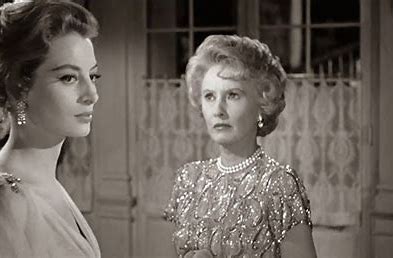
Edward Dmytryk
(APPROVED)
LGBTQ+ CHARACTERS
*Hallie (Capucine)
*Jo (Barbra Stanwyck)
LGBTQ+
ACTOR: Capucine
ACTOR: Barbara Stanwyck
ACTOR: Laurence Harvey
COSTUME DESIGNER: Charles LeMaire
Laurence Harvey’s Dove Linkhorn and Jane Fonda’s Kitty Twist meet on a dusty Texas road during the Great Depression and decide to hitchhike together to New Orleans. Dove is searching for his lost love, Hallie (Capucine), and when they arrive in the Big Easy, he finds her working at the Doll House, an upscale French Quarter bordello run by Jo (Barbara Stanwyck). The film strongly suggests that Jo and Hallie share a lesbian relationship. Hallie, unhappy with her life but accustomed to its comforts, continues working for Jo and hesitates to risk everything for the married life Dove proposes.
Stanwyck—looking decidedly butch—and Capucine—radiantly femme—have several compelling scenes together, their dynamic far more charged than anything involving Harvey or Fonda. Harvey is wan, and Fonda, still early in her career, isn’t given enough to do. The result is a film with flashes of queer electricity but not enough narrative or emotional momentum to sustain it. It’s no fun.
The film also stars Anne Baxter as the owner of the diner where Harvey gets a job, as well as Joanna Moore (mother of Tatum O’Neill) and Juanita Moore (no relation).
Music by Elmer Bernstein.
Adapted by John Fante from the 1956 novel A Walk on the Wild Side by Nelson Algren.
Cinematography:
Joseph MacDonald
A Charles K. Feldman Production for Columbia Pictures
NOW SCREENING ON AMAZON PRIME VIDEO
68. The L-Shaped Room
B+
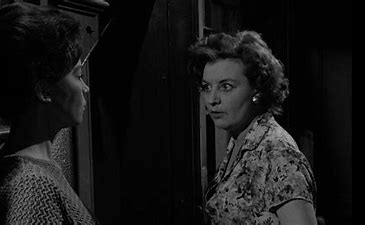
Bryan Forbes
(SUBMITTED: APPROVED WITHOUT CUTS)
Johnny, who is gay in the book, is not identified as queer in the movie.
LGBTQ+ CHARACTERS
*Mavis (Cicely Courtneidge)
A recording of the song Take Me Back to Dear Old Blighty, sung in the film by Mavis, is sampled at the beginning of the title track of the album The Queen is Dead by the Smiths.
In The L-Shaped Room, we meet Jane Fosset (Leslie Caron), a young Frenchwoman, who becomes pregnant after an affair and refuses to marry the baby’s father. Facing strict parents and social stigma, she moves into a dingy boarding house in West London. Her attic room is L-shaped, symbolic of her marginal position in society. The house is filled with outsiders: the aging actress Mavis (Cicely Courtneidge), the West Indian jazz musician Johnny (Brock Peters), and the aspiring writer Toby (Tom Bell). Initially considering abortion, Jane changes her mind after a cold encounter with Dr. Weaver (Emlyn Williams). She takes a café job, slowly adapts to her surroundings, and grows close to Toby. Jane and Toby fall in love. However, Toby feels betrayed when he learns of Jane’s pregnancy and Jane is left to face her future alone. Despite heartbreak, Jane embraces her independence and prepares to raise her child, finding strength in her community of misfits.
Writer/director Bryan Forbes’s lovely and faithful adaptation of the Lynne Reid Banks novel boasts Leslie Caron’s most outstanding performance. Equally impressive is Courtneidge as Mavis, an aging actress who is a lesbian and is mourning the loss of a companion. For Tom Bell, it was his breakthrough as a leading man in British film and TV.
Cinematography:
Douglas Slocombe
Romulus Films
Distributed by Columbia Pictures in the US.
NOW STREAMING ON YOUTUBE
69. The Haunting (1963)
A-
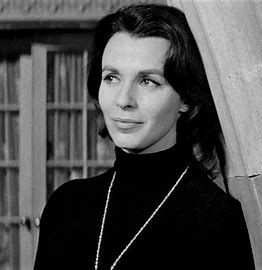
Robert Wise
(APPROVED)
LGBTQ+ CHARACTER
*Theo (Theodora) (Claire Bloom)
LESBIAN CHIC COURTESY OF CLAIRE BLOOM
As the chic Greenwich Village lesbian Theo—short for Theodora—Claire Bloom is a knockout in The Haunting, Robert Wise’s chilling 1963 adaptation of Shirley Jackson’s 1959 novel The Haunting of Hill House. Shot in England (standing in for New England), the film features Theo in couture designed exclusively by Mary Quant, the queen of Carnaby Street. It remains one of the finest, if not the finest, haunted‑house films ever made.
Theo is one of several guests invited by Dr. John Markway (Richard Johnson), a paranormal researcher, to spend a weekend investigating the notorious Hill House. For ninety years—and likely ninety more—the mansion has been marked by tragedy, insanity, and violent death. Joining Theo are Eleanor (Julie Harris), a lonely woman with psychic sensitivity, and Luke (Russ Tamblyn), the skeptical heir to the estate.
The group soon experiences terrifying phenomena: pounding on doors, ghostly voices, shifting architecture, and a sense that the house itself is alive. Eleanor, fragile and yearning for belonging, feels a deep personal connection to Hill House, believing it speaks directly to her. Her psyche deteriorates as she becomes increasingly isolated and obsessed. In the film’s devastating final act, Eleanor drives her car into a tree on the estate—an act that may be suicide or supernatural compulsion. The film closes with the unforgettable line:
AND WE WHO WALK HERE, WALK ALONE!
This is perhaps Julie Harris’s most emblematic screen performance; no one played fragility mixed with a troubled mind better. And it’s easy to see why Theo is drawn to her. Bloom’s portrayal is subtle, elegant, and deeply humane. Theo’s attraction is expressed with care and restraint, making her one of the most enlightened gay characters to appear in mainstream cinema up to that point.
Cheers, Claire. You always were a class act!
As the caretaker’s wife, Rosalie Crutchley, has a great departure scene when bidding Theo and Nell goodbye on their first night in the house:
I DON’T STAY AFTER SIX. I LEAVE BEFORE THE DARK COMES, SO THERE WON’T BE ANYONE AROUND IF YOU NEED HELP.
NO ONE CAN HEAR YOU IF YOU SCREAM IN THE NIGHT. NO ONE LIVES ANY NEARER THAN TOWN.
NO ONE WILL COME ANY NEARER THAN THAT. IN THE NIGHT. IN THE DARK!
The haunting atonal music score, one of my personal favorites, is by Humphrey Searle
Cinematography
Davis Boulton
MGM
NOW STREAMING ON AMAZON PRIME VIDEO, APPLE TV+, YOUTUBE
70. The Servant (1963)
(A)
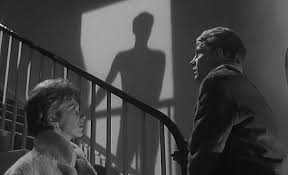
Joseph Losey
(SUBMITTED: APPROVED WITHOUT CUTS)
LIKE PSYCHO, THE SERVANT QUIETLY GUTTED THE CODE BY GETTING PAST IT!
LGBTQ+ CHARACTERS
*Hugo (Dirk Bogarde)
*Tony (James Fox)
*Older lesbian in restaurant scene (Doris Nolan – billed as Doris Knox)
*Younger lesbian in restaurant scene (Jill Melford)
LGBTQ+
ACTOR: Dirk Bogarde
THE SERVANT ENDURES AS ONE OF THE SHARPEST DISSECTIONS OF BRITAIN’S SOCIAL AND SEXUAL HYPOCRISIES.
Tony (James Fox), an upper‑class bachelor settling into a new London townhouse, hires Hugo Barrett (Dirk Bogarde) to manage his household. Barrett appears efficient, deferential, and indispensable, but Tony’s girlfriend, Susan (Wendy Craig), distrusts him from the start and urges Tony to dismiss him. Barrett soon brings Vera (Sarah Miles) into the house, claiming she is his sister. Tony begins a clandestine affair with her. When Tony and Susan return early from a trip, they discover Barrett and Vera together in Tony’s bedroom. ,Vera is revealed not as Barrett’s sister but as his lover. Tony fires Barrett and ends his relationship with Susan. Yet Barrett insinuates himself back into Tony’s life, and over time, the balance of power reverses: Tony becomes passive, dependent, and degraded, while Barrett assumes total control of the house.
Adapted by Harold Pinter from Robin Maugham’s novella and directed by Joseph Losey, The Servant pulses with homoerotic tension rooted in its dominance‑and‑submission dynamic. The sexual charge between master and servant is unmistakable, and its influence radiates forward in time—most notably into Donald Cammell and Nicolas Roeg’s Performance (1970 – see Essay Two), where James Fox again plays a man undone by another’s seductive power.
Pinter’s screenplay is a masterclass in sharp dialogue, loaded silences, and psychological tension, earning the New York Film Critics Circle Award for Best Screenplay of 1964. Losey’s direction creates a claustrophobic, almost suffocating atmosphere, using mirrors, shadows, and shifting spatial relationships to chart the collapse of class boundaries. The film’s exploration of power, dependency, and social rot anticipates the themes Losey and Pinter would later refine in Accident (1967) and The Go‑Between (1971).
A landmark of British cinema, The Servant remains one of the most incisive dissections of Britain’s social and sexual hypocrisies. Though it falters in its final thirty minutes, it contains Bogarde’s most extraordinary performance—controlled, insinuating, and devastating.
In the beautifully choreographed and edited restaurant scene, there are four couples, one of whom is obviously a lesbian couple:
- COUPLE ONE: Wendy Craig and James Fox (our leads)
- COUPLE TWO: Harold Pinter and Ann Firbank (society man and woman)
- COUPLE THREE: Doris Knox and Jill Melford (the lesbian couple)
- COUPLE FOUR: Patrick Magee and Alun Owen (the bishop and the priest)
The black-and-white cinematography is by Douglas Slocombe.
Warners-Pathe
NOW STREAMING ON AMAZON PRIME VIDEO, APPLE TV+, AND BFI CLASSICS.
71. The Leather Boys (1964)
(B)
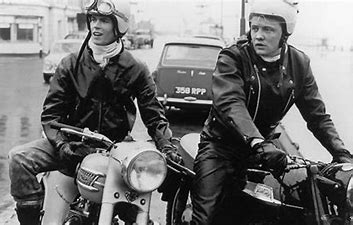
Sidney J. Furie
(SUBMITTED: APPROVED WITHOUT CUTS )
As a British production distributed in the U.S. by Columbia/British Lion, the film had to be submitted to the Production Code Administration (also known as the Hays Office) for approval. The film’s treatment of homosexuality was considered daring and in violation of the Code’s prohibition against sex perversion. Despite this, it was screened in the U.S. without cuts, making it one of the rare examples of a queer‑themed film shown before the Code’s collapse in 1968. This also underscores its importance as an early queer cinema landmark and a sign of the Production Code’s waning power in the mid‑1960s.
LGBTQ+ CHARACTER
*Pete (Dudley Sutton)
*Reggie (Colin Campbell)
LGBTQ+ COSTUME DESIGNER
Harry Haynes
Adapted by Gillian Freeman from her novel of the same name, The Leather Boys introduces us to Reggie(Colin Campbell), a young South London mechanic and biker who marries his teenage sweetheart, Dot (Rita Tushingham). Their marriage quickly deteriorates as Dot proves to be immature and self-centered, more interested in having fun than in taking responsibility. Reggie finds solace in the camaraderie of the “ton-up boy” (see below) rocker scene, riding motorcycles and spending time with friends. Reggie grows increasingly close to fellow biker Pete (Dudley Sutton), whose eccentric personality and warmth contrast with Dot’s indifference. Their friendship deepens into an emotionally charged relationship, with queer undertones that were daring for the time. Dot drifts away, while social pressures and a revealing scene in a gay bar test Reggie and Pete’s bond. The film ends ambiguously, with Reggie caught between conformity and self-discovery.
Canadian journeyman Sidney J. Furie, who would come into his own the following year with The Ipcress File, does a nice job here getting good performances from all three leads. The final scene in the gay bar is a bit of a disappointment from a gay perspective. However, the movie’s long closing tracking shot is a beauty.
“Ton-up boys” were a 1950s and 1960s British youth subculture defined by their obsession with motorcycles and speed. The term refers to their goal of “doing the ton”—achieving speeds of 100mph or more on public roads. To reach these speeds on machines often limited to 70–80mph they heavily modified their motorcycles for performance, unintentionally creating the “café racer” style. Often synonymous with “Rockers” or “Leather Boys,” these riders were typically working-class teenagers who used motorcycles for freedom and social escape in post-WWII Britain. They were heavily influenced by American rock and roll and often wore leather jackets (sometimes repurposed from military gear). Because they were often too young for pubs, they gathered at transport cafés.These cafes served as both social hubs and the start/finish lines for impromptu races. The famous Ace Cafe, located on London’s North Circular Road, the diner/meeting point featured in the film, was restored and reopened in 2001 after being used for many years as a tire depot.
The Smiths’ single Girlfriend in a Coma features Tushingham and Campbell on the cover.
The Leather Boys influenced Katherine Bigelow’s movie debut, The Loveless (1981).
Cinematography: Gerald Gibbs
British Lion-Columbia: Raymond Stross
NOW STREAMING: YouTube, Tubi, and Classix
72. My Fair Lady (1964)
A+

GEORGE CUKOR
(APPROVED)
LGBTQ+ CHARACTERS
*Professor Henry Higgins (Rex Harrison)
*Colonel Hugh Pickering (Wilfrid Hyde-White)
LGBTQ+
DIRECTOR: George Cukor
ACTOR: Jeremy Brett
ART-SET DIRECTION: Cecil Beaton
ART-SET DIRECTION: George James Hopkins
AET-SET DIRECTION: Gene Allen
COSTUME DESIGNER: Cecil Beaton
Adapted from the 1956 Lerner and Lowe stage musical based on George Bernard Shaw’s 1913 stage play Pygmalion. Screenplay by Alan Jay Lerner and direction by George Cukor. Costumes and set-design by Cecil Beaton – with George James Hopkins and Ken Adam (a gay threesome!) Cinematography by Harry Stradling.
Winner of eight Oscars, including Best Film, Best Director, Best Actor, Best Set-Design, Best Costumes and Best Cinematography.
Why can’t a woman be more like a man
Henry Higgins to Colonel Pickering in My Fair Lady (1964)
My Fair Lady, the 1964 American musical-comedy-drama, was George Cukor’s late-career triumph. It is fitting that, in his emeritus years, Hollywood’s most renowned gay director was able to deliver the screen’s most relaxed and blissfully at ease gay couple while, at the same time, reveling in the gay camp of Cecil Beaton’s magnificent set and costume designs.
The couple in question is Professor Henry Higgins (Rex Harrison, reprising his role from the stage musical) and Colonel Hugh Pickering (a marvelous Wilfrid Hyde-White). The two actors are perfect together, practically finishing one another’s sentences and capturing the essence of a relationship that stems from a long cohabitation. Whether they are confirmed bachelors or lovers seems immaterial. As with Sherlock Holmes and Dr. Watson, they are, in many ways, the perfect gay couple.
Then, into their lives, comes a poor Cockney flower-seller named Eliza Doolittle (Audrey Hepburn, replacing Julie Andrews from the stage musical) who overhears Higgins, as he casually wagers with Pickering that he could teach her to speak English so well she could pass for a duchess in Edwardian London or better yet, from Eliza’s viewpoint, secure employment in a flower shop. Yet, even at the film’s denouement, when it appears that Higgins has achieved his Pygmalion goals and transformed Eliza into a Lady, we do not honestly believe the two have fallen in love. We know that in the next unshown reel, Eliza is out, and our two Edwardian gentlemen are back together in their men-only sanctuary.
The movie is a delight from beginning to end, and if Audrey seems more at ease in the latter half of the film, where she plays Eliza as a Lady, that may be because these scenes are more in keeping with the Audrey persona we have come to know and love. She had signed on to the movie thinking that she would be doing her own singing – she had accomplished this with aplomb in Funny Face – and was bitterly disappointed when the decision was made to dub her voice with Marni Nixon’s vocals.
With Stanley Holloway as Eliza’s father, Gladys Cooper as Henry’s mother (both were Oscar-nominated) and gay actor Jeremy Brett as Eliza’s suitor Freddy Eynsford-Hill. He sings a rousing version of On the Street Where You Live (dubbed by Bill Shirley).
The soundtrack contains the following Lerner and Lowe classics:
Wouldn’t It Be Lovely
With a Little Bit of Luck
(Just) You Wait (Henry Higgins)
The Rain in Spain
I Could Have Danced All Night
Ascot Gavotte
On the Street Where You Live
You Did It
Show Me
Get Me to the Church on Time
I’ve Grown Accustomed to Her Face
Warner Bros.
NOW STREAMING ON AMAZON PRIME VIDEO, APPLE TV+, YOUTUBE
73. Inside Daisy Clover (1965)
C+

Robert Mulligan
(SUBMITTED: APPROVED WITHOUT CUTS)
THERE WAS A LOT OF BACK AND FORTH BETWEEN THE STUDIO AND THE HAYS OFFICE WITH RESPECT TO BOTH THE NATALIE WOOD AND ROBERT REDFORD CHARACTERS. THE FINAL SUBMITTED PRODUCT, HOWEVER, WAS RELEASED WITHOUT CUTS.
LGBTQ+ CHARACTER
*Wade Lewis (Robert Redford)
LGBTQ+
SOURCE MATERIAL: Gavin Lambert (novel)
SCREENWRITER: Gavin Lambert
SET DESIGNER: George James Hopkins
COSTUME DESIGNER: Edith Head
COSTUME DESIGNER: Bill Thomas
In 1936 Angel Beach, California, Daisy Clover (Natalie Wood) is a tough, chain‑smoking fifteen‑year‑old tomboy living with her eccentric mother (Ruth Gordon) in a rundown trailer. Dreaming of stardom, she sends a recording of her singing to Swan Studios. Studio head Raymond Swan (Christopher Plummer) signs her, rebrands her as “America’s Valentine,” and promptly commits her mother to an institution to sanitize Daisy’s public image.
Daisy marries fellow actor Wade Lewis (Robert Redford), but he abandons her during their honeymoon. She later learns Wade is bisexual and has had affairs—including with Swan’s wife. Daisy retrieves her mother from the institution, only for her to die suddenly. Swan’s manipulative control over Daisy’s career intensifies her emotional collapse. After a failed suicide attempt, Daisy decides to walk away from Hollywood entirely. In the film’s iconic ending, she blows up her beach house and strolls off, declaring, “Someone declared war.”
Although Redford insisted that his character be changed from homosexual (as in Gavin Lambert’s novel) to bisexual, it was still a bold choice of role for the time, and one that helped launch his career. Natalie Wood throws herself into the role of Daisy, though her singing is dubbed by Jackie Ward. Yet because Lambert had to eviscerate his own book in the translation to screen, and because Robert Mulligan’s direction is uneven, Wood’s work here cannot match the high‑water marks of Rebel Without a Cause, Splendor in the Grass, or Love with the Proper Stranger (also directed by Mulligan).
The film’s finest performance comes from Ruth Gordon, in what would become her signature screen persona: the eccentric yet sympathetic older woman. She earned her first Oscar nomination for the role and would win three years later for Rosemary’s Baby.
A BO and a critical failure at the time, the film has developed a cult following over the years.
The beach house that Daisy demolishes at the end of the movie once belonged to silent movie queen Barbara La Marr.
Cinematography: Charles Lang
Produced by Alan J. Pakula
Warner Bros.
NOW STREAMING ON AMAZON PRIME VIDEO, APPLE TV+, YOUTUBE
74. King Rat (1965)
(A)

Bryan Forbes
(APPROVED)
LGBTQ+ CHARACTERS
*Corporal King (George Segal)
*Lt. Peter Marlowe (James Fox)
LGBTQ+ ACTOR
Denholm Elliott
Changi Prison, Singapore, 1945. In this Japanese POW camp, Allied prisoners endure starvation, disease, and despair. Traditional military hierarchies collapse as survival becomes the only currency. Unlike most, American Corporal King (George Segal) thrives. Running a black‑market empire, trading with guards, and manipulating scarce resources, he becomes both admired and despised. Lt. Peter Marlowe(James Fox), an upper‑class British officer fluent in Malay, becomes King’s translator. He benefits from King’s schemes but wrestles with the moral cost of survival. Lt. Robin Grey (Tom Courtenay), the camp provost, embodies rigid British discipline. He despises King’s corruption and becomes obsessed with exposing him, even as corruption among higher‑ranking officers goes unpunished.
King saves Marlowe’s arm with medicine, but the gesture is ambiguous: genuine friendship, strategic self‑interest, or both? Marlowe knows where King’s profits are hidden. When liberation finally arrives, the restored military hierarchy instantly strips King of his influence, revealing how transactional his power—and his relationships—truly were.
Adapted from James Clavell’s 1962 novel, drawn from his own POW experience, and directed by Bryan Forbes, King Rat is one of the great WWII prison‑camp films. Although James Fox’s Marlowe is not explicitly portrayed as gay, there is a strong homoerotic subtext in his relationship with King. Their friendship is unusually intimate compared to other POW interactions. King tends to Marlowe’s wounds, stays by his bedside, entrusts him with secrets, and looks at him with a warmth he shows no one else. Clavell’s novel hints at Marlowe’s sensitivity and ambiguous attachments, while the film leaves their bond open to interpretation. Some viewers read Marlowe’s wistful gaze as King departs the camp as coded longing.
James Fox, an actor of unusual sensitivity, is easy to queer‑code, and his scenes with Segal have a beauty and yearning that any gay man can recognize. Segal, rising to stardom, still had depths and mysteries that later roles rarely tapped. The British‑American dynamic between them adds yet another layer of fascination.
Tom Courtenay once again proves what a tremendous actor he is, and the supporting cast is a treasure trove of British greats: John Mills, Denholm Elliott, and James Donald, each bringing nuance and gravity to this stark, morally complex world.
Cinematography: Burnett Guffey
Columbia Pictures
NOW STREAMING ON AMAZON PRIME VIDEO, APPLE TV+, YOUTUBE
75. The Loved One (1965)
A-
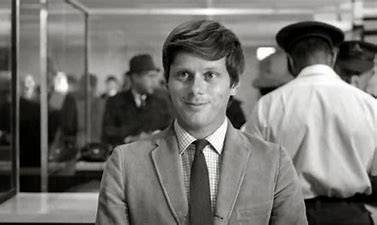
Tony Richardson
(APPROVED)
LGBTQ+ CHARACTERS
*Mr. Joyboy (Rod Steiger)
*Mr. Starker (Liberace)
LGBTQ+
DIRECTOR: Tony Richardson
SCREENWRITER: Christopher Isherwood
ACTOR: John Gielgud
ACTOR: Tab Hunter
ACTOR: Liberace
ACTOR: Roddy McDowell
COSTUME DESIGNER: Rouben Ter-Arutnian
Everyone had great fun adapting Evelyn Waugh’s 1948 short satirical novel about the funeral business in Los Angeles. However, understandably, it was not a hit at the box office and ruined any chance of a Hollywood career for director Tony Richardson. It now has a cult following and is highly regarded in some quarters, including TheBrownees. Haskell Wexler’s black-and-white photography is impressive. Christopher Isherwood and Terry Southern wrote a very witty screenplay. The fantastic cast includes:
- Robert Morse as Dennis Barlow
- Anjanette Comer as Aimée Thanatogenos**
- Jonathan Winters as both Henry Glenworthy and Wilbur Glenworthy
- Rod Steiger as Mr. Joyboy
- Dana Andrews as Gen. Buck Brinkman
- Milton Berle as Mr. Kenton
- James Coburn, as the Immigration Officer
- Ayllene Gibbons as Mr. Joyboy’s Mother
- John Gielgud as Sir Francis Hinsley
- Tab Hunter, as the Whispering Glades tour guide
- Margaret Leighton as Mrs. Helen Kenton
- Liberace as Mr. Starker
- Roddy McDowall as DJ, Jr.
- Robert Morley as Sir Ambrose Abercrombie
- Alan Napier, as the English Club’s official
- Barbara Nichols as Sadie Blodgett
- Lionel Stander, as the Guru Brahmin
- Paul Williams as Gunther Fry
- Jamie Farr as a waiter at an English Club (uncredited)
** Aimée means BELOVED, and Thanatogenos means BORN OF DEATH.
FILMWAYS
NOW STREAMING ON AMAZON PRIME VIDEO, APPLE TV+, YOUTUBE
76. Darling (1965)
B-
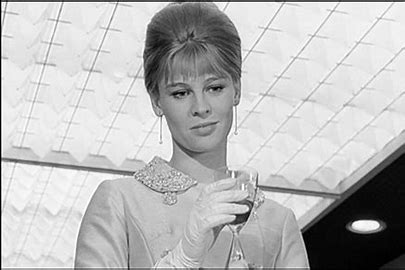
John Schlesinger
(SUBMITTED: APPROVED WITHOUT CUTS)
LGBTQ+ CHARACTER
*Miles Brand (Dirk Bogarde)
LGBTQ+
DIRECTOR: John Schlesinger
ACTOR: Dirk Bogarde
ACTOR: Laurence Harvey
It was so fashionable in 1965, so dated today. Never has a film demonstrated how rapidly modishness withers. Still, it features a star-making and Academy Award-winning turn by the impossibly beautiful Julie Christie, even if far more people saw her as Laura in David Lean’s Doctor Zhivago, released the same year – she even got a theme of her own. Christie is Diana Scott, a young, successful model in swinging sixties London who plays with the affections of two older men (Dirk Bogarde and Laurence Harvey), one of whom is married (Bogarde).
Bogarde and Harvey were both gay. The latter experienced significant career advancements due to his decade-long relationship with producer James Woolf. With his brother John, Woolf founded Romulus/Remus Films in the early ’50s and produced Harvey’s star-making performance in Room at the Top.
Director John Schlesinger would go on to direct far better Queer Films, such as Midnight Cowboy and Sunday Bloody Sunday, which will be covered in Essay Two: 85 Queer Films from the New Hollywood, 1968-1980
The Oscar-winning Original Screenplay is by Frederic Raphael.
CINEMATOGRAPHY
Kenneth Higgins
Joseph Janni Productions
NOW STREAMING ON AMAZON PRIME VIDEO, BFI CLASSICS (APPLE TV+)
77. My Hustler (1965)
B+
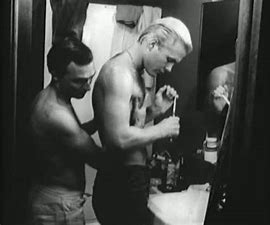
Andy Warhol and Chuck Wein
(NOT SUBMITTED FOR APPROVAL)
The film premiered at the Filmmakers’ Cinematheque in New York in January 1966 and then ran in alternative and art-house venues across the U.S. through 1968. At the time, the Production Code (Hays Code) still prohibited depictions of homosexuality as “sex perversion”. Mainstream studios had to submit films for approval, but Warhol’s underground productions operated outside the studio system. Because My Hustler was independently produced and distributed through non‑studio channels, it bypassed the Production Code Administration entirely. It never carried the Code seal of approval.
My Hustler is the only extant Factory Film that:
1) has been transferred to digital media and 2) has made a profit.
LGBTQ+ CHARACTER
*Ed – the client (Ed Hood, uncredited)
*Joe – the older hustler (Joe Campbell, uncredited)
*Paul – the younger hustler (Paul America, uncredited)
LGBTQ+
DIRECTOR: Andy Warhol
DIRECTOR: Chuck Wein
PRODUCER: Andy Warhol
CINEMATOGRAPHER: Andy Warhol
ACTOR: Ed Hood (uncredited)
ACTOR: Paul America (uncredited)
ACTOR: Joe Campbell (uncredited)
Prepare to be surprised. If your only encounters with Andy Warhol’s cinema are Chelsea Girls or Empire, don’t give up just yet. My Hustler is a very different experience: a film with a straightforward narrative, strong performances, and a sly sense of humor. Shot on Fire Island in 1965, it follows the rivalry among two men and a woman competing for the attention of a young male hustler—openly engaging with queer themes that were daring for its time.
At 76 minutes, the film is brisk and unexpectedly engaging. Warhol shares directorial credit (with Chuck Wein) for the first time, as he would later with Paul Morrissey. Wein’s presence obviously made a difference. Much of the film’s appeal comes from Ed Hood, who transforms what could have been a stock “bitter old queen” role into a hilarious yet sympathetic character. The cast also includes Paul America as the hustler at the center of desire; Joe Campbell (nicknamed the Sugar Plum Fairy) as an older, more seasoned hustler; and Genevieve Charbin as a straight woman determined to get her share of the action. The Factory’s legendary door person—and Chelsea Girls alum—Dorothy Dean makes a cameo appearance, adding another layer of Warholian texture. All of the actors are uncredited.
The film’s wit, looseness, and sun‑bleached Fire Island energy have made it a favorite among both gay and straight audiences. Conceived by Warhol and Wein, the project relied heavily on improvised dialogue—hence the absence of an official screenwriting credit. Paul Morrissey served as the camera operator and general electrical guru, while Warhol himself is credited as cinematographer. Morrissey was the first to introduce synchronized sound and camera movement into a Factory film, giving My Hustler a clarity and immediacy that set it apart from Warhol’s earlier experiments.
Joe Campbell, also known as The Sugar Plum Fairy, was immortalized in Lou Reed’s recollection of his Warhol Factory days, as featured in Walk on the Wild Side. He was also Harvey Milk’s boyfriend in New York from 1955 to 1962.
Andy Warhol Films (The Factory)
NOW AVAILABLE TO STREAM ON THE INTERNET ARCHIVE (ARCHIVE.ORG)
78. The Pawnbroker
A-

Sidney Lumet
INITIALLY, REFUSED A SEAL OF APPROVAL BY THE PCA. The film’s Producer Ely Landau and his distributer Allied Artists were having none of this. They decided on a two-pronged approach: they would make arrangements for the film to be released without Hays Code approval – it was originally released in New York state under these conditions in 1964 – and it would appeal the PCA’s verdict to the Motion Picture Association of America (the same MPAA that would take over the rating system after the PCA’s dissolution in 1968). They won. The MPAA voted 6 to 3 to reverse the PCA’s verdict. The film was GIVEN THE HAYS CODE SEAL OF APPROVAL on its general US release in 1965. The ruling was one of a series of injuries to the Production code that would prove fatal within three years.
LGBTQ+ CHARACTER
*Rodriguez (Brock Peters)
Sol Nazerman, (Rod Steiger) once a Jewish professor in Europe, now runs a pawn shop in East Harlem. Twenty‑five years after surviving the Nazi concentration camps, he lives emotionally numb, having lost his wife, children, and faith in humanity during the Holocaust. His life is marked by recurring flashbacks of the atrocities he witnessed, which intrude on his daily routine and keep him detached from everyday life.
The film follows Sol’s gradual unraveling as he realizes how his detachment harms those around him. His inability to connect or act compassionately leads to tragic consequences, ultimately forcing him to face the depth of his trauma and the cost of shutting out the world.
Rod Steiger is exceptional in what is, arguably, his greatest performance. He received the first of his two Best Actor Oscar nominations for this movie but lost to Lee Marvin in Cat Ballou. He won two years later for In the Heat of the Night (1967).
With Geraldine Fitzgerald.
THE PAWNBROKER IS:
- FIRST AMERICAN FILM TO FEATURE A QUEER AFRICAN AMERICAN CHARACTER – BROCK PETERS*
- FIRST AMERICAN FILM TO DEAL WITH THE HOLOCAUST FROM THE POINT OF VIEW OF A SURVIVOR
- FIRST AND ONLY PCA-APPROVED FILM TO SHOW A WOMAN’S BARE BREASTS** ***
*Brock Peters’character JOHNNY was neutered on his transition from book to screen in The L-Shaped Room. Peters made up for this two years later in The Pawnbroker, where he plays the small but pivotal role of the mob boss Rodriguez, the man who controls Sol’s business. The L-Shaped Room even gets a Marquee cameo in the movie.
**The film was controversial on initial release for depicting nude scenes in which actresses Linda Geiser and Thelma Oliver fully exposed their breasts. The scene with Oliver, who played a prostitute, was intercut with a flashback to the concentration camp, in which Nazerman is forced to watch his wife (Geiser) and other women being raped by Nazi officers.
*** One year later, in 1966, Vanessa Redgrave famously bared her breasts in Michelangelo Antonioni’s Blow-Up . The film, distributed by MGM, was submitted to the PCA but denied a Seal. MGM then decided to distribute the movie without Hays Office approval through its subsidiary Premier Productions. It was an arthouse smash and the final nail in the Hays Code coffin.
Cinematography: Boris Kaufman
Screenplay by Morton S. Fine and David Friedkin based on the 1961 novel by Edward Lewis Wallant.
Music: Quincy Jones
Producer: Ely Landau – The Landau Company
Distributer: Allied Artists
NOW STREAMING ON AMAZON PRIME VIDEO, APPLE TV+, and YOUTUBE
79. Persona (1966)
A+
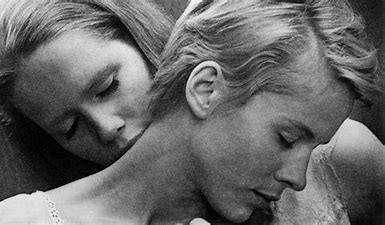
Ingmar Bergman
(SUBMITTED – APPROVED WITH CUTS)
Measured in seconds rather than minutes. A few frames of nudity and some dialogue tightening. Bibi Andersson’s sexual monologue was left largely intact. These frames have since been restored. Persona was the last major motion picture to defer to the PCA. The same year, MGM decided to distribute Michelangelo Antonioni’s Blow-Up without Hays Office approval through its subsidiary Premier Productions. It was an arthouse smash and the final nail in the Hays Code coffin.
LGBTQ+ CHARACTER
*Alma (Bibi Andersson)
*Elisabet (Liv Ullmann)
My Favorite Foreign Language Film
Ingmar Bergman’s Persona is a cinematic masterpiece that examines the complex and intimate relationship between two women, Elisabet (played by Liv Ullmann) and Alma (played by Bibi Andersson). Elisabet, a theatre actress, suddenly becomes mute during a performance of Electra, and Alma, a nurse, is assigned to care for her. They move to a cottage on Fårö (also known as Bergman) island off the coast of Sweden, where, in their isolation, the women develop a deep emotional bond that blurs the lines between reality and imagination. Elisabet’s silence and withdrawal contrast with Alma’s volubility and desire for emotional connection. Eventually, Alma begins having trouble distinguishing herself from her patient.
Bergman’s revolutionary script and direction delve into topics such as vampirism, motherhood, abortion, and the Jungian theory of persona while highlighting what is fundamentally a love story between two women. Andersson’s and Ullman’s performances rank among the greatest in movie history.
In addition, the movie gives us not just one but two supremely erotic moments. The first is Andersson’s now-famous monologue, in which Alma recounts an episode from her youth in which she and her friend Katarina engaged in a spontaneous orgy on a beach. The sensuality of the moment is centered on Alma’s memory of the intimate connection between herself and her friend as they were, in turn, penetrated by an unknown man while another watched. The second is a series of intimate compositions featuring the two women, filmed in black and white and shot in extreme close-ups by the legendary Swedish cinematographer Sven Nykvist. These images have become iconic.
Original screenplay by Ingmar Bergman
Lopert/United Artists
NOW STREAMING ON AMAZON PRIME VIDEO, APPLE TV+, MAX (YOUTUBE)
80. The Group (1966)
(C)
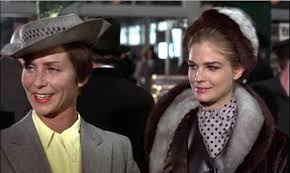
Sidney Lumet
(APPROVED)
LGBTQ+ CHARACTER
*Lakey (Candice Bergen)
*The Baroness, Lakey’s friend from Europe (Lidia Prochnicka)
Based on the 1963 novel of the same name by Mary McCarthy about the lives of eight female graduates (played by Joanna Petit, Jessica Walter, Mary Robin Redd, Candice Bergen, Shirley Knight, Joan Hackett, Kathleen Widdoes, and Elizabeth Hartman) from Vassar from 1933 to 1940, director Sidney Lumet’s movie is like a microcosm of his career – biting off more than he can chew. The film meanders incessantly, with only Joan Hackett’s Dottie (at the beginning), Elizabeth Hartman’s Priss (in the middle), and Shirley Knight’s Polly (at the end) getting the respect they deserve. The other five actresses and their characters get no respect or insight whatsoever. It’s a lost opportunity. This goes double for Candice Bergen, making her movie debut as the film’s token lesbian character, Lakey. Lakey spends most of the movie in Europe, a place where rich lesbians were banished in film like this before there was a California.
At the outbreak of World War II, Lakey returns to the United States with a baroness in tow. However, said Baroness (Lidia Prochnicka) gets no dialogue. Her sole purpose is to be introduced to The Group at the railway station so we can see the shock on their faces; her queerness is not subtle! So, unlike Lauren Bacall and Katherine Kurasch in Young Man with a Horn or Sandy Dennis and Anne Heywood in The Fox, no relationship is documented here. Probably just as well since, even though Bergen’s natural beauty is striking, she is so tightly coutured in a series of stiff lesbian outfits by designer Anna Hill Johnstone that it’s a wonder the poor thing could even breathe. I swear, in some of her scenes, she looks like a prototype for the Corleone brothers in The Godfather, for which Johnstone would design her landmark costumes six years later.
Cinematography
Boris Kaufman
United Artists
NOW STREAMING ON AMAZON PRIME VIDEO, APPLE TV+, MAX (YOUTUBE)
81. Valley of the Dolls (1967)
Rated (C) (Solo)
High Camp at a Midnight Screening
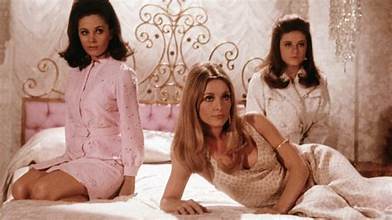
Mark Robson
(SUBMITTED : APPROVED WITH CUTS)
SOME SCENES WERE CUT FOR RATING AND PACING – NOT CENSORSHIP ALONE – WHAT WE SEE TODAY IS ESSENTIALLY WHAT AUDIENCES SAW IN 1967
LGBTQ+ CHARACTER
*Ted Casablanca (Alexander Davion) is a hairdresser who is often assumed to be gay by others, but his actual sexual orientation is unknown.
LGBTQ+ COSTUME DESIGNER
William Travilla
Based on Jacqueline Susann’s trashy but compulsively readable novel about three women (Patty Duke, Barbara Parkins, and Sharon Tate) trying to forge careers in the entertainment industry, each descending into barbiturate addiction – the valley of the dolls. TCF quickly realized that they had a real turkey on their hands, but the film, coasting on the book’s popularity, was a hit. Over time, Fox also realized that, thanks to Miss Patty Duke’s Neely O’Hara and, to a lesser degree, the terrible performance of Susan Hayward as fading star Helen Lawson, they also were the proud owners of a gay kitsch cult classic – A MOVIE TO BE SCREENED AT MIDNIGHT WITH A GAY CROWD. In other words, it’s a Rocky Horror GROUP experience and should NEVER be seen alone. Duke is so bad in this movie precisely because she thinks she is giving a shoo-in Oscar-caliber performance. Amid all the campness, Parkins and a surprisingly moving Tate survive relatively unscathed.
Andre and Dory Previn wrote the campy yet haunting theme of the film. As sung by Dionne Warwick, it reached #2 on the Hot 100 but was NOT nominated for an Oscar in the Best Original Song category.
The two Best Quotes in the movie are, of course, courtesy of Neely:
I have to get up at five o’clock in the morning and SPARKLE, Neely, SPARKLE!
Neely O’ Hara (PATTY DUKE) in “VALLEY OF THE DOLLS”
Ted Casablanca is not a fag, and I’m the dame to prove it!
Neely O’ Hara (PATTY DUKE) in “VALLEY OF THE DOLLS”
CINEMATOGRAPHY
William Daniels
TCF
NOW STREAMING ON AMAZON PRIME VIDEO, APPLE TV+, YOUTUBE
82. The Producers (1967)
B+

Mel Brooks
(SUBMITTED: APPROVED WITHOUT CUTS)
Mel Brooks’ debut feature, The Producers, was released by Embassy Pictures in the fall of 1967. Producer Joseph E. Levine nevertheless chose to submit the film to the Hays Office, fully aware that the Production Code’s authority was rapidly eroding. He also understood that the film’s flamboyantly gay characters—written as broad comic figures—were unlikely to provoke meaningful pushback from a system that was already losing its grip on Hollywood. He was correct. The film received the seal of approval without a single cut.
LGBTQ+ CHARACTER
*Roger De Bris (Christopher Hewett)
*Carmen Ghia (Andreas Voutsinas)
LGBTQ+
ACTOR: Christopher Hewett
ACTOR: Andreas Voutsinas
Mel Brooks’s debut feature is a deliriously irreverent farce about greed, show business, and the spectacular unpredictability of audiences. It’s also one of the sharpest satires ever made about the entertainment industry’s willingness to exploit anything—even fascism—if it might turn a profit.
Max Bialystock (Zero Mostel) is a washed‑up Broadway producer who finances his flops by seducing elderly women for checks. When timid accountant Leo Bloom (Gene Wilder) reviews Max’s books, he makes an offhand discovery: a producer could actually make more money with a guaranteed flop than with a hit, by overselling shares in a show that will close immediately.
SPRINGTIME FOR HITLER AND GERMANY
WINTER FOR POLAND AND FRANCE
DON’T BE STUPID BE A SMARTY
COME AND JOIN THE NAZY PARTY
They choose the play SPRINGTIME FOR HITLER, ex-Nazi Franz Liebkind’s musical valentine to Adolf Hitler—an idea so tasteless it seems foolproof. Liebkind is played by Kenneth Mars. They then hire LSD (short for Lorenzo St. DuBois, played by Dick Shawn), a blissed‑out hippie, to play Hitler, Roger De Bris (Christopher Hewett), a flamboyant (gay) director who turns everything into a camp spectacle, and Ulla (Lee Meredith), a Swedish bombshell who becomes their “secretary”. Everything is engineered to fail. Until it doesn’t. The play becomes a comedic smash, leaving Max and Leo in the red.
Not nearly as shocking today as it was in 1967, The Producers remains wildly entertaining. A huge part of its staying power comes from Roger De Bris and his exquisitely mannered assistant Carmen Ghia (Andreas Voutsinas), who sweep into the film’s latter half and all but hijack it. Their entrance scene—Max and Bloom’s first visit to the townhouse—is pure comedic gold, a rapid‑fire cascade of quotable lines and perfectly calibrated camp that could give Carrie a run for its money. It’s the moment the film shifts from outrageous to transcendent, carried entirely by Roger and Carmen’s unapologetic theatricality.
Please enjoy!
Cinematography: Joseph Coffey
Embassy Pictures
Now streaming on APPLE TV+, Amazon Prime Video, and YouTube
83. The Fox (1967)
B+
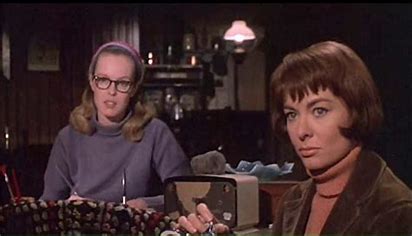
Mark Rydell
(NOT SUBMITTED)
Bypassing the Hays Office, the film was released independently, without a Code seal. Playing at film festivals, arthouses, and college campuses, it found an audience, and Lalo Schifrin’s Oscar-nominated score gave it a second wind in the Spring of 1969 – the movie was not shown in LA until 1968. It was later submitted to the MPAA retroactively and received an R rating.
.
LGBTQ+ CHARACTERS
*Jill Banford (Sandy Dennis)
*Ellen March (Anne Heywood)
LGBTQ+
Sandy Dennis
Director Mark Rydell (The Rose, On Golden Pond) moves the location of D.H. Lawrence’s short story to rural Canada, where our lesbian couple, Jill Banford (Sandy Dennis) and Ellen March (Anne Heywood), support themselves by raising chickens. They are happy and content. There is genuine chemistry between the two actresses without things being overtly physical. Then, unexpectedly, in the dead of winter, merchant seaman Paul (Keir Dullea) arrives on the property in search of his grandfather.
Yes, a fox keeps killing the chickens, and there is a dying oak tree, which we begin to realize is the Canadian equivalent of Chekov’s gun. Like John Huston’s Reflections in a Golden Eye, released the same year, The Fox does interesting things with color saturation (Bill Fraker was the cinematographer), and the Lalo Schifrin score has deservedly entered the jazz canon.
All three leads are impressive, and although the ending is a disappointment from a gay perspective, the movie is well worth seeing.
PRODUCER: Raymond Stross
Claridge Pictures – Warner Bros. Seven Arts
“THE FOX” IS NOT AVAILABLE FOR STREAMING. THE DVD CAN BE PURCHASED FROM AMAZON.
84. Portrait of Jason (1967)
(A)
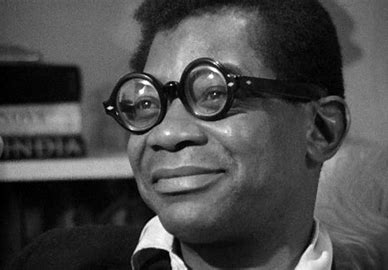
Shirley Clarke
(NOT SUBMITTED)
Bypassing the Hays Office, the film was released independently, without a Code seal. Playing at film festivals, arthouses and college campuses, it found an audience and paved the way for Independent Film as we know it today.
LGBTQ+ CHARACTER:
*Jason Holliday (né Aaron Payne, playing Himself)
Director Shirley Clarke and her partner, Carl Lee, remain off‑camera as they employ cinéma vérité techniques—prompting, prodding, provoking—to draw out hustler Jason Holliday (born Aaron Payne), who narrates his life story directly into the lens. For the entire film, Jason is the sole on‑screen presence, holding us enraptured as he bares his soul. He sings, changes costumes, performs theatrical monologues, and shifts effortlessly between bravado and vulnerability.
The film oscillates between comedy and tragedy, exposing Jason’s contradictions: the flamboyant self‑presentation versus the pain of marginalization, the survival instinct versus the longing for recognition. Blending cabaret flair with raw confession, Jason gradually reveals the sadness beneath his exaggerated persona. His performance is both constructed and devastatingly real, a portrait of a man who has learned to survive by turning himself into a show.
Portrait of Jason remains essential viewing—one of the most searing, intimate, and groundbreaking works of queer cinema.
Trivia: Director Shirley Clarke was the sister of novelist Elaine Dundy and, from 1951 to 1964, the sister‑in‑law of theatre critic Kenneth Tynan.
Cinematography: Jeri Sopanen
Film-Makers Distributers (Original release)
Milestone Films (Re-release)
NOW STREAMING ON THE CRITERION COLLECTION
85. Reflections in a Golden Eye (1967).
A+
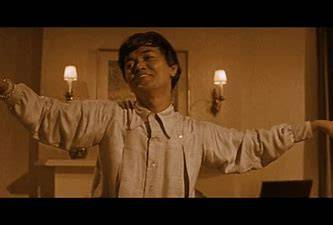
John Huston
(SUBMITTED: APPROVED WITHOUT CUTS)
RELEASED BY WARNER BROS. ON OCTOBER 13,1967, TWO WEEKS AFTER THE DEATH OF ITS AUTHOR, CARSON MCCULLERS, REFLECTIONS IN A GOLDEN EYE IS OFTEN CITED AS A PRIME EXAMPLE OF THE WEAKENING OF THE HAYS CODE. A FEW MONTHS LATER, THE HAYS CODE WOULD CEASE TO EXIST. IT IS FITTING, THEREFORE, THAT JOHN HUSTON’S MASTERPIECE STANDS AS THE FINAL CHAPTER IN MY ESSAY ENTITLED 85 QUEER FILMS MADE UNDER THE HAYS CODE (1934-1968).
LGBTQ+ CHARACTER
*Anacleto (Zorro David)
*Major Weldon Penderton (Marlon Brando)
LGBTQ+
ACTOR: Marlon Brando
ACTOR: Zorro David
SOURCE MATERIAL: Carson McCullers – based on her novel Reflections in a Golden Eye
AT AN ARMY BASE IN THE SOUTH……….
We meet Major Weldon Penderton (Marlon Brando), a repressed, closeted officer at war with his own masculinity and desires. His marriage to Leonora (Elizabeth Taylor) is passionless and openly humiliating: she flaunts her affair with his best friend, Col. Langdon (Brian Keith), with a cruelty that borders on sport. Langdon’s wife, Alison (Julie Harris), emotionally fragile and despairing, has mutilated herself—cutting off her nipples with garden shears—and finds her only solace in her flamboyant Filipino houseboy, Anacleto (gay actor Zorro David, mesmerizing and far more complex than the “gay archetype” he initially appears to be). Meanwhile, a young soldier, Private Williams (Robert Forster), becomes a nocturnal voyeur, slipping into the Pendertons’ yard to watch Leonora sleeping. His presence awakens Penderton’s suppressed desires.
If this sounds like Carson McCullers territory, it is—Reflections in a Golden Eye is adapted from her 1941 novel, and the film captures her trademark blend of Southern Gothic, sexual repression, and emotional violence.
John Huston considered this his favorite of all his films, and while it is not for everyone, those attuned to its wavelength find it spellbinding. Brando does something extraordinary with Penderton: a portrait of closeted torment that stands alongside his Stanley Kowalski in its psychological daring. Taylor gives one of her most relaxed, confident performances—she was beginning to gain weight at this time, and she uses her body fearlessly, almost as a weapon. Julie Harris, who made surprisingly few films for an actress of her caliber, is transcendent. Her scenes with Anacleto are girlish, flirtatious, and unspeakably sad.
Brian Keith, always underrated, underplays beautifully. His Col. Langdon is not a villain—just a man too oblivious to see the suffering around him or the multiple storylines converging toward tragedy.
And then there is Robert Forster, making his film debut as Private Williams. In contrast to the aging bodies around him, he is startlingly beautiful, spending much of the film nude while riding Leonora’s prized horse. It’s a tribute to the narrative’s complexity that she never even knows he exists until the fateful final scene.
THE GOLDEN TINT
Reflections in a Golden Eye was initially released with a gold‑tinted filter applied to every scene. Huston and cinematographer Aldo Tonti designed the desaturated, shimmering palette to evoke a drawing made by Anacleto—a golden peacock’s eye reflecting the world—and to create a dreamlike, overheated, otherworldly atmosphere. Only certain shades of red and green were allowed to bleed through.
Audiences were baffled, and the film performed poorly. Warner Bros. withdrew it within a week and reissued it in standard Technicolor, which flattened Huston’s vision. Today, both versions are available, included on the 2020 two‑disc Blu‑ray from Warner Bros. Home Entertainment.
The haunting score is by Toshiro Mayuzumi.
Adapted by Gladys Hill and Chaplin Mortimer from the novel of the same name by Carson McCullers
Warner Bros. Seven Arts
NOW STREAMING ON AMAZON PRIME VIDEO, APPLE TV+, YOUTUBE
QUEER CINEMA: HIGHLY RATED
Queer‑coded films often distinguish themselves through sophistication and intellectual depth. Because audiences approach them with heightened attentiveness—always searching for subtext or coded meaning—these works place significant demands on the viewer but also deliver exceptional rewards. This dynamic helps explain the consistently strong ratings, as reflected in my personal opinions, across the 75 films examined, with an average rating of:
B+
ESSAY ONE – TABLE 7
85 QUEER FILMS MADE UNDER THE HAYS CODE – RATED
| FILM | RATING | FILM | RATING | FILM | RATING |
| All About Eve | A+ | The Dark at the Top of the Stairs | A- | Victim | B+ |
| Casablanca | A+ | Les Diaboliques | A- | Ben-Hur | B |
| Double Indemnity | A+ | Gilda | A- | Calamity Jane | B |
| Funny Face | A+ | The Haunting | A- | Johnny Guitar | B |
| Kind Hearts and Coronets | A+ | I Vitelloni | A- | The Leather Boys | B |
| Laura | A+ | In a Lonely Place | A- | Pillow Talk | B |
| Meet Me in St. Louis | A+ | The Loved One | A- | Spartacus | B |
| Mildred Pierce | A+ | The Maltese Falcon | A- | Young Man with a Horn | B |
| My Fair Lady | A+ | The Man Who Came to Dinner | A- | Auntie Mame | B- |
| North By Northwest | A+ | Red River | A- | The Big Combo | B- |
| Persona | A+ | Rope | A- | Compulsion | B- |
| Psycho | A+ | Stage Door | A- | Darling | B- |
| Rebecca | A+ | Strangers on a Train | A- | Oscar Wilde (The Trials of Oscar Wilde) | B- C+ |
| Rebel Without a Cause | A+ | Tea and Sympathy | A- | Sylvia Scarlett | B- |
| Reflections in a Golden Eye | A+ | The Wizard Of OZ | A- | The Uninvited | B- |
| Some Like it Hot | A+ | The Women | A- | That Touch of Mink | C+ |
| A Streetcar Named Desire | A+ | Written on the Wind | A- | Inside Daisy Clover | C+ |
| Top Hat | A+ | A Taste of Honey | B+ | Suddenly Last Summer | C+ |
| Whatever Happened to Baby Jane? | A+ | The Bad Seed | B+ | Billy Budd | C |
| Adam’s Rib | A | Brute Force | B+ | The Children’s Hour | C |
| King Rat | A | Cat on a Hot Tin Roof | B+ | The Group | C |
| Lawrence of Arabia | A | The Fox | B+ | The Seventh Victim | C |
| The Picture of Dorian Gray | A | Gentlemen Prefer Blonds | B+ | The Valley of the Dolls | C |
| Portrait of Jason | A | The L-Shaped Room | B+ | Caged | C- |
| The Servant | A | Murder My Sweet | B+ | Walk on the Wild Side | C- |
| The Strange Love of Martha Ivers | A | My Hustler | B+ | ||
| Touch of Evil | A | The Pawnbroker | B+ | ||
| Advice and Consent | A- | The Producers | B+ | ||
| The Bride of Frankenstein | A- | Purple Noon | B+ | ||
| Bringing Up Baby | A- | The Strange One | B+ |
MY MAJOR INFLUENCES IN WRITING THESE TWO ESSAYS
- The Celluloid Closet: Homosexuality in the Movies: Vito Russo’s landmark 1981 non-fiction book.
- Queer & Now & Then: Michael Koresky’s series of articles on Queer Cinema in the magazine Film Comment.
- Homosexuality in Film Noir: Richard Dyer’s seminal 1977 article on Homosexuality in Film Noir in the magazine JUMP CUT
- I Lost It at the Movies (1965), Kiss Kiss Bang (1968) and When the Lights Go Down (1980): Three essential collections of film criticism by my favorite film critic, Pauline Kael.
- Lost Gay Novels: Anthony Slide’s 2003 Reference Guide to Fifty Works from the First Half of the Twentieth Century.
ESSAY ONE – TABLE 8
85 QUEER FILMS MADE UNDER THE HAYS CODE -SUMMARY
Directors | Actors | Screenwriters| Source Material | Production Designers | Costume Designers
| DIRECTORS (GAY DIRECTORS HIGHLIGHTED) | ACTORS PLAYING GAY CHARACTERS (GAY ACTORS HIGHLIGHTED) | ACTORS PLAYING GAY CHARACTERS (GAY ACTORS HIGHLIGHTED) | GAY SCREENWRITERS & GAY WRITERS OF SOURCE MATERIAL | GAY COSTUME DESIGNERS |SET DECORATORS |
| Alfred Hitchcock (5) | Dirk Bogarde (3) * | Andrea Leeds (1) | Tennessee Williams (3) | George James Hopkins (6) |
| George Cukor (4) | Eve Arden (2) | Jack Lemmon (1) | Patricia Highsmith (2) | Edith Head (5) |
| Michael Curtiz (3) | James Fox (2) * | Liberace (1) | Oscar Wilde (2) | Orry-Kelly (5) |
| Howard Hawks (3) | Mercedes McCambridge (2) | Peter Lorre (1) | Patrick Dennis (1) | Cedric Gibbons (4) |
| Nicholas Ray (3) | Barbara Stanwyck (2) | Shirley MacLaine (1) | Leonard Gershe (1) | Bill Thomas (4) |
| Edward Dmytryk (2) | Judith Anderson (1) | Fred MacMurray (1) | William Inge (1) | Gilbert Adrian (3) |
| Bryan Forbes (2) | Bibi Andersson (1) | George Macready (1) | Gavin Lambert (1) | William Travilla (3) |
| John Huston (2) | Lauren Bacall (1) | Achille Majeroni (1) | Carson McCullers (1) | Charles Le Maire (2) |
Sidney Lumet (2) * | Anne Baxter (1) | Peter McEnery (1) * | Herman Melville (1) | Moss Mabry (2) |
| Joseph L. Mankiewicz (2) * | Candice Bergen (1) | Audrey Meadows (1) | Gore Vidal (1) | Anthony Mendelson (2) |
| Delbert Mann (2) | Claire Bloom (1) | Murray Melvin (1) | Bernard Newman (2) | |
| Otto Preminger (2) | Eric Blore (1) | Sal Mineo (1) | Gene Allen (1) | |
| Tony Richardson (2) | Humphrey Bogart (1) | Agnes Moorhead (1) | Cecil Beaton (1) | |
| Mark Robson (2) | Stephen Boyd (1) | Robert Morley (1) | Bill Blass (1) | |
| Billy Wilder (2) | Marlon Brando (1) | John Neville (1) | Howard Greer (1) | |
William Wyler (2) * | Jacqueline Brooks (1) | Paul Newman (1) | Harry Haynes (1) | |
| Coral Browne (1) * | Peter O’Toole (1) | Jean Louis (1) | ||
| Robert Aldrich (1) | Victor Buono (1) | Laurence Olivier (1) | Oliver Messel (1) | |
| Lewis Allen (1) | Colin Campbell (1) | Cornelia Otis Skinner (1) | Walter Plunkett (1) | |
| Ingmar Bergman (1) | Capucine (1) | Gail Patrick (1) | Howard Shoup (1) | |
| Mel Brooks (1) | Montgomery Clift (1) | Anthony Perkins (1) * | Edward Stevenson (1) | |
| Richard Brooks (1) | Vera Clouzot (1) | Brock Peters (1) | Rouben Ter-Arutnian (1) | |
| David Butler (1) | Elisha Cook Jr (1) | Dennis Price (1) | ||
| Shirley Clarke (1) | Cicely Courtneidge (1) | Lidia Prochnicka (1) | ||
| Rene Clement (1) | Joan Crawford (1) | Claude Rains (1) | ||
| Henri-Georges Clouzot (1) | Hume Cronyn (1) * | Tony Randall (1) | ||
| John Cromwell (1) | John Dahl (1) | Robert Redford (1) | ||
| Morton DaCosta (1) | Zorro David (1) | Paul E. Richards (1) | ||
Jules Dassin (1) | Alexander Davion (1) | Edward G. Robinson (1) | ||
Basil Dearden (1) | Doris Day (1) | Ginger Rogers (1) | ||
Stanley Donen (1) * | James Dean (1) | Gail Russell (1) | ||
| Federico Fellini (1) | Alain Delon (1) | Robert Ryan (1) | ||
Richard Fleischer (1) * | Sandy Dennis (1) | George Saunders (1) | ||
| Victor Fleming (1) | Bradford Dillman (1) | George Segal (1) | ||
| Sidney J. Furie (1) | Kirk Douglas (1) | Omar Sheriff (1) | ||
| Jack Garfein (1) | Hilton Edwards (1) | Simone Signoret (1) | ||
| Michael Gordon (1) | Leif Erickson (1) | Art Smith (1) | ||
| Robert Hamer (1) | Robert Eyer (1) | Robert Stack (1) | ||
| Elia Kazan (1) | Glenn Ford (1) | Terence Stamp (1) | ||
| William Keighley (1) | Betty Garde (1) | Rod Steiger (1) * | ||
| Stanley Kubrick (1) * | Lowell Gilmore (1) | James Stewart (1) | ||
| Gregory La Cava (1) | Farley Granger (1) | Dean Stockwell (1) | ||
| Mervin LeRoy (1) | Cary Grant (1) | Dudley Sutton (1) | ||
| David Lean (1) | Sydney Greenstreet (1) | Ernest Thesiger (1) | ||
| Albert Lewin (1) | Alec Guinness (1) | Kay Thompson (1) | ||
Joseph H. Lewis (1) | Rex Harrison (1) | Liv Ullmann (1) | ||
| Joseph Losey (1) | Hurd Hartfield (1) * | Peter Ustinov (1) | ||
| Lewis Milestone (1) | Katherine Hepburn (1) | Lee Van Cleef (1) | ||
| Robert Mulligan (1) | Charlton Heston (1) | Andreas Voutsinas (1) | ||
| Gregory Ratoff (1) | Christopher Hewett (1) | Robert Walker (1) | ||
| Mark Rydell (1) | Anne Heywood (1) | Douglas Walton (1) | ||
| Mark Sandrich (1) | Jason Holliday (1) | David Wayne (1) | ||
| John Schlesinger (1) * | Earl Holliman (1) | Clifton Webb (1) | ||
| Douglas Sirk (1) | Edward Everett Horton (1) | Monty Wooley (1) | ||
Peter Ustinov (1) | Rock Hudson (1) | Gig Young (1) | ||
| Charles Vidor (1) | Ruth Hussey (1) | |||
| Andy Warhol & Chuck Wein (1) | Wilfrid Hyde-White (1) | |||
| Orson Welles (1) | Isabell Jewel (1) | |||
| James Whale (1) | Bert Lahr (1) | |||
| Robert Wise (1) | Martin Landau (1) | |||
| **Paul America (1) **Joe Campbell (1) **Richard Deacon (1) **Ed Hood (1) **Ruth Gillette (1) ** Lynda Grey (1) **Katherine Kurasch (1) | ** Christopher Fry (1) **Gore Vidal (1) |
*This director or actor will also be discussed in Essay Number Two: 85 Queer Films of the New Hollywood (1968-1980)
** Uncredited
ESSAY ONE – TABLE 9
85 QUEER FILMS MADE UNDER THE HAYS CODE -SUMMARY
CINEMATOGRAPHERS
| William Daniels | 3 | Tony Gaudio | 1 |
| William A. Fraker | 1 | Georges Perinal | 1 |
| Sven Nykvist | 1 | Russell Harlan | 1 |
| Ted Moore | 1 | Robert De Grasse | 1 |
| Otello Martelli | 1 | Armand Thirard | 1 |
| Nicholas Musuraca | 1 | Victor Milner | 1 |
| Sam Leavitt | 1 | Carl E. Guthrie | 1 |
| Paul Morrissey (cinematography credit to Warhol) | 1 | Ted McCord | 1 |
| Otto Heller | 1 | Russell Metty | 5 |
| Oliver T. Marsh & Joseph Ruttenberg | 1 | Wilfred M. Cline | 1 |
| Kenneth Higgins | 1 | Freddie Young | 1 |
| Joseph MacDonald | 1 | William C. Mellor | 1 |
| Joseph H. August | 1 | Arthur E. Arling | 1 |
| John L. Russell | 1 | Robert Surtees | 1 |
| John J. Mescall | 1 | Robert Burks | 3 |
| Jeri Sopanen | 1 | Milton Krasner | 1 |
| Haskell Wexler | 1 | John F. Seitz | 1 |
| Harry Stradling | 6 | John Alton | 2 |
| Harold Rosson | 2 | Henri Decae | 1 |
| Gerald Gibbs | 1 | Ray June | 1 |
| George Barnes | 1 | Davis Boulton | 1 |
| Franz Planer | 1 | Douglas Slocombe* | 3 |
| Ernest Haller | 4 | Jack Hildyard | 1 |
| David Abel | 1 | Walter Lassally | 1 |
| Charles Lang | 3 | Joseph Valentine (color consultant: William Skall) | 1 |
| Burnett Guffey | 3 | Robert Krasker | 1 |
| Boris Kaufman | 2 | George Folsey | 2 |
| Arthur Edeson | 2 | Joseph LaShelle | 1 |
| Aldo Tonti | 1 | Harry J. Wild | 2 |
*This cinematographer will also be discussed a further four times in Essay Number Two: 85 Queer Films from the New Hollywood (1968-1980).
@TheBrownees www.thebrownees.net https://thebrownees.net
https://thebrownees.net/85-queer-films-made-under-the-hays-code-1934-1968/
https://thebrownees.net/85-queer-films-from-the-new-hollywood-1968-1980/
URL links to 85 Queer Films Made Under the Hays Code
The Bride of Frankenstein (1935) Film Review A- TheBrownees
Top Hat (1935) Film Review A+ – TheBrownees
Sylvia Scarlet (1935) Film Review B- TheBrownees
https://thebrownees.net/stage-door-1937-queer-film/
https://thebrownees.net/bringing-up-baby-1938-queer-film/
The Women (1939) Film Review A- TheBrownees
The Wizard of Oz (1939) Film Review A- TheBrownees
Rebecca (1940) Film Review A+ – TheBrownees
The Maltese Falcon (1941) Film Review A- TheBrownees
The Man Who Came to Dinner (1942) Film Review A- TheBrownees
https://thebrownees.net/casablanca-1942-1943-heres-looking-at-you-kid/
https://thebrownees.net/the-seventh-victim-1943-queer-film/
Meet Me in St. Louis (1944) Minnelli’s masterpiece and Garland’s Best Film A+ – TheBrownees
Laura (1944) Film Review A+ – TheBrownees
Double Indemnity (1944) Film Review A+ – TheBrownees
Murder My Sweet (1944) Film Review. B+ – TheBrownees
The Uninvited (1944) Film Review B- TheBrownees
Mildred Pierce (1945) Film Review A+ – TheBrownees
The Picture of Dorian Gray (1945) Film Review A – TheBrownees
Gilda (1946) Film Review A- TheBrownees
https://thebrownees.net/the-love-of-martha-ivers-1946-queer-film-a/
Brute Force (1947) Film Review B+ – TheBrownees
Red River (1948) Film Review A- TheBrownees
Rope (1948) Film Review A- TheBrownees
Kind Hearts and Coronets (1949) Film Review A+ – TheBrownees
Adam’s Rib (1949) Film Review A – TheBrownees
All About Eve (1950) Film Review A+ – TheBrownees
Caged (1950) Film Review C- TheBrownees
Young Man with a Horn (1950) Film Review B – TheBrownees
https://thebrownees.net/in-a-lonely-place-1950-queer-film-a/
A Streetcar Named Desire (1951) Film Review A+ – TheBrownees
Strangers on a Train (1951) Film Review A- TheBrownees
Gentlemen Prefer Blondes (1953) Film Review B+ – TheBrownees
Calamity Jane (1953) Film Review B – TheBrownees
https://thebrownees.net/i-vitelloni-1953-queer-film/
Johnny Guitar (1954) Film Review B – TheBrownees
Rebel Without a Cause (1955) Film Review A+ – TheBrownees
The Big Combo (1955) Film Review B- TheBrownees
https://thebrownees.net/les-diaboliques-1955-queer-film/
Written on the Wind (1956) Film Review B+ – TheBrownees
The Bad Seed (1956) Film Review B+ – TheBrownees
Tea and Sympathy (1956) Film Review. A- TheBrownees
Funny Face (1957) Film Review A+ – TheBrownees
https://thebrownees.net/the-strange-one-1957-queer-film/
A Touch of Evil (1958) Film Review A – TheBrownees
Auntie Mame (1958) Film Review C+ – TheBrownees
Cat on a Hot Tin Roof (1958) Film Review B+ – TheBrownees
Suddenly Last Summer (1959) Film Review C- TheBrownees
Some Like it Hot (1959) Film Review A+ – TheBrownees
Pillow Talk (1959) Film Review B – TheBrownees
Ben Hur (1959) Film Review B – TheBrownees
https://thebrownees.net/compulsion-1959-film-review/
https://thebrownees.net/north-by-northwest-1959-film-review/
https://thebrownees.net/oscar-wilde-1960-film-review/
The Dark at the Top of the Stairs (1960) Film Review A- TheBrownees
Spartacus (1960) Film Review B – TheBrownees
Psycho (1960) Film Review A+ – TheBrownees
Purple Noon (1960) Film Review B+ – TheBrownees
Victim (1961) Film Review B+ – TheBrownees
A Taste of Honey (1961) Film Review B+ – TheBrownees
The Children’s Hour (1961) Film Review C – TheBrownees
Lawrence of Arabia (1962) Queer Subtext A – TheBrownees
Advice and Consent (1962) Film Review A- TheBrownees
Whatever Happened to Baby Jane (1962) – TheBrownees
That Touch of Mink (1962) Film Review C+ – TheBrownees
Billy Budd (1962) Film Review C – TheBrownees
Walk on the Wild Side (1962) Film Review C- TheBrownees
The L-Shaped Room (1963) Film Review A- TheBrownees
The Haunting (1963) Film Review B+ – TheBrownees
The Servant (1963) Film Review A – TheBrownees
The Leather Boys (1964) Film Review B – TheBrownees
My Fair Lady (1964) Cukor’s Late-Career Triumph A+ – TheBrownees
https://thebrownees.net/inside-daisy-clover-1965-film-review/
https://thebrownees.net/king-rat-1965-film-review/
The Loved One (1965) Film Review A- TheBrownees
Darling (1965) Film Review B+ – TheBrownees
https://thebrownees.net/my-hustler-1965-film-review/
The Pawnbroker (1965) Queer Film B+ – TheBrownees
Persona (1966) Film Review A+ – TheBrownees
The Group (1966) A Lost Opportunity C – TheBrownees
Valley of the Dolls (1967) Rated C (Solo) High Camp at a Midnight Screening. – TheBrownees
https://thebrownees.net/the-producers-1967-queer-film-b/
https://thebrownees.net/the-fox-1967-film-review/
https://thebrownees.net/portrait-of-jason-hustler-jason-holliday/
Reflections in a Golden Eye (1967) Film Review A+ – TheBrownees


