

One of Peter Weir’s best, this 1975 Australian film remains a masterwork to this day.
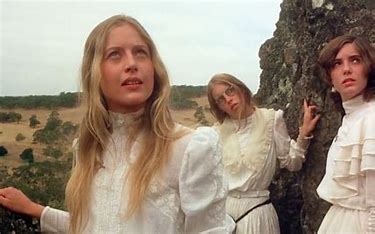
The plot revolves around the disappearance of several teenage schoolgirls and their teacher during a picnic at Hanging Rock, Victoria, on Valentine’s Day in 1900, and the subsequent impact on the local community.
Spearheading the then-emerging Australian New Wave Cinema, which included notable directors like Bruce Beresford and Fred Schepisi, the film boasts bravura direction from Weir. Like Hitchcock, Weir showed that horror can occur on the brightest and most beautiful of summer days. There’s a suggestion that it was the young charges’ blossoming sexuality, in concert with some ancient force within those rocks, that led to the girl’s transportation into some other realm.
A sense of something unsettling is there from the beginning as the girls awaken to a beautiful morning. Sara (Margaret Nelson), a young, newly arrived orphan not allowed to go on the outing, is clearly enamored with the gorgeous Miranda (Anne-Louise Lambert). When Sara whispers something to Miranda, she is rebuffed and told, somewhat fatalistically, “You must learn to love someone else, apart from me; I will not be around for much longer.”
Miranda has self-possession and knowingness beyond her years. At the picnic, the school’s French teacher (Helen Morse) likens her to a Botichelli angel. It is Miranda who initiates the walk up the rocks and, as some mysterious magnetic force stops everyone’s watch at noon, you begin to feel that sublimated queer desire may be at the heart of the events depicted in the film. There are also hints of a romantic relationship between the schoolmistress, Rachel Roberts, and the headmistress, Miss McCraw (Vivean Gray), who was last seen running up the hill in her underwear to join the girls and was never seen again.
Russell Boyd created the striking cinematography, and Bruce Smeaton composed the haunting score, incorporating the didgeridoo and other Aboriginal musical instruments. Weir also skillfully utilized sound design to significant effect, combining the sounds of earthquakes and other natural phenomena into the mix.
Boyd’s camera operator on the set was John Seale, who would eventually supplant his master and become Weir’s cinematographer on three movies (“Witness,” “The Mosquito Coast,” and “Dead Poets Society”) and Anthony Minghella’s cinematographer on “The Talented Mr. Ripley”, winning an Oscar for “The English Patient.”
Weir and Boyd would eventually get back together in the new millennium for two more movies, one of which, “Master and Commander of the World,” would win Boyd his own Oscar.
The film was released in the United Kingdom and Ireland in 1977 and not until 1979 in the United States.


